
Pricing your commissions is one of the most stressful parts of starting out as a freelance artist. Charge too little and you’re working yourself into the ground for nothing. Charge too much and the inbox stays quiet.
Most guides make it sound like a clean, rational process. Here’s the honest version: it’s not. You’ll get it wrong at first. Almost everyone does.
I did — badly. My first commissions were underpriced to the point where, if I’d tracked the actual hours, I was making less than minimum wage. I took them anyway because I didn’t know what I was worth yet and I was too scared to charge more. That fear is real and normal. But staying in that position costs you more than just money — it burns you out and attracts clients who don’t value the work.
💬 From Allard — my pricing background:
I’ve priced and sold character commissions (single figure and multi-character), game and concept art work, and various client projects across different scopes. My current approach is a mix — per piece for standard character work where I know my time well, and per hour or negotiated project rates for concept art and game clients where scope can shift significantly. Getting to that mix took a few years of adjusting, making mistakes, and recalibrating. What I’m sharing here is the framework I wish I’d had at the start.
Why Digital Art Pricing Is Different
Most pricing calculators online are built for traditional artists. They factor in material costs — canvas, paint, framing — and price by physical size. Neither of those things apply to digital art.
As a digital artist, you’re almost always delivering a file. No materials. No shipping (unless you’re offering prints separately). And canvas size is meaningless — you can change it in seconds, and it has no relationship to how long the piece actually took.
The only honest metric for digital art pricing is time. How long did it take, and what is your time worth per hour? Everything else — complexity, detail level, number of characters, background type — is just a way of estimating how much time it adds.
💬 From Allard:
When I first started taking character commissions I was pricing by feel and comparing myself to other artists I saw online — which is the worst possible method. Artists who post their prices publicly tend to be either very new and undercharging, or using low prices as a marketing angle. The artists charging sustainable rates mostly don’t advertise the number — they let the work speak. I was comparing myself to the wrong benchmark entirely and it took longer than it should have to figure that out.
Step 1: Calculate Your Minimum Hourly Rate
Before you can price a single commission, you need a floor — the minimum you can charge per hour and still make the work worthwhile. Everything below this number is a loss, even if the client is happy and the piece looks great.
Here’s the formula:
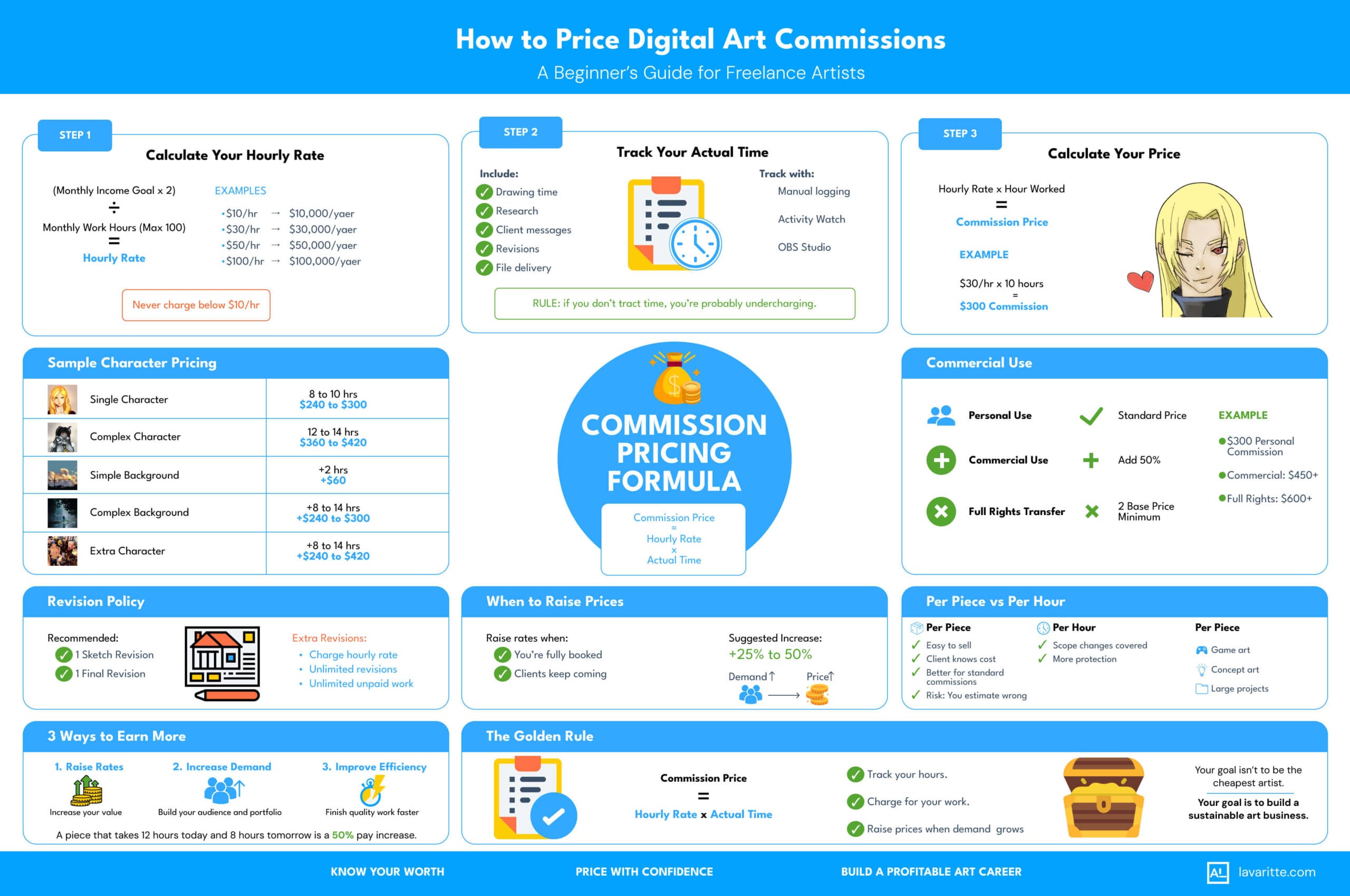
Monthly income needed → double it → divide by hours available (max 100)
= Minimum hourly rate
Minimum hourly rate × 1,000 = realistic maximum annual income
The doubling step isn’t arbitrary. It accounts for everything a salary job covers that freelancing doesn’t: taxes, sick days, slow months, software subscriptions, equipment replacement, and the hours you spend on admin, marketing, and client communication that no one pays you for directly.
The 100-hour monthly cap is real. I’ve tried going beyond it. It’s not sustainable — the quality of the work drops, the burnout builds, and you end up taking longer on everything anyway. A hard limit protects both the work and you.
⚠️ The $10 absolute floor:
If the formula spits out less than $10 per hour, round up to $10. No exceptions. If your art is good enough to land commissions at all, it’s worth at least $10 per hour of your time. Artists who charge less aren’t doing it because that’s what the market pays — they’re doing it because they’re scared to charge more. That fear is understandable. It’s also self-defeating.
What does your hourly rate actually mean for annual income?
Here’s a rough but honest translation:
| Hourly Rate | Realistic Max Annual Income | Notes |
|---|---|---|
| $10/hr | ~$10,000/year | Entry level, part-time or just starting |
| $20/hr | ~$20,000/year | Full-time solo, lean budget |
| $30/hr | ~$30,000/year | Solid foundation for full-time freelance |
| $50/hr | ~$50,000/year | Experienced, consistent demand, specialist work |
| $100/hr | ~$100,000/year | Senior concept art, strong industry reputation |
These are maximums assuming consistent full workload — real annual income will be lower, especially starting out. Use the 1,000x rule as a ceiling to check whether your rate is viable, not as a guarantee.
💬 From Allard — why comparing to a salary job is a trap:
When I was starting out, I’d compare my hourly rate to what my developer job paid and think “that seems fine.” It’s not a valid comparison. A salaried employee’s rate includes holiday pay, sick pay, equipment provided by the employer, no marketing overhead, no client acquisition time, and being paid to exist in the office even during unproductive hours. As a freelancer, you’re paying all of those costs yourself — out of whatever that hourly rate generates. A freelancer charging $30/hr is in a completely different financial position to an employee earning $30/hr. The developer income gave me a safety net that meant I could learn this lesson without it costing me rent money. Not everyone has that cushion, which is why getting the rate right from the start matters more than most guides acknowledge.
Step 2: Track How Long Your Art Actually Takes
The most common pricing mistake after undervaluing your hourly rate is underestimating your time. Artists consistently think pieces take less time than they do — because they remember the drawing hours and forget everything around them.
Time that counts as billable:
- Actual drawing and painting time
- Reference gathering and research
- Client communication — emails, revision discussions, clarification
- Sketch presentation and waiting for approval
- File preparation and delivery
All of that is work time. All of it should factor into your price.
Three ways to track it accurately
Option 1 — Manual Time Logging
Note your start and stop times each session. Simple, requires no tools, and works well if you tend to complete pieces in one or two focused sittings. Falls apart quickly if you work across multiple sessions over several days — which most serious commissions require.
Option 2 — Automatic Software Tracking
Clockify (free) tracks time spent in whichever programs you designate as work — set Photoshop or Krita as work apps and it logs automatically. ActivityWatch (also free) is more comprehensive and tracks everything across your machine, useful for seeing where your time actually goes across your whole workflow.
💬 From Allard:
Automatic tracking revealed something uncomfortable for me: the gap between “time I thought I spent drawing” and “time I actually spent drawing” was significant. I’d think a piece took six hours and discover it took nine — because I wasn’t counting the email back-and-forth, the reference hunting, the ten minutes of staring at the canvas deciding what to do next. That gap was the reason my prices were too low. The hours were always there; I just wasn’t seeing them.
Option 3 — Screen Recording
Record your screen while you work using OBS Studio (free) or streamlabs, then review the footage to calculate exact time. More effort to set up and review, but highly accurate. Bonus: you’re simultaneously creating timelapse content for YouTube or social media — a process video is a legitimate marketing asset, and the recording is already done.
💬 From Allard:
Recording your process has a secondary benefit beyond time tracking: watching yourself back is one of the fastest ways to spot inefficiencies in your workflow. Moments where you repaint the same area four times, or spend twenty minutes on a detail that gets cropped in the final version — these are invisible when you’re in the flow state but obvious on review. Fixing workflow inefficiencies effectively increases your hourly rate without raising your prices.
Step 3: Calculate Your Commission Prices
Once you know your hourly rate and your average time per piece type, the math is simple:
Hourly rate × hours spent = commission price
The harder part is building your menu of piece types and estimating time for variations you haven’t done before. Here’s how I think about it for character work specifically:
Building a character commission price structure
| Commission Type | Estimated Hours (My Workflow) | At $30/hr |
|---|---|---|
| Single character, simple design, no background | 8–10 hrs | $240–$300 |
| Single character, complex armor/design | 12–14 hrs | $360–$420 |
| Simple background added | +2 hrs | +$60 |
| Complex background (environment, architecture) | +8–10 hrs | +$240–$300 |
| Each additional character | +8–14 hrs (depends on design) | +$240–$420 |
💬 From Allard — a real multi-character example:
A client once commissioned a scene with two characters — one relatively straightforward design, one with detailed armor, weapons, and a secondary element (a creature companion). My time breakdown: Character 1 at ~10 hours, Character 2 at ~14 hours given the complexity, a mid-complexity background at ~6 hours, plus client communication rounds at ~2 hours. Total: ~32 hours. At my rate that came to just over $960. The client was surprised — they’d expected something in the $300–$400 range based on single character prices they’d seen elsewhere. Walking them through the time breakdown made the price make sense. Itemized thinking protects you in client conversations.
Concept art and game client pricing
Concept art and game clients work differently from private character commissioners. Scope can shift. Revisions are often more extensive. Usage rights matter significantly. For these clients I move away from a fixed per-piece price and toward one of two approaches:
- Per-hour with a project estimate: Quote a time range upfront (“this will likely take 15–20 hours at my rate of $X”), track actuals, and invoice for real time with the ceiling agreed in advance
- Project rate with defined scope: Fixed price for a clearly defined deliverable — specific number of concepts, specific revision rounds, specific file formats. Anything outside the defined scope is a change order at hourly rate
💬 From Allard:
The shift to project rates for game and concept art clients came after a fixed-price job that expanded significantly mid-project. The client kept adding “small” requests — additional color variants, alternate poses, a second character added to the key piece — each one individually reasonable, but collectively turning a 15-hour job into 28 hours at the same price. I learned to define scope in writing before starting, and to treat anything outside that scope as a new line item. That’s not being difficult — that’s running a sustainable practice.
Commercial Use and Licensing — Don’t Forget This
Standard commission prices assume the art is for personal use — the client hangs it on their wall, uses it as a profile picture, or keeps it privately. The moment they want to use it commercially, the pricing changes.
- One commercial use (book cover, product front, merchandise design) — add approximately 50% to the base price
- Full IP transfer (client owns all rights, can use however and whenever) — double the base price at minimum, often more depending on the commercial scope
💡 Why commercial licensing costs more:
When a client uses your art commercially, they’re generating revenue from it. The licensing fee reflects your share of that value — not just the time you spent making it, but the ongoing commercial benefit they’re getting from your work. This is standard industry practice, not an upsell.
💬 From Allard:
I didn’t charge commercial licensing fees on my early work. I didn’t even think to ask what the art was being used for. In one case, a piece I’d priced as a personal commission ended up being used on merchandise. I only found out later. That’s money I left on the table — not because the client was dishonest, but because I never asked the question and didn’t have terms that covered it. Now every commission inquiry gets the same question upfront: “Is this for personal use or will it be used commercially?” It’s not confrontational. It’s professional.
Revision Policy — Set It Before You Start, Not After
Unlimited revisions sounds generous. In practice, it’s a pricing catastrophe.
Most clients won’t abuse it. But some will — and the ones who do will consume more of your time than three normal clients combined. One revision spiral on a single commission can turn a profitable job into a loss.
My standard policy:
- One revision round after the sketch stage
- One revision round after the final
- Any additional revisions beyond these are charged at my hourly rate
Communicate this before taking payment. Put it in writing — even a brief message that says “my commission terms include two revision stages” is enough to set the expectation clearly.
💬 From Allard:
The revision policy I learned to enforce came directly from experiencing what happens without one. A character commission that should have been 10 hours stretched to 16 across six rounds of “small tweaks” — pose adjustments, color changes, expression revisions, then reverting back to an earlier version. The client wasn’t malicious; they just didn’t have a clear picture of what they wanted and were using revisions to find it. A structured revision policy fixes this by forcing clarity at the sketch stage, before significant rendering time is invested. The sketch approval is a checkpoint — both sides confirm the direction before the expensive work begins.
When and How to Raise Your Prices
Starting prices are not permanent. The goal is a practice where demand consistently exceeds your capacity — at which point raising prices is the correct and necessary response.
The signal to raise prices: you have more than a month’s worth of work queued and you’re still accepting new inquiries. At that point, raise your rate by 25–50%. If the queue keeps growing, raise again. Keep going until the queue stabilizes at a comfortable level.
✅ The three levers for increasing commission income:
- Raise your hourly rate— directly increases income per hour worked. Only sustainable if demand supports it.
- Increase demand— more visibility, better marketing, stronger portfolio, more specific niche targeting. Creates the conditions to raise rates.
- Increase efficiency— make the same quality art in less time. Halving your production time on a fixed-price piece effectively doubles your hourly rate on that piece without raising client prices.
💬 From Allard — on the efficiency lever specifically:
This is the one most pricing guides skip. Some of my biggest hourly rate improvements came not from raising prices but from getting faster — developing a more efficient sketch-to-final workflow, using 3D references for complex poses instead of rebuilding them from scratch, getting better at reading client briefs so I needed fewer clarification rounds. Efficiency gains are quiet but they compound. A workflow that takes you from 12 hours to 8 hours on a standard commission at the same price is the same as a 50% pay raise on that commission type.
Per Hour vs. Per Piece — Which Should You Use?
This is the question I get most often from artists starting commissions. The honest answer: both, depending on context.
| Per Piece (Fixed Price) | Per Hour |
|---|---|
| Client knows exact cost upfront — easier to sell | You’re protected if scope expands unexpectedly |
| Rewards efficiency — get faster, earn more per hour | Rewards thoroughness — more time = more pay |
| Risky if you misjudge the time required | Harder sell — clients prefer cost certainty |
| Best for: standard, well-defined commission types you know well | Best for: concept art, game clients, complex or open-ended projects |
💬 From Allard — my actual approach:
Standard single-character commissions I price per piece — I know my time well enough on that work that the fixed price is accurate and the client conversation is simple. Concept art and game clients get hourly or project-rate quotes with defined scope. The rule I use: if I can predict the time within about 20%, per piece works. If there are too many unknowns — open-ended brief, client who changes direction, complex multi-element scope — hourly or project rate protects me. Learning which category a project falls into before quoting is a skill that develops with experience.
The Summary — All the Key Numbers in One Place
Minimum hourly rate = (monthly income goal × 2) ÷ monthly hours (max 100)
Maximum annual income estimate = hourly rate × 1,000
Commission price = hourly rate × hours spent
Commercial use = base price + 50% minimum
Full IP transfer = base price × 2 minimum
Absolute floor = $10/hour, no exceptions
The numbers will feel uncomfortable at first. Charge them anyway. The discomfort fades. The underpricing consequences don’t.
Frequently Asked Questions
Should I show my prices publicly or only share them on inquiry?
Both approaches work — the right choice depends on your positioning. Showing prices publicly filters out clients who can’t afford your rates before they contact you, saving time on both sides. It also signals confidence. Keeping prices private lets you quote project-by-project based on scope, which works better for variable or high-end work where a flat public rate doesn’t represent the range accurately. My approach: public starting prices for standard character commissions (“starting from $X”), private quotes for concept art and multi-character or complex projects where scope determines cost.
What do I do if a client tries to negotiate my price down?
Be polite, be firm, don’t apologize. “My rates are based on the time required to deliver this at the quality in my portfolio — I’m not able to reduce below $X for this scope.” That’s it. If they push further, the options are: reduce the scope to meet their budget (fewer characters, simpler background, no background), or decline. What you don’t do is discount your rate. Discounting your rate signals that the price you quoted wasn’t real, which undermines your credibility and sets a precedent for the whole client relationship.
How do I handle a client who ghosts after I’ve started working?
Require a deposit before starting — 25–50% of the total upfront, non-refundable. This is standard practice in freelance illustration and protects you from abandoned projects. A client who won’t pay a deposit is telling you something important about how the rest of the engagement will go. If a client ghosts mid-project despite a deposit, keep the deposit and move on. If they return weeks later wanting to resume, require a second deposit for the remaining work.
Is it okay to charge different rates for different types of clients?
Yes — and it’s common practice. Personal commission clients, indie game studios, and commercial publishers have very different budget realities and very different commercial relationships to your work. Charging a private individual the same rate as a commercial publisher isn’t required. What matters is that your rate for each client type is internally consistent and sustainable. Many artists have a personal commission rate and a commercial/licensing rate that reflects the different context of the work.
How do I know when I’m ready to raise my prices?
Two signals: consistent demand and consistent quality. If you’re turning away work because you’re full, that’s the clearest possible signal that demand exceeds supply at your current price — raise it. If clients are consistently happy with the result and returning or referring others, your quality is at the level where higher prices are justified. You don’t need to wait for permission. You don’t need to announce it. Update your rate, apply it to new inquiries, and see what happens. You can always adjust again.
How do I price rush orders?
Rush fees are standard and legitimate — add 25–50% to the normal price for any commission with a deadline that compresses your working schedule. A rush commission isn’t just about working faster; it means reorganizing your queue, potentially working outside normal hours, and prioritizing one client over others who are waiting patiently. That reorganization has real cost and the rush fee reflects it. State your rush fee policy publicly or in your commission terms so it’s not a surprise.
What’s a fair price for a beginner’s first commission?
Apply the formula honestly and charge the result, even if it feels too high. The fear that no one will pay your real rate is almost always worse than the reality. The alternative — undercharging to guarantee work — trains you, your clients, and the market that your time is worth less than it is. That positioning is very hard to escape later. One exception: if you genuinely want to do a first commission at a reduced rate as a deliberate portfolio-building exercise, frame it that way explicitly — both to yourself and to the client. “I’m offering this at a reduced rate for my portfolio” is honest. Pretending a low rate is your real rate is not.
What to Read Next
- Do You Need a Degree to Be a Freelance Artist? — the honest breakdown of what actually matters for building a freelance art career
- How to Know If You’re Good Enough to Take Commissions — if you’re still unsure whether your work is ready, read this first
- Ways to Make Money as an Artist — commissions are one revenue stream; here are the others worth building alongside it
- Best Free Drawing Apps for Beginners — if you’re still building the technical foundation, start with the right tools
- 8 Habits That Will Actually Improve Your Art — improving faster means reaching sustainable rates sooner
Price your work honestly, track your time accurately, and raise your rates whenever demand tells you to. The discomfort of charging what you’re worth is temporary. The regret of not charging it lasts a lot longer. 🖊
Discover More Posts
Keep exploring stories, insights, and creative notes from my journey as an artist. Check out the latest blog entries and find topics that inspire your own process.
5 Hidden Art Career Killers That Stop Most Artists Before They Even Start — And How to Beat Them
Learn to draw anime-style clouds with this easy, step-by-step cloud tutorial. You’ll pick up tips on shapes, color, and composition—plus get free cloud brushes to use in your own art.

Sketching vs. Drawing: 5 Powerful Insights Every Artist Should Know
Learn the key differences between sketching and drawing—how detail, speed, tools, and intent separate the two and when to use each in your art practice.

How to Find Your Art Style in 3 Simple Steps
Learn how to find your unique art style through a clear three-step process. Discover how to collect inspiration, analyze your influences, and build your own signature look with deliberate practice.