
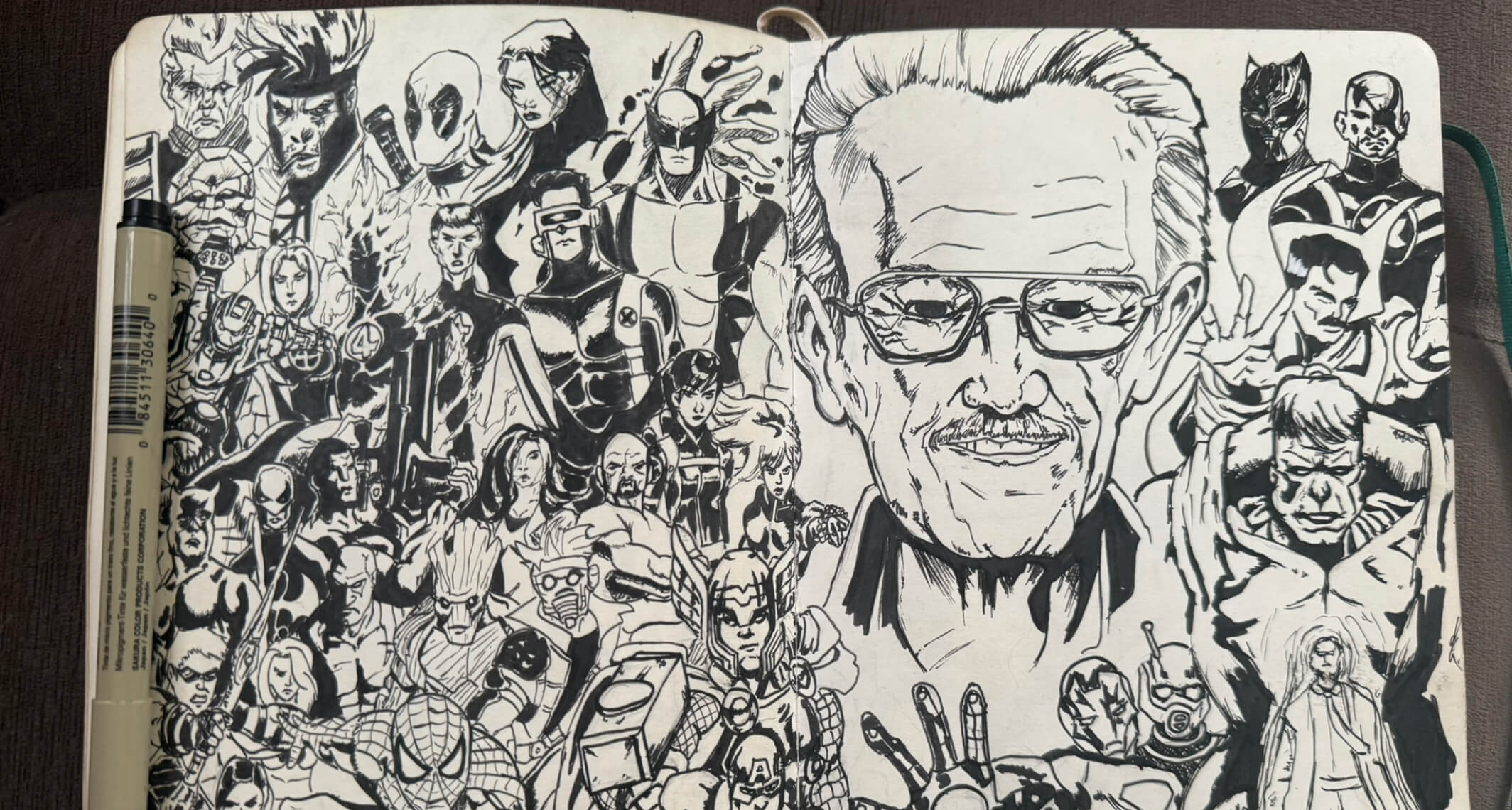
I want to be upfront about something: I don’t believe in shortcuts to becoming a better artist. I’ve tried a few — traced photographs, chased trending styles, spent more time researching the “perfect brush” than actually drawing. None of it worked the way I hoped. What actually improved my art was slower, less exciting, and more repeatable than any shortcut: habits built and maintained over time.
I started drawing in grade school with pen, paper, and borrowed oil pastels. I made my own manga in high school with a ballpoint pen. I took a two-year detour through 3D modeling in Blender to fix problems in my 2D work. I came back to digital illustration with my first developer paycheck funding a Wacom Intuos Pro that still sits on my desk today. None of that journey was linear, and none of it happened because I found the right technique. It happened because I kept drawing — consistently, imperfectly, with the habits I’m about to describe.
These eight habits are the ones that I’ve found genuinely move the needle. Not motivational fluff. Not generic advice. The real things.
1. Keep Your Tools Ready to Use — Always
This is the most unsexy advice in the list and also the most impactful one I’ve found in practice. My Wacom Intuos Pro tablet lives on my desk permanently. It is never put away, never moved to storage, never packed into a bag. It is always there, pen in the holder, ready to go. All I have to do is sit down and open the software.
This isn’t laziness. It’s intentional friction reduction. Every step between you and starting to draw is a decision point where motivation gets to say no. Setup takes time. Time gives your brain a chance to find something easier to do. By removing the setup step entirely, the habit runs on its own inertia rather than requiring a fresh decision every session.

💬 From Allard:
I keep my sketchbook in my bag too — always. When I’m at the coffee shop after the gym, it’s already there. I don’t decide to bring it. It lives there. The barrier to sketching is “open the bag” rather than “remember the sketchbook, find it, pack it.” That difference sounds trivial. The difference in how often I actually sketch is not trivial.
How to apply this:
- If you draw digitally: leave your tablet on your desk, always plugged in, always deployed
- If you draw traditionally: leave your sketchbook open on the table, pencil or pen beside it, not in a drawer
- Configure your software once — workspace, brush presets, default settings — so every session starts immediately, not with configuration
- Before ending each session, leave a note (a text layer in your file, or a sticky note by the sketchbook) about what you’ll work on next time — so the next session starts with a direction already decided
The artists who draw the most consistently aren’t the ones with the most discipline. They’re the ones who made it hardest to not draw.
2. Schedule One Hour — Not “Whenever I Have Time”
“Whenever I have time” is a plan that never produces time. Time doesn’t appear on its own. It gets taken — by work, by life, by the endless low-grade demands of existing. If art practice doesn’t have a protected slot in your schedule, it gets consumed by everything else without you making a single conscious decision to deprioritize it.
I schedule one hour a day for drawing. A specific hour, on specific days, treated as a commitment rather than an aspiration. Most of my finished rendered pieces take seven or more hours to complete, which means a single weekday hour doesn’t finish anything. That’s fine. During the week I’m building. On weekends I try to finish what I started. The result is a pile of unfinished work on my drive at any given time — which I’ve come to see not as failure but as inventory. Proof that I showed up.
💬 From Allard:
I used to feel bad about having so many unfinished pieces. I don’t anymore. Every unfinished piece represents a session where I sat down and worked. Some of them get finished eventually. Some don’t. The ones that do get finished are the ones worth finishing — which becomes clear over time, not at the moment of starting. The pile is evidence of showing up, not evidence of failing to finish.
The minimum viable session: On the days when the full hour isn’t possible, a 20-minute session still counts. It keeps the habit alive, keeps the work in your head, and prevents the psychological distance that builds up during absence. Something is always better than nothing — not as an excuse for underperforming, but as protection against the perfectionism that makes you wait for a “proper” session and ends up producing no session at all.
| Vague Version (Fails) | Specific Version (Works) |
|---|---|
| “I’ll draw in the evenings” | “8:00–9:00pm, Monday to Friday” |
| “I’ll work on my art this weekend” | “Saturday 10am: continue the piece I started Tuesday” |
| “I’ll draw more when I have time” | “20 minutes minimum, even on bad days” |
| “I’ll finish this when I have a long session” | “I’ll advance it 30% each weekday session” |
3. Draw From Dark to Light — Build From Structure, Not Surface
This is a technical habit as much as a practice habit, but it’s shaped how I approach every piece and has consistently produced better results than the reverse approach.
I block in the darkest value of each shape first. The character, the scene, the hair — all start as dark masses that establish volume and position before any detail or color is added. Then I paint upward toward the light: midtones on top of the dark foundation, lighter tones on top of midtones, highlights last. Color Dodge or Add blend mode for the most intensely lit areas — it creates the luminous quality of light actually penetrating a surface rather than sitting on top of it.
This approach forces you to think about form and value structure before you think about surface detail. When you start from dark and build toward light, every subsequent layer adds energy and clarity. When you start from flat midtones and try to add shadow later, you’re removing energy — which is psychologically harder and often results in shadows that aren’t dark or rich enough to read properly.
💬 From Allard:
I never went to art school and my process looks a bit unconventional to classically trained artists. I start with a big brush stroke, not with linework. I think of the character as shapes first — blocking in the darkest color in each shape before anything else. The linework sometimes comes later, sometimes not at all. Most of my YouTube videos show this process if you want to see it in practice rather than just read about it.
Why this habit matters: It’s not just a painting technique — it’s a thinking discipline. Working dark-to-light forces you to commit to the major shapes before investing time in detail. If the dark foundation shape is wrong, you see it immediately and can correct it before you’ve rendered twenty minutes of detail on top of a flawed structure. Working light-to-dark, you often don’t discover the structural problem until you’ve already committed significant time to the piece.
4. Study With Your Pen Moving, Not Your Eyes Alone
There is a specific habit trap that looks exactly like productive learning: watching tutorials, studying reference images, looking at the work of artists you admire. All of these feel like practice because they’re art-adjacent. None of them are practice.
Practice means your hand is moving. You are making marks in response to what you’re studying. You are attempting to reproduce, interpret, or apply what you’re observing. The gap between what you can see and what you can produce is where growth lives — and you only encounter that gap when the pen is in your hand.
You can’t learn to swim by reading books. You need to get into the water first.
Color theory, anatomy, perspective, composition — these become useful once you’ve made enough mistakes that the theory explains what you’ve already observed going wrong. Reading about color temperature before you’ve ever painted skin that looked plastic is abstract. Reading about it after the skin looked plastic gives you the vocabulary to understand what you were already experiencing.
💬 From Allard:
I do use reference — always. But I use it to understand, not to copy. When I look at a reference photo of anatomy or lighting, I’m asking: why does this look this way? What is the three-dimensional form producing this surface? That question forces active understanding rather than passive reproduction. Tracing a photo gives you the output without the understanding. Studying with your pen moving — trying to draw the same subject from the reference without tracing it — gives you both.
Practical application: For every tutorial you watch, pause it when a technique is demonstrated and draw that technique yourself before continuing. For every reference image you study, close the reference and try to draw the same subject from memory, then reopen it and compare. The gap between your attempt and the reference is your growth target.
5. Don’t Just Draw What You’re Good At
There is a version of “drawing consistently” that produces no growth at all: drawing the same subjects, in the same style, at the same level of challenge, session after session. This looks like practice. It produces polished repetition, not skill development.
Real skill growth requires discomfort — specifically, the discomfort of attempting something slightly beyond your current ability, failing partially at it, learning from the failure, and attempting again. Without that cycle, you’re performing existing skills rather than building new ones.
💬 From Allard — the Blender story:
When I got blocked on my 2D work — when comparison with artists like Marc Brunet and Ash Thorp made my output feel flat and hopeless — the answer wasn’t more 2D practice. It was learning something entirely new: Blender. 3D modeling. Two years of being a complete beginner in something I’d never tried before. That investment fixed problems in my 2D work that years of 2D practice hadn’t touched. My composition stopped feeling flat because I could now think about scenes as three-dimensional spaces before translating them to 2D. The skill that fixed my drawing came from going sideways into something uncomfortable, not from grinding harder at the thing I was already doing.
What this looks like in practice:
- If you avoid drawing hands — spend one session per week drawing nothing but hands
- If you never draw backgrounds — take one piece per month to a fully rendered background
- If you only draw in your comfortable style — spend one session per month studying and attempting a style you’ve never tried
- If your work feels flat — learn one thing about perspective, lighting, or color theory and deliberately apply it in your next piece
The discomfort of attempting what you can’t yet do is not a sign you’re doing something wrong. It’s the signal that growth is happening.
6. Use the Silhouette Test — On Everything
This habit changed how I evaluate my own work more than almost anything else. The silhouette test is simple: fill the entire subject — character, composition, whatever you’ve drawn — with solid black, removing all internal detail. Then evaluate whether it reads clearly.
A well-designed character is recognizable as a silhouette. A strong composition reads as an arrangement of interesting shapes even without color or detail. A hairstyle that works as a solid black shape is a well-designed hairstyle. Anything that only reads correctly when you can see the internal detail has a foundational design problem that rendering won’t fix.
💬 From Allard:
The anime I grew up with — Hellsing, Devil May Cry: The Animated Series (the original one), Ninja Scroll, Akira — all have characters with instantly recognizable silhouettes. You could cut out Alucard in solid black and know who he is from his coat shape and hair mass alone. That’s the target. Strong silhouette first, detail second. If the silhouette doesn’t work, no amount of rendering detail will fix the underlying design problem.
How to build this as a habit: After completing the initial sketch or block-in of any major element, create a new layer, fill the shape with black, and evaluate it. If it doesn’t read — if the shape is boring or unrecognizable — fix the shape before investing any time in rendering. This takes thirty seconds and saves you from discovering a structural problem after hours of detail work.
Apply this to characters, hairstyles, compositions, and environments. The habit costs almost nothing and produces consistently stronger foundational design.
7. Compare Yourself to Your Past Work, Not to Other Artists
Comparison with other artists is one of the most reliable ways to lose motivation to draw — and I say that as someone who stopped drawing for a significant period after discovering the work of artists so far above my level that continuing felt pointless.
But comparison isn’t the problem. The direction of comparison is the problem.
Comparing your current work to your work from one year ago almost always shows growth that’s invisible week-to-week. The improvements that accumulate over months — better line confidence, more accurate anatomy, stronger color sense — compound into a significant difference across a year, even when each individual session felt like grinding with no visible result.
💬 From Allard:
The artists whose work discouraged me most — Marc Brunet, Ash Thorp, Maciej Kuciara — I still admire deeply. Their work is genuinely excellent and I still study it. The difference is that now I use it as a study resource rather than a measuring stick. I ask: what specific skills does this demonstrate that I could learn? That’s a question with an actionable answer. “Why isn’t my art as good as theirs?” is not a question with a useful answer.
Practical habit:
- Keep dated archives of your work — even rough sketches. File them by month.
- Every three months, pull out work from a year ago and compare it to your current work
- When you feel like you’re not improving, this comparison almost always reveals otherwise
- When you study artists you admire, make it a study session — identify one specific skill they demonstrate and add it to your learning list — not a comparison session
Your own growth arc is the only progress metric that actually measures your development rather than someone else’s. Everything else is noise.
8. Protect Some Art for Yourself — Don’t Post Everything
This habit is about something that took me a while to understand clearly: the relationship between art made for an audience and art made for yourself is fundamentally different, and both kinds are necessary.
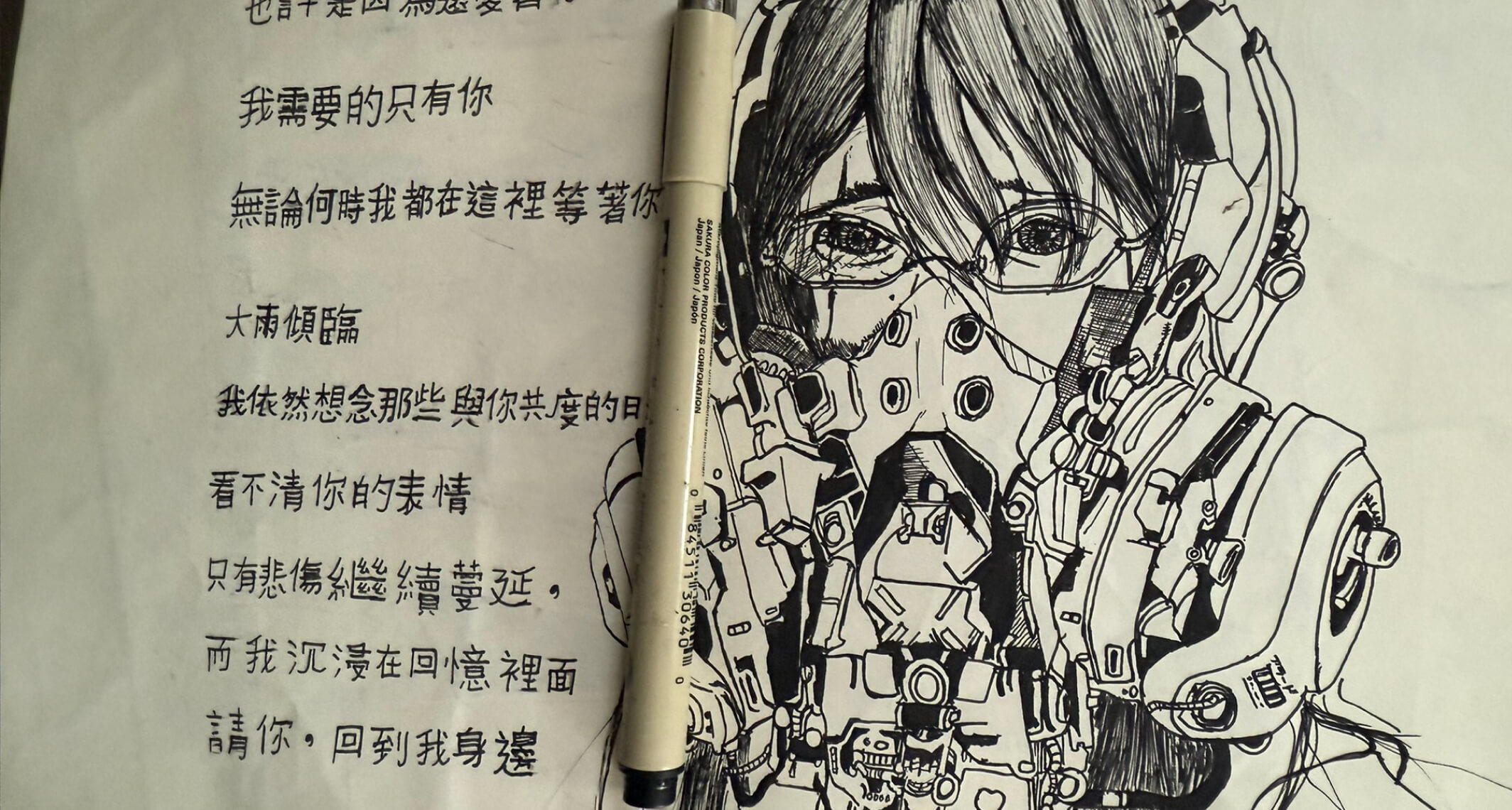
When I was making my high school manga — the unlucky hero whose plans always ended with him face-first in a pile of trash — I wasn’t making it for an audience. I was making it because the story amused me, because I wanted to see what happened next, because drawing those characters was genuinely fun. I never got paid for it. I didn’t care. That manga taught me more about storytelling and character through sequential images than anything I’ve made since, precisely because it was free from external judgment.
💬 From Allard:
My sketchbook — the one I bring to the coffee shop after the gym — is not for posting. Those pages are mine. I draw in direct ink with no pencil underneath because I like the commitment of it, and because no one is going to see it except me. That freedom is valuable. It’s where I try things I’d be embarrassed to post, draw subjects I don’t know are “good” or not, and generally make marks without the weight of an audience watching. When all your art is made for posting, the audience becomes the filter for your creative decisions. That’s not entirely bad — being aware of how your work reads to others is a real skill. But when it becomes the primary filter, you stop making the weird experiments and honest failures that are where real learning happens.
The practical habit: Protect time and space for art that isn’t for posting. A sketchbook that isn’t shared. A digital sketchbook folder that never gets exported. A practice series where you’re deliberately trying things you might fail at. The art you make for yourself is often where your most honest creative voice lives — and that voice is what eventually makes your public work distinctive rather than generic.
The Thread Running Through All Eight
Looking at these eight habits together, there’s a pattern: none of them are about talent, inspiration, or motivation. All of them are about structure, environment, and deliberate practice. They’re about building conditions where improvement happens consistently, regardless of how you feel on any given day.
Motivation is unreliable. It shows up when it wants to and disappears without warning. The artists who improve most consistently aren’t the ones with the most motivation — they’re the ones who built systems that work even when motivation doesn’t show up. Tablet on the desk. Hour scheduled. Dark-to-light workflow. Silhouette test. Archive of past work. Sketchbook in the bag.
These aren’t glamorous. They don’t make for exciting YouTube thumbnails or inspirational quotes. They’re the actual work behind the work — the invisible infrastructure that makes consistent creative output possible.
Pick one of these habits. Just one. Build it until it’s automatic. Then add another. That’s the whole approach. It’s slower than a dramatic transformation and more reliable than any technique. It’s also the only thing I’ve found that actually works long-term.
Frequently Asked Questions
How long does it take to build a new art habit?
The popular claim that habits take 21 days to form is not well-supported by research — the actual range varies widely by person and habit complexity, from a few weeks to several months. For drawing-related habits, the most honest answer is: it takes as long as it takes for the behavior to feel like a default rather than an effort. The more you reduce friction (tablet on the desk, time scheduled, direction already decided) and the more consistently you repeat the behavior, the faster the automaticity develops. Expect 6–8 weeks of deliberate effort before any new habit feels natural rather than forced.
Is drawing every day necessary to improve?
Consistent practice is necessary. Daily practice is one way to achieve consistency but not the only way. Three focused sessions per week, sustained over a year, produces more improvement than a 30-day daily streak followed by six weeks of nothing because you missed day twelve and felt like you’d failed. The goal is regularity, not perfect daily adherence. “Drawing every day” becomes problematic when missing a single day breaks the habit entirely — which it does for many people. Design your practice schedule to be sustainable and recoverable, not perfect.
What’s the fastest way to improve at drawing?
Deliberate practice on your specific weakest areas, combined with active study (pen in hand while observing, not passive watching). The fastest improvers aren’t the ones who draw the most total hours — they’re the ones who spend those hours on the things they can’t yet do rather than on the things they’re already comfortable with. Discomfort is the signal that growth is happening. If your sessions feel comfortable and familiar, you’re probably practicing existing skills rather than building new ones.
How do I stop getting distracted during drawing sessions?
Environment design matters more than willpower. Put your phone in another room or face-down with notifications off. Close all browser tabs except your reference. Use full-screen mode in your art software to remove the distraction of the desktop. Set a timer for your session so you’re not checking the clock. Tell the people in your household that your drawing hour is not to be interrupted. These are structural solutions that work better than “trying harder to focus” — because willpower is finite and structure is not.
Should I start a new piece or finish old ones?
Both, with intention. Starting new pieces exercises ideation, composition planning, and the energy of beginning. Finishing pieces exercises problem-solving in the difficult middle stages, follow-through, and the specific skills of rendering and resolution that only develop through completion. Most artists naturally prefer starting over finishing — it’s more exciting. The habit worth building is finishing at least one piece per week, even imperfectly, because the skills you develop in the finish phase don’t develop any other way. Having unfinished pieces in progress simultaneously is fine and normal. Finishing nothing is the problem, not the pile itself.
How do I know if I’m actually improving or just getting better at the same thing?
Compare your work across categories, not just within them. If your character faces have improved but your backgrounds, hands, and perspective haven’t changed in a year, you’ve been practicing character faces consistently but avoiding everything else. True skill growth shows across multiple areas simultaneously — because the foundational skills (value, proportion, spatial thinking, line quality) that improve with deliberate practice are cross-domain. If only one area is improving, the practice is too narrow. Broaden it by deliberately practicing the areas you find difficult.
What should I do when I sit down to draw and nothing comes out?
Have something decided before you sit down. The “nothing comes out” problem is almost always a decision-making problem, not a skill problem. If you sit down with a direction already chosen — I’m working on the background of the piece I started Tuesday — you’re not staring at a blank page. You’re continuing. If you genuinely don’t know what to draw, go to gesture drawing (Line of Action, posemaniacs) or a prompt resource and spend the session copying or responding to what’s in front of you rather than generating something from nothing. The generation problem is a separate challenge from the execution problem. Don’t try to solve both simultaneously in a session where you’re already stuck.
Do I need to post my art to improve?
No — posting is about visibility and audience, not about skill development. You can improve profoundly without ever posting publicly. That said, the feedback loop of posting — seeing how your work reads to others, noticing what resonates and what doesn’t, receiving occasional specific critique — can accelerate improvement by giving you information you don’t have when you work in isolation. The balance in habit 8 (protect some art for yourself) is the key: some work benefits from sharing and the feedback it generates; some work benefits from the freedom of not sharing. Both serve different functions in a healthy practice.
How do I get better at anatomy without it being boring?
Connect anatomy study to something you actually want to draw. If you draw anime characters, study anime anatomy specifically — how anatomy is stylized in the style you’re targeting, not just realistic anatomy in isolation. Use the 3D model in Clip Studio Paint or a poseable reference app to set up specific poses you want to draw, then draw them, then compare to reference. Gesture drawing with a timer (30–60 seconds) is highly effective and hard to find boring because the pace is fast. The key is making anatomy study serve a drawing you care about rather than drilling it in isolation — the context keeps the motivation alive.
Is it okay to take a break from drawing?
Yes — and sometimes it’s necessary. The important distinction is between an intentional break (you decide to stop for a specific duration and return) and an unintentional absence (you just stop and lose track of time). Intentional breaks refresh your perspective and prevent burnout. Unintentional absences can become permanent if the re-entry barrier gets high enough. When you take a break, name it as a break with an approximate return date. That naming makes the return feel like continuation rather than restarting from scratch, which psychologically is a much easier threshold to cross.
What to Read Next
- How to Stay Motivated to Draw — habits keep you drawing when motivation fails; this covers what to do when even the habits aren’t working
- Sketching vs. Drawing — understanding the two modes of creative practice and how to use both deliberately in your sessions
- Color Theory Made Simple — the specific technical knowledge that habit 4 (study with pen moving) applies to most powerfully
- Complete Anime Drawing Guide for Beginners — the structured skill-building roadmap that gives habit 5 (draw outside your comfort zone) a clear direction
- Art Career Killers to Avoid — the flip side of this post: the bad habits that quietly undermine the good ones
Pick one habit from this list. Not all eight — one. Build it until it requires no effort to maintain. Then come back and pick another. That’s how eight habits become eight competitive advantages instead of eight good intentions. 🖊
Discover More Posts
Keep exploring stories, insights, and creative notes from my journey as an artist. Check out the latest blog entries and find topics that inspire your own process.
How to Draw Stunning Anime Clouds
Learn to draw anime-style clouds with this easy, step-by-step cloud tutorial. You’ll pick up tips on shapes, color, and composition—plus get free cloud brushes to use in your own art.
How to Paint Realistic Metal
Learn how to paint realistic metal with this step-by-step guide. From base colors to to lighting and reflections, get practical tips for your artwork shine, literally.

Color Theory Made Simple: A guide for Beginner Artist
New to Digital painting? This beginner-friendly guide breaks down hue, value, saturation, color harmonies, and practical tips to help you choose better palettes and level up your art.