

Most “digital vs traditional” articles are written by people who picked a side and are arguing for it. This one isn’t. I’ve spent years on both sides — and I’m not fully on either side even now.
I grew up drawing traditionally in Davao, Philippines. Not with fancy materials — my family didn’t have money for that. I drew with pen and paper because that’s what was available. Oil pastels were a luxury item. When I needed them for art competitions, I borrowed them from my competitors. (I like to think I was charming. Or maybe they were just good people. Probably both.)
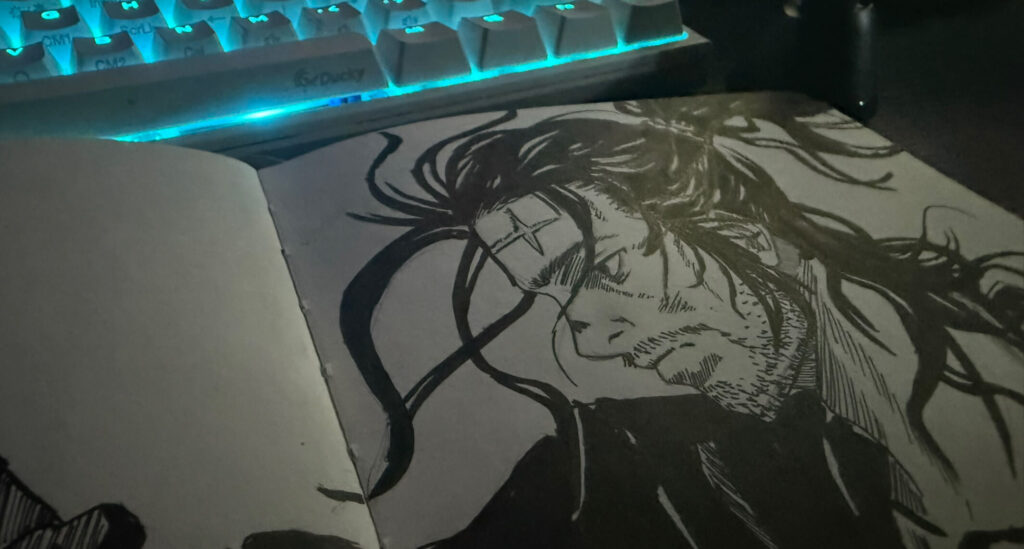
I started my own manga in high school with those same cheap materials. In 2016, a college friend showed me what a drawing tablet could do, and I was amazed. I went digital and never looked back — mostly. I still bring a sketchbook to the coffee shop after the gym. I still draw directly in ink, no pencil, no undo, because I like the challenge of commitment. I’m a digital artist who never fully left traditional art behind.
That’s the honest version of this debate. Not “which one is better” — but what each one actually does for you, what it costs you, and how to choose based on your real situation rather than an abstract comparison.
Part 1 — Where I Actually Started: Traditional Art in Davao
📖 Allard’s Story: The Borrowed Oil Pastels
Growing up in Davao, my family didn’t have money for art supplies. Art materials cost money we didn’t have, so I worked with what was around: pens, paper, and whatever I could find. Oil pastels were genuinely a luxury to me — something other kids had that I didn’t. When I entered art competitions — which I did regularly, because winning was one of the ways I could be known — I would sometimes borrow oil pastels from my competitors before the competition started. I don’t know if they found it charming or just couldn’t say no. Either way, I made it work. In high school, I started drawing my own manga. It was about a hero who was fundamentally unlucky — all his carefully laid plans somehow ended with him face-first in a pile of trash. Slapstick, comedic, completely made-up. Kids liked it, or at least I hope they did. I never got paid for it. I didn’t care. That manga taught me how to tell a story with sequential images, how to keep a reader engaged from panel to panel, and how to develop a character’s personality through repeated failure. You don’t learn those things from tutorials. You learn them from doing. I also got in trouble for drawing during class. Not for failing — I didn’t fail anything. But I was noisy. I’d be sketching and making sound effects out loud: laser sounds, machine gun sounds, whatever matched the action I was drawing. My teacher would notice before my classmates did. That’s the traditional art foundation I came from. No formal training. No expensive supplies. Just paper, pen, stolen oil pastels, and a lot of noise.
I tell you that background because it shapes everything I think about the digital vs traditional debate. The argument that “traditional art builds real foundations” is true — but it’s also true that traditional art has a cost barrier that digital art doesn’t, and for a lot of artists around the world, that cost barrier is the real issue, not some philosophical debate about which medium is more “authentic.”
If young Allard in Davao had access to a drawing tablet and free software, would it have helped? Probably. Would it have replaced what I learned from committing a line in ink with no undo? No. Would it have replaced the discipline of drawing a 20-page manga chapter with borrowed oil pastels and pen? Also no.
Both things can be true simultaneously. That’s the honest starting point for this comparison.
Part 2 — What Traditional Art Actually Teaches You
Traditional art gets romanticized a lot. People talk about the “feel of paper” and the “authenticity of physical marks” in ways that can sound like they’re defending one medium against another. But there are real, practical things that traditional art teaches that are genuinely harder to learn digitally.
Commitment to Every Mark
I still draw in ink directly — no pencil sketch underneath, no undo — even when I work traditionally today. Not because I’m trying to prove something, but because I genuinely find value in the commitment. When you can’t take back a line, you learn to think more carefully before you make it. You develop a different relationship with decisiveness.
In digital art, the unlimited undo function is one of the most powerful features available. It’s also, for some artists, a trap. You can undo forever, endlessly refining, never actually committing to a direction. I’ve seen artists spend more time in undo history than actually drawing. The solution I use: in my digital work, I often work on a single layer, mimicking the traditional approach of committing to marks. You can see this in my YouTube videos — it’s a deliberate choice, not a mistake.
Reading Value Without Color
Pen and ink, graphite, charcoal — traditional monochrome media force you to think in values (light and dark) because color isn’t available. This is one of the best disciplines a developing artist can practice. Value structure is the foundation of everything — it’s what makes an image readable at any distance, in any medium. Artists who learn to draw well in ink or graphite carry that value literacy into every other medium they use.
Material Constraints as Creative Force
When I had to borrow oil pastels for a competition, I couldn’t choose any color I wanted whenever I wanted. I worked with what was available. That constraint — far from being limiting — trained a kind of resourcefulness and intentionality that unlimited digital tools don’t automatically develop. Some of the most creative solutions in art history came from artists working around the constraints of their materials rather than having infinite options.
The Physical Object
A traditional artwork exists in the world as a physical object. It has texture, scale, a specific surface. Someone can own it in a way they can’t own a digital file. This has real value — for collectors, for selling originals, for the experience of making something that exists independently of any screen. The manga I drew in high school still exists as paper somewhere, probably in someone’s drawer in Davao. That’s something digital files can’t replicate.
Part 3 — What Changed When I Went Digital
📖 Allard’s Story: The Cheap Tablet That Changed Everything
A friend of mine in college bought a cheap drawing tablet — nothing expensive, just an entry-level thing. He encouraged me to try it. I sat down with it and within a few hours I was genuinely amazed. Before that, the only digital drawing I’d done was with a mouse in Microsoft Paint. Which, if you’ve tried it, you know is a particular kind of suffering. My family had a computer at home and I’d use Paint sometimes, but a mouse is just not a drawing instrument — it’s a pointing instrument used for drawing, which is a very different thing. The tablet changed everything. Suddenly I had pressure sensitivity. I had the ability to vary line weight naturally, the way I could with a pen on paper. I had layers. I had undo. I had the ability to experiment with color without buying a new tube of paint. I had access to brushes and textures I could never afford physically. That experience — going from mouse-in-Paint to proper tablet — is partly why I started this blog. I wanted to share what I’ve learned about digital art with people who are at that same starting point. The sense of “wait, I can actually do this now” is worth documenting. I was already working as a web developer by then. I had my own laptop. I could afford to invest in tools for the first time in my creative life. I bought my Wacom Intuos Pro with one of my early paychecks and I still use that same tablet today. The idea that I would eventually build my own website and share my artwork publicly — this blog, right now — was already forming.
Going digital didn’t make me abandon everything I’d learned traditionally. It changed where I applied those skills. The value literacy I’d built from years of pen-and-ink work transferred directly to digital shading. The commitment to line quality carried over into how I approach digital linework — I aim for confident single strokes rather than building lines from many small uncertain marks. The storytelling instincts I’d developed writing manga chapters in high school informed how I think about composition and character expression in my digital character art.
Digital didn’t replace traditional. It gave the traditional foundation a new set of tools to work with.
Part 4 — The Honest Comparison: What Each Medium Actually Costs You
Most comparisons focus on what each medium gives you. Fewer talk honestly about what each one costs — not just financially, but in terms of what you have to give up or work around. Here’s the real picture from someone who’s been on both sides.
🖊️ Traditional Art
- Ongoing material costs — paper, ink, brushes, paint all run out
- Mistakes are permanent or difficult to fix
- Can’t easily duplicate work or try color variations
- Scanning/photographing for digital sharing loses some quality
- Storage and transport of finished work
- Limited by what materials you can afford (real barrier for many artists)
- Harder to share and reach an online audience
- Takes longer to experiment — mixing colors physically vs. clicking
💻 Digital Art
- Higher upfront hardware cost (tablet, computer/iPad)
- Software subscription costs (Clip Studio Paint, Adobe, etc.)
- Software crashes — losing unsaved work is a real risk (Ctrl+S constantly)
- Screen fatigue over long sessions
- Hand-eye disconnect of drawing on tablet while watching screen
- Undo temptation can undermine decisiveness
- Work only exists as a file — feels less “real” to some artists
- Technology dependency — dead battery, broken stylus stops everything
💡 The one digital annoyance I genuinely hate:
Software crashes. I’ve lost work to crashes more than once, and it never gets less frustrating. My solution now is automatic: Ctrl+S is a reflex, not a thought. I save after every significant change. If you’re moving from traditional to digital, build this habit before you need it — not after losing two hours of work to a crash.
Part 5 — What I Still Miss About Traditional Art
I want to be honest here, because most digital artists who write about this topic are fully in the “digital is better” camp and treat traditional art as something they’ve graduated from. That’s not how I feel.
I still bring a sketchbook when I go to the coffee shop after the gym. There’s something about drawing with physical tools in a public space that feels different from drawing at a desk with a screen. The sketchbook is portable in a way that doesn’t require a charger. The act of opening it and putting pen to paper is immediate — no boot time, no software loading, no layer setup. Just the page and the mark.
“Something I miss is the feel of paper when you create a line. That physical resistance — the tooth of the paper pushing back against the pen — is something a tablet screen doesn’t replicate, no matter how good the texture overlay is.”
I also miss the directness of working without layers. In digital art, the layer system is incredibly powerful — but it can also encourage a kind of hedging, where you never fully commit because you can always adjust later. Traditional art doesn’t allow that. Every mark is real. Every decision is final. There’s a clarity that comes from working that way, and I try to bring it into my digital practice by often working on a single layer, the way you’d see in my YouTube videos.
And the sketchbook itself as an object — worn covers, smudged pages, the accumulated history of what you were thinking about on specific days — that’s something a folder of digital files doesn’t reproduce. My high school manga exists somewhere on paper. I can hold it, or imagine holding it. My early digital work exists on hard drives that may or may not still be readable in twenty years.
None of this means digital is worse. It just means that what you gain and what you lose in each medium is real — and being honest about both sides of that makes you a more intentional artist regardless of which you use.
Part 6 — The Real Costs: Money, Time, and Access
Let me give you numbers, because this is a practical decision as much as a creative one.
Traditional Art: Ongoing Costs Add Up
| Material | Entry Level Cost | How Often to Replace |
|---|---|---|
| Sketchbook (A5) | ₱150–₱400 / $3–$8 | Every 1–3 months depending on use |
| Pens (Micron, Staedtler) | ₱80–₱200 each / $2–$4 | Every few months per pen |
| Oil pastels (set of 36) | ₱300–₱1,200 / $6–$25 | Individual colors run out unevenly |
| Watercolor set | ₱500–₱3,000 / $10–$60 | Refill individual pans as needed |
| Acrylic paint (starter set) | ₱800–₱2,500 / $15–$50 | Colors deplete with use |
| Canvas or art paper (pack) | ₱200–₱800 / $4–$16 | Each piece uses one sheet |
Traditional art is cheap to start but expensive to maintain consistently. Materials run out, and the cost compounds over time. For artists in lower-income situations — like I was growing up — this is a real barrier, not a minor inconvenience.
Digital Art: Higher Upfront, Lower Ongoing
| Tool | Entry Level Cost | How Often to Replace |
|---|---|---|
| Graphics tablet (Wacom Intuos Small) | ₱4,000–₱6,000 / $80–$120 | Years — my Intuos Pro has lasted since 2016 |
| Pen display (Huion Kamvas 13) | ₱10,000–₱16,000 / $200–$320 | 3–5+ years with care |
| iPad + Apple Pencil (entry) | ₱25,000–₱40,000 / $500–$800 | 4–6 years |
| Clip Studio Paint (one-time) | ₱1,500–₱2,500 / $25–$50 on sale | One-time purchase or annual plan |
| Krita | Free | Free forever |
| Procreate (iPad) | ₱650 / $12.99 one-time | One-time purchase |
The upfront cost of digital is genuinely higher. A tablet is a significant purchase, especially in the Philippine context. But the ongoing cost is dramatically lower — once you have the hardware and software, you can make as many pieces as you want with no additional material cost. For a high-volume artist, digital becomes cheaper per piece very quickly.
This was true for me. As soon as I had my own income as a developer, digital became financially accessible in a way that buying enough oil pastels, paper, and ink never quite was growing up.
Part 7 — Career Paths: Which Medium Opens Which Doors
This is the practical question most comparison articles avoid answering directly. Here’s what’s actually true about career paths in each medium.
Traditional Art Career Paths
- Fine art and gallery work — Original traditional pieces have rarity and collectibility that digital files don’t. Gallery sales, art fairs, and collector markets favor physical originals.
- Children’s book illustration — Many publishers still prefer traditional media, particularly watercolor and gouache, for picture books. The physical texture of traditional art reproduces differently in print than digital.
- Printmaking and ceramics — Disciplines that are inherently physical and can’t be replicated digitally.
- Art education — Teaching drawing and painting fundamentals is often done through traditional media, even in schools that also teach digital.
- Selling originals — Each traditional piece is unique and can only be sold once at its original price. Signed originals command higher prices than prints.
Digital Art Career Paths
- Game art and concept art — Almost entirely digital. Game studios use digital workflows from concept through final asset. This is one of the most active hiring markets for skilled digital artists.
- Animation and film — Digital production pipelines are standard in animation, VFX, and motion graphics.
- Freelance illustration and commissions — Online commission markets are dominated by digital artists because the work is easy to deliver, revise, and share.
- Print-on-demand products — Redbubble, Society6, and similar platforms work best with digital files that can be applied across many product sizes.
- Web and UI/UX design — Digital skills transfer directly to design careers.
- Content creation — YouTube speedpaints, Twitch drawing streams, and social media art content are overwhelmingly digital-first.
| Career Goal | Better Medium | Why |
|---|---|---|
| Game/concept art | Digital | Industry standard workflow; studios expect digital deliverables |
| Online commissions | Digital | Easier delivery, revision, and sharing; larger online market |
| Gallery / fine art sales | Traditional | Physical originals have rarity and collectibility value |
| Children’s book illustration | Either (lean traditional) | Many publishers prefer traditional texture; both are accepted |
| Manga / comics (indie) | Either | Digital is faster to produce and publish; traditional has specific aesthetic |
| Print-on-demand products | Digital | File-based workflow suits POD platforms natively |
| Teaching / education | Traditional first | Fundamentals are best taught through physical media |
| Social media / content | Digital | Screen-native art shares better and reaches larger audiences |
Part 8 — The “Which Should I Start With?” Question
If you’re a beginner trying to decide where to start, here’s my honest answer — not the diplomatic both-are-equal answer, but the real one based on real experience:
Start Traditional If:
- You already have pencils, pens, and paper at home and can’t yet afford a tablet
- You struggle with screens or get eye fatigue easily
- You learn better through physical, tactile feedback
- You want to develop patience and commitment in your marks (the no-undo discipline)
- You’re interested in fine art, gallery work, or physically unique pieces
- You want to draw in cafés, parks, and places without needing power or a screen
Start Digital If:
- You have access to a tablet (even a cheap entry-level one) and software (Krita is free)
- You want to share your work online and build an audience
- You’re interested in game art, animation, commissions, or content creation
- You want to experiment with color without the cost of buying physical paint
- You’re interested in anime-style illustration specifically — digital workflows are built for it
- You want to undo mistakes while you’re learning (valid! especially early on)
The Answer I Actually Give:
Do both, if you can. Not equally — pick a primary medium based on your goals and budget. But don’t completely abandon the other one. I still bring my sketchbook to the coffee shop. The traditional drawing I do there informs my digital work in ways I’d lose if I stopped entirely. The digital skills I’ve built since 2016 inform how I think about value, composition, and efficiency in my sketchbook work.
The artists who grow fastest aren’t the ones who found the “right” medium. They’re the ones who kept drawing, in whatever medium was available, consistently. Young me borrowed oil pastels from competitors and made laser sounds in class because I couldn’t stop drawing. That drive — not the medium — is what actually built the skill.
Part 9 — The “Is Digital Art Real Art?” Question
I want to address this because it comes up constantly, usually in comment sections, and it needs a direct answer.
Yes. Digital art is real art. Full stop.
The argument that it isn’t usually comes from one of two places: either a misunderstanding of what digital art actually involves, or a defensive reaction from traditional artists who feel their medium is being devalued by digital’s accessibility. Both are understandable. Neither is correct.
Digital art requires the same foundational skills as traditional art — proportion, value, color theory, composition, line quality, understanding of light and shadow. The tools are different. The underlying knowledge is identical. A bad digital artist is bad for the same reasons a bad traditional artist is bad: weak fundamentals, poor decision-making, lack of deliberate practice. A great digital artist is great for the same reasons a great traditional artist is great: strong foundations, intentional choices, consistent improvement.
The tool doesn’t make the art. The artist does.
What IS a legitimate criticism of digital art — not of its validity, but of some artists’ approach to it — is the over-reliance on undo, on filters, on automated features that substitute for actually learning the underlying skills. But that’s a practice problem, not a medium problem. You can be a lazy traditional artist too. The medium doesn’t automatically make you thoughtful or skilled.
Part 10 — The Hybrid Approach: Why I’m Not Fully Either
I described myself at the start as a digital artist who never fully left traditional art behind. Let me be specific about what that actually looks like in practice, because I think the hybrid approach is genuinely underrepresented in these conversations.
My primary work is digital. The illustrations on this site, my YouTube content, my character art — all digital, all on my Wacom Intuos Pro. I work in Clip Studio Paint. I use layers, undo, reference layers, and all the tools that digital makes available. This is where I produce finished work.
My sketchbook goes with me to the coffee shop after the gym. I draw in it with pen — direct ink, no pencil underneath, no undo. These sketches are usually quick observations, character ideas, or just drawing for the pleasure of drawing. They don’t get scanned. They don’t get shared. They exist for me, on paper, in a drawer somewhere.
In my digital work, I often deliberately work on a single layer to mimic the constraint of traditional art — committing to marks rather than endlessly hedging with separate layers I can hide or delete. This is visible in my YouTube videos if you watch how I work. It’s a choice, not a limitation. The traditional habit of commitment bleeds into the digital workflow and makes both better.
This is the part of the digital vs traditional debate that most articles skip: you don’t actually have to choose permanently. You can be primarily digital and maintain a traditional sketchbook practice. You can be primarily traditional and use digital tools for color studies or final polish. The framing of “which one should you be” is less useful than “what role should each one play in your practice right now.”
Frequently Asked Questions
Does traditional art make you a better digital artist?
In my experience, yes — but not because of anything magical about physical media. Traditional art, especially work done without undo (pen and ink, direct painting), builds commitment and decisiveness that translates into better digital linework and painting. It also forces you to think in values when you’re working in monochrome media, which is a foundational skill that benefits all digital work. That said, plenty of excellent digital artists never seriously practiced traditional art. The skills transfer, but they’re not the only path to developing them.
Is it worth learning traditional art if I want to work in game art or animation?
Some traditional drawing practice — especially gesture drawing, life drawing, and value studies — builds observation and spatial thinking skills that benefit game and animation artists. But the actual job is digital, and your portfolio needs to be digital. If your goal is a game art or animation career, prioritize digital skills and use traditional practice as supplementary foundation-building, not as your main focus. Studios aren’t hiring traditional artists and asking them to switch — they’re hiring artists with strong digital portfolios who also happen to have good fundamentals.
What’s the cheapest way to start digital art in the Philippines?
The lowest-barrier entry: a Wacom Intuos Small or Huion H610 Pro (both available for around ₱3,000–₱5,000 on Lazada or Shopee) paired with Krita, which is completely free. This setup is fully capable of producing professional-quality digital art — the tool ceiling is far above where beginners start. If you have a budget iPad (₱15,000–₱20,000 range for older models), Procreate at ₱650 is also a genuinely excellent option. You don’t need the most expensive hardware to start — you need something pressure-sensitive and software that works. Everything else is refinement.
Can you sell traditional art online?
Yes — in several ways. You can sell original pieces through Etsy, Facebook Marketplace, or direct social media sales. You can photograph or scan traditional work and sell prints through print-on-demand platforms like Redbubble. You can sell original commissions where you mail the physical piece to the client. The logistical challenge of traditional art sales is shipping — physical pieces need careful packaging and add cost and complexity that digital commissions don’t have. For international sales specifically, digital delivery is significantly simpler than shipping physical originals.
How long does it take to get used to drawing on a tablet?
The hand-eye disconnect — drawing on a flat surface while looking at a screen — takes most people 1–3 weeks to stop noticing. In the first few days, lines feel wobbly and uncontrolled because you’re recalibrating your spatial sense. This is normal and temporary. The best way through it: draw simple exercises (long straight lines, circles, curves) repeatedly in the first week rather than trying to produce finished work. Build the muscle memory for the new tool before asking it to carry creative weight. Most artists look back at the adjustment period as shorter than it felt at the time.
Is digital art easier than traditional art?
Different, not easier. Digital art makes some things genuinely easier: correcting mistakes, trying color variations, sharing work online, working in layers. It makes some things harder: committing to marks, developing a feel for physical media, working without the safety net of undo. Traditional art makes some things easier: the physical feedback of tool on surface, the immediacy of having a finished object in your hand, working without technology dependency. It makes some things harder: fixing errors, duplicating work, sharing digitally. Neither is objectively easier. They have different friction points, and artists tend to find the medium easier that matches how they naturally think.
Do I need to learn to draw on paper before I can draw digitally?
No — and this is a misconception that keeps a lot of people from starting digital art. The core skills of drawing (proportion, value, composition, line quality) can be built in either medium. Learning on paper first gives you physical feedback and forces commitment; learning digitally first gives you undo and easy experimentation. Neither is a prerequisite for the other. If you have access to a tablet now and want to start digital, start digital. Don’t wait for a traditional foundation you feel you “should” have first.
What do you use to draw in your sketchbook now?
Direct ink — pen straight to paper, no pencil sketch underneath. No undo. I like the commitment of it. It keeps the traditional practice honest: every mark counts, and hesitation shows. When I’m in a coffee shop after the gym with my sketchbook, I’m not trying to produce portfolio-ready work. I’m thinking with a pen, sketching ideas, drawing whatever’s in front of me. The low-stakes nature of it is the point. The sketchbook is for me, not for an audience.
Is it too late to start traditional art if I’ve been digital for years?
Definitely not. The digital skills you’ve built — understanding of value, color, composition, proportion — transfer directly to traditional media. What will feel unfamiliar is the physical feedback of specific tools and the lack of undo. Both adjust quickly. Many digital artists who pick up traditional media for the first time after years of digital work are surprised how quickly their existing skills carry over. The main adjustment is psychological: accepting that mistakes are permanent and that the process is inherently less forgiving. Some artists find that constraint refreshing after years of digital flexibility.
Which is better for someone who just loves drawing for fun, not for career purposes?
Whichever feels more enjoyable to you, full stop. If the feel of pen on paper brings you joy, draw on paper. If you love the flexibility of digital and the ability to share easily, draw digitally. If you like both, do both — a sketchbook for coffee shop sessions and a tablet for more involved work. Art for personal enjoyment doesn’t owe anything to career logic or medium hierarchy. The right medium is the one that makes you want to keep drawing. Everything else is secondary.
What to Read Next
- Digital Art for Beginners — if this post got you interested in starting digital, this is the complete setup guide: hardware, software, canvas sizes, layers, and your first drawing
- Sketching vs. Drawing: What’s the Difference? — a deeper look at the two modes of mark-making that applies to both traditional and digital work
- Canvas Size for Digital Art — the first practical decision you’ll make when starting digital: what dimensions and DPI to use for different purposes
- Complete Anime Drawing Guide for Beginners — whether you choose traditional or digital, this is the structured skill-building roadmap for anime-style character art
- Digital Art Careers — how different medium choices map onto different income and career paths
Whatever medium you choose — or whichever combination you end up with — the most important thing is that you keep drawing. Borrow oil pastels if you have to. Make laser sounds in class if you can’t help it. Build a website to share your work if that’s where you end up. The medium is the vehicle. The drawing is the point. 🖊
Discover More Posts
Keep exploring stories, insights, and creative notes from my journey as an artist. Check out the latest blog entries and find topics that inspire your own process.
5 Hidden Art Career Killers That Stop Most Artists Before They Even Start — And How to Beat Them
Learn to draw anime-style clouds with this easy, step-by-step cloud tutorial. You’ll pick up tips on shapes, color, and composition—plus get free cloud brushes to use in your own art.

Sketching vs. Drawing: 5 Powerful Insights Every Artist Should Know
Learn the key differences between sketching and drawing—how detail, speed, tools, and intent separate the two and when to use each in your art practice.
How to Find Your Art Style in 3 Simple Steps
Learn how to find your unique art style through a clear three-step process. Discover how to collect inspiration, analyze your influences, and build your own signature look with deliberate practice.