
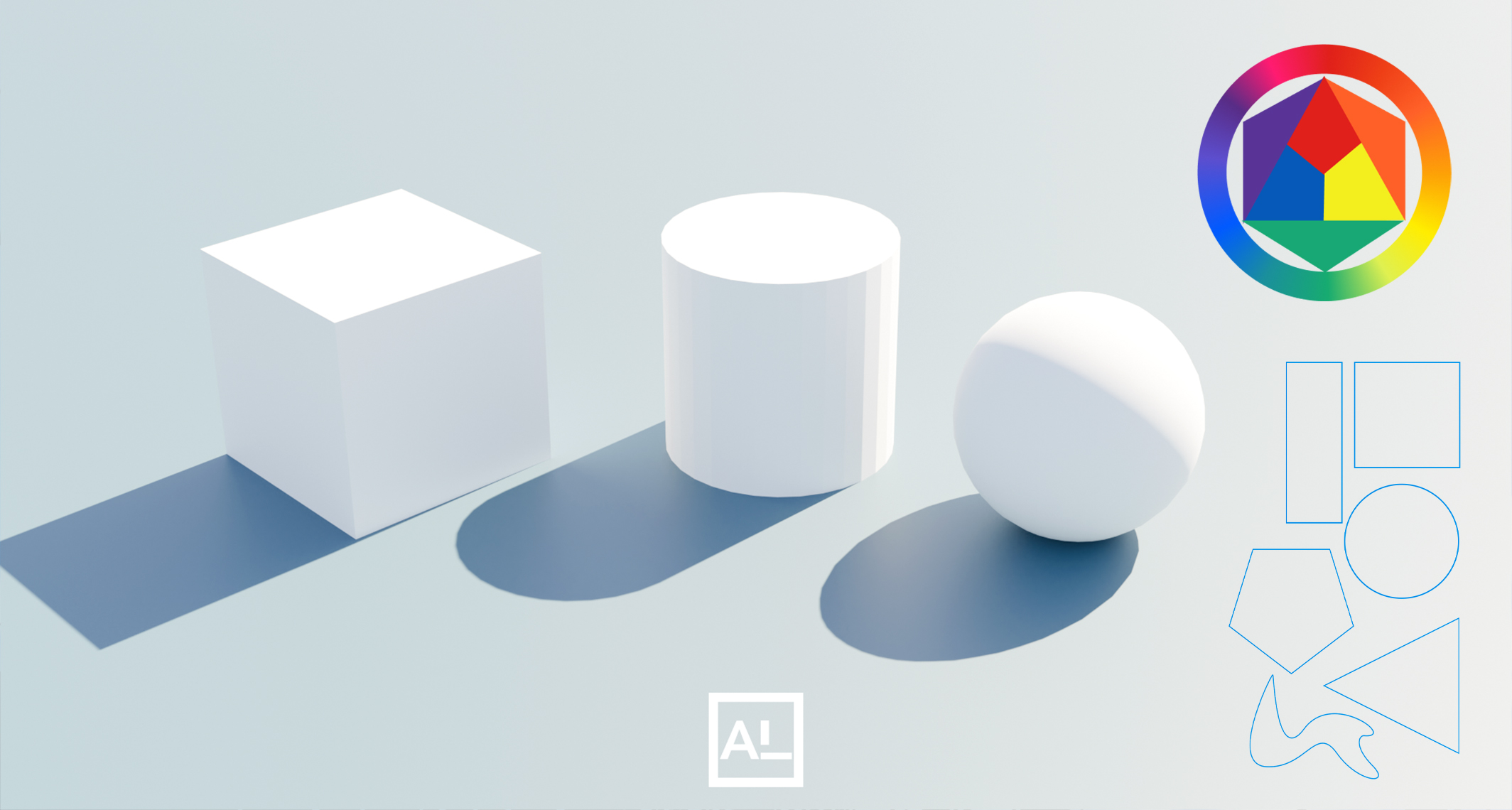
If you draw anime characters, you’re already using the 7 elements of design — line, shape, color, texture, space, form, and value. You’re just probably using them without thinking about them.
That’s fine early on. But at some point — usually when your pieces start looking “almost right” but not quite — you need to go from intuitive to intentional. The elements of design are the vocabulary that lets you diagnose what’s wrong and fix it on purpose rather than by accident.
This guide breaks down all seven, specifically in the context of anime and character illustration. Not graphic design theory in the abstract — how these elements actually work when you’re drawing characters, building their world, and trying to make a piece feel alive.
💬 From Allard:
I’ve been drawing characters for 10+ years — starting with ballpoint manga in high school, moving to digital illustration, and eventually taking on character commissions professionally. For a long time I worked on instinct. The turning point was my Guts from Berserk piece — a semi-realistic rendering that forced me to think deliberately about every element, especially value, form, and line weight. I use that piece as a reference point throughout this guide because it’s where a lot of these lessons became concrete for me rather than theoretical.
Why Design Elements Matter Specifically in Anime Art
Anime and manga have a specific visual language that already encodes a lot of design thinking — even if the artists creating it never studied formal theory. The thick-to-thin line variation in manga inking. The flat color fields with deliberate shadow shape design. The way Miura used value in Berserk to make characters feel physically heavy and present. The way Shinkai uses color temperature to carry emotion.
These aren’t accidental choices. They’re design decisions — made intuitively by experienced artists, but design decisions nonetheless. Understanding the elements behind them gives you the ability to make those decisions intentionally rather than hoping they fall into place.
Good anime illustration isn’t “flat” because it ignores design principles. It’s controlled simplification of those principles — and that control is a skill.
Here’s how each element plays out in character work specifically.
1. Line — Energy, Weight, and Character Personality
In anime illustration, line does more than define edges — it communicates personality and energy before the viewer consciously registers anything else.
Thick lines read as heavy, grounded, powerful. Thin lines feel delicate, fast, or precise. Variation between thick and thin within a single stroke — the hallmark of good manga inking — creates dynamism and hierarchy. The outline of a character’s jaw hits heavier than the line of their eyelash. That weight difference tells you something about form and importance without any shading needed.
Line character also varies by style intention:
- Clean, even linework — reads as polished, controlled, modern. Common in professional character design and game art.
- Loose, sketchy linework — reads as energetic, expressive, gestural. Effective for action or emotional pieces.
- No linework at all — forces form to be read entirely through color and value. More advanced, but powerful when done right.
💬 From Allard — line weight in the Guts piece:
Guts is a physically massive character — large frame, heavy armor, enormous sword. The line weight in my piece had to reflect that. Thin, even lines would have made him look fragile regardless of how well the anatomy was drawn. I used heavier outlines on the armor silhouette and the main body, with progressively thinner lines for interior detail. That hierarchy — heavy on the outside, lighter on the inside — is what gives armored characters visual weight even before shading is applied. Line weight is structural information, not just style.
💡 Practice this:
Draw the same character outline twice — once with uniform line weight, once with deliberate thick-to-thin variation. The second version will read as more alive even if the shapes are identical. That difference is pure line design.
2. Shape — The Language of Character Design
Shape is the most fundamental tool in character design, and it’s one of the most underused by self-taught artists who go straight to detail without thinking about the underlying geometry.
Every well-designed character reads clearly as a silhouette. That silhouette is built from shape decisions — and those shapes carry meaning:
- Circles and curves — friendly, approachable, soft. Used heavily in chibi design, young characters, and comedic figures.
- Triangles and sharp angles — dangerous, aggressive, unpredictable. Villain designs, weapons, and armor use this constantly.
- Squares and rectangles — stable, reliable, powerful. Tank characters, stoic warriors, authority figures.
Most complex anime character designs are combinations of these — a heroic character might be built on a stable rectangular torso but have triangular armor details that signal they’re capable of violence. The design is communicating personality before the character does anything.
💬 From Allard:
Guts is almost entirely angular — his silhouette is built on hard, aggressive geometry. Broad rectangular shoulders, triangular weapon shapes, the diagonal scar across his face. Even his cape breaks into sharp rather than soft folds. That consistent shape language across the whole design is what makes him read as dangerous and unstable rather than powerful and trustworthy (which would use more stable rectangular shapes). Shape language is character writing in visual form.
💡 Practice this:
Block every character you draw in basic shapes before adding any detail. Circle, triangle, rectangle — nothing else. If the silhouette doesn’t communicate the character’s personality at that stage, the details won’t fix it later.
3. Color — Mood Before Detail
Color hits the viewer before they’ve read a single line of the composition. In anime illustration, color carries emotional weight that no amount of rendering can compensate for if it’s wrong.
The most common mistake in character color: using too many hues competing at equal saturation. The eye has nowhere to go, and the character reads as chaotic rather than designed. The fix is a simple hierarchy:
- One dominant color — covers the majority of the character’s surface area and sets the overall mood
- One supporting color — contrasts or harmonizes with the dominant, usually on secondary elements like armor trim, hair, or clothing accents
- One accent color — used sparingly for the focal point: eyes, weapon, key detail
💬 From Allard:
For the Guts piece I kept the palette extremely limited — near-blacks and deep browns for the armor and cloak, with a narrow range of warm mid-tones for the skin. The only real color accent was the warm amber rim light catching the edge of the armor and face. That restraint was intentional: Guts is a character defined by loss and grimness, and a colorful palette would have fought that reading. Color choices are emotional choices. Before you pick a palette, ask what you want the viewer to feel — then build from there.
Color temperature is equally important. Warm characters feel energetic and present. Cool characters feel distant or mysterious. Characters caught between warm light and cool shadow feel dramatic — which is why sunset and overcast lighting are so common in anime illustrations that want emotional impact.
For a full breakdown of color theory principles including hue, value, saturation, and temperature, read my Color Theory guide for artists.
4. Texture — Surface Information and Material Storytelling
Texture in anime character illustration is about surface differentiation — making skin feel like skin, fabric feel like fabric, metal feel like metal, without over-rendering any of it.
The key principle: different materials within the same character should read differently, even in a stylized context. A character wearing plate armor, a linen shirt, and leather boots should have three visually distinct surface qualities. If everything has the same level of smoothness or the same rendering approach, the materials lose specificity and the character loses believability.
In anime style, this often doesn’t require physical texture at all — it’s handled through edge quality and rendering approach:
- Soft, blended edges → fabric, skin, hair
- Hard, sharp edges and high contrast → metal, glass, ceramic
- Varied, broken edges → worn leather, rough stone, organic surfaces
💬 From Allard:
The hardest part of the Guts piece was keeping the texture of the Black Swordsman armor feeling heavy and worn without overworking it. Real armor isn’t shiny and perfect — it has scratches, dents, and surface variation. But rendering every individual scratch would take forever and make the piece feel overwrought. The solution was selective texture: heavy surface detail on the areas of armor closest to the viewer and most lit, simplified almost to flat color at the edges and in shadow. Your eye fills in the rest. Strategic texture reads as more realistic than uniform texture applied everywhere.
5. Space — Where You Put Nothing Is as Important as Where You Put Something
Space is the element most ignored by beginners and most deliberately used by skilled artists. In character illustration, space decisions are composition decisions — where the character sits in the frame, how much empty canvas surrounds them, and what that emptiness communicates.
Negative space (empty areas) isn’t wasted space. It’s breathing room that makes your subject feel more present. A character centered in a tight frame with no surrounding space feels claustrophobic and static. The same character with deliberate empty space in the direction they’re looking or moving creates tension, movement, and implied narrative.
Space in character design also applies internally:
- Busy, cluttered designs with detail everywhere read as chaotic or overwhelming
- Designs with clear “quiet zones” — areas of low detail that let the eye rest — make the high-detail focal areas read more powerfully by contrast
💬 From Allard:
One of the composition decisions I made on the Guts piece was giving him significant space above and to one side — not centering him tightly in the frame. That empty space carries weight for the character: it feels like the world around him is vast and threatening, which is exactly right for Berserk’s tone. Cramming the character into the frame would have made the piece feel action-ready but lost the sense of isolation that defines Guts as a character. Space is narrative.
💡 A fast composition check:
Squint at your piece until it blurs. The dark mass of your character should be clearly separated from the surrounding space. If they blend together, you’ve lost the spatial contrast that makes the character read clearly at a distance — the first test any illustration has to pass.
6. Form — Turning Flat Shapes Into Solid Characters
Form is the element that separates flat character designs from characters that feel physically present. It’s the difference between a circle and a sphere — the addition of light, shadow, and volume that makes a 2D shape read as a 3D object.
In anime illustration, form is often simplified rather than fully rendered — but it’s always present in the work of skilled artists. Even in highly stylized art that uses flat color and minimal shading, the shadow shapes are designed to suggest three-dimensional form. They’re not random. They follow the logic of light hitting a solid object.
The most common form problem in beginner character work: shading that decorates rather than describes. Dark areas placed for visual balance rather than because that’s where the shadow would actually fall given the light source. The result looks textured but flat — the shadows don’t tell you anything about the shape underneath.
💬 From Allard — form in the Guts piece:
Semi-realistic rendering makes form non-negotiable. Every surface on Guts — the face, the armor planes, the hand on the sword — had to read as a specific three-dimensional form catching light from a specific direction. The approach I use is to solve the form entirely in greyscale before adding any color. This forces the question: does this shadow shape describe the form underneath it, or is it just sitting there? Anything that couldn’t answer that question correctly got redrawn. The color pass is about mood and material. The form pass is about structure — and you can’t skip it or fake it.
💡 The single best form exercise:
Draw a sphere lit from one direction. Not a circle with a dark side — a fully rendered sphere with a highlight, a midtone, a core shadow, a terminator edge, and a bounce light on the shadowed side. Do this until you can do it from memory. Every form in every character you’ll ever draw follows this same logic.
7. Value — The Most Important Element in the List
Value — the range from light to dark — is the foundation everything else sits on. Get it wrong and no amount of color, texture, or detail fixes the piece. Get it right and the piece works even in greyscale.
In anime and manga, value does most of the heavy lifting. Manga is entirely value — no color at all — and the best manga reads as fully realized and emotionally complete because the value work is doing everything: form, mood, depth, focus, drama. If you study how Miura, Araki, or Ito use value in their work, you’ll learn more about illustration than most drawing courses will teach you.
The key value principles for character illustration:
- Value contrast draws the eye. The area of highest contrast in your piece is where the viewer looks first. Place it on what matters most — usually the face, especially the eyes.
- Group your values. Aim for three clear value zones: lights, midtones, darks. Pieces with five or six scattered value levels read as muddy and busy. Squint at your piece — the value structure should simplify into three clear groups.
- Check in greyscale before finalizing color. If the value structure is broken, the color won’t fix it — it’ll hide it temporarily and make it harder to diagnose.
💬 From Allard — value as the backbone of the Guts piece:Guts from Berserk is almost entirely dark values. Deep blacks, heavy shadows, very limited light. That value structure is a character statement — it communicates what the character is before you’ve read a single word about him. My piece was built on that same logic: I pushed the value range further than felt comfortable, keeping most of the armor in very dark tones and reserving the lightest lights for the face and the edge highlights catching the single warm light source. That restraint — resisting the urge to add light to every surface — is what gives the piece its weight. Value control is the single most impactful skill you can develop as a character illustrator. Everything else is built on top of it.
How These Elements Work Together in Practice
The seven elements don’t operate independently — they’re in constant relationship with each other. In a well-constructed character illustration, each element is supporting the others:
| If this feels wrong… | Check this element first |
|---|---|
| Character looks flat and lifeless | Value — your light-dark structure is probably too compressed |
| Design feels generic or forgettable | Shape — the silhouette isn’t communicating personality |
| Piece feels chaotic or hard to read | Space — too much detail everywhere, no quiet zones |
| Mood feels off despite correct rendering | Color — temperature and palette aren’t matching the emotional intent |
| Materials look the same on everything | Texture — edge quality and rendering approach aren’t differentiated |
| Lines feel either stiff or too messy | Line — weight variation and confidence need deliberate practice |
| Character feels 2D despite shading | Form — shadows are decorating rather than describing volume |
💬 From Allard:
The diagnostic table above is genuinely how I troubleshoot pieces when something feels wrong but I can’t immediately identify what. I go through each element and ask whether it’s doing its job. Usually the problem is one or two specific elements failing — not everything at once. Isolating which element is the culprit is what separates deliberate improvement from randomly redrawing things and hoping something fixes it.
What to Actually Practice — A Focused Approach
Don’t try to work on all seven elements at once. Pick the one that’s most limiting your work right now and practice it deliberately for 2–4 weeks before moving on.
✅ Suggested practice sequence for character illustrators:
- Value first.Render 10 character sketches in greyscale only. No color. Force yourself to solve form and mood entirely through light and dark.
- Shape second.Design 5 character silhouettes using only circles, triangles, and rectangles. No detail. The personality should read at that stage.
- Line third.Ink 10 character outlines with deliberate thick-to-thin variation. Compare each one to the same outline drawn with uniform weight.
- Color fourth.Limit every piece for one month to three colors maximum: one dominant, one supporting, one accent. No exceptions.
- Form, texture, and spacedevelop naturally as you improve the first four — but give each one a focused study session when you feel ready.
Frequently Asked Questions
Do I need to study design theory formally to improve my character illustration?
No — but you need to study it somehow. Most skilled self-taught character artists have absorbed these principles intuitively through years of analyzing work they admire. Understanding them explicitly just makes the same learning faster and more targeted. You don’t need a textbook or a course. You need to look at great anime illustration, ask “what is this piece doing with line, value, and shape?”, and then try to do the same thing intentionally in your own work.
Which of the 7 elements matters most for anime character illustration?
Value, without much competition. You can simplify or eliminate almost every other element and still have a compelling character illustration — manga does this constantly. But if the value structure is broken, nothing else saves the piece. Study manga specifically for value education: Berserk, JoJo’s Bizarre Adventure, Junji Ito’s work. These artists use value with extraordinary intention and their work is freely available as reference.
How do I make my character silhouettes more distinctive?
Two things: shape language consistency and outline variety. Shape language consistency means picking a dominant shape category for each character (angular for aggressive characters, rounded for friendly ones) and applying it to every major design element — not just the face, but the armor, the hair, the accessories. Outline variety means breaking the silhouette in interesting ways — avoiding long uninterrupted curves that make the outline feel smooth and forgettable. Spikes, folds, overlapping elements, and asymmetry all create silhouette interest.
How many colors should I use in an anime character illustration?
Three to five distinct hues as a working rule — one dominant, one supporting, one accent, with possible variations in temperature within those categories. The more stylized the piece, the fewer colors you typically need. Highly rendered semi-realistic work can support more color variation because the rendering complexity provides visual richness. Flatter, more graphic styles need tighter palette control because there’s less else going on to hold the eye’s attention.
Why does my character feel flat even when I add shading?
Almost always one of two reasons: your shadow shapes aren’t describing form (they’re placed for visual effect rather than following the actual logic of your light source), or your value range is too compressed (your darks aren’t dark enough and your lights aren’t light enough, so everything sits in the midtone zone where form contrast is weakest). Check both. Desaturate your piece and look at the value structure in greyscale — if the shadow shapes don’t tell you clearly where the forms are and where the light is coming from, that’s the problem to fix.
How do I get better at line weight variation?
Deliberate inking practice — not as part of a finished piece, but as a standalone exercise. Take a simple character outline and ink it three ways: uniform weight, thick-outline-thin-interior, and full pressure variation throughout. Compare them. Then practice the pressure variation specifically: slow down, use your whole arm rather than just your wrist, and commit to each stroke rather than sketching tentatively. Line confidence comes from committing to the stroke before the pen hits the canvas, not from correcting while drawing.
What to Read Next
- Color Theory Made Simple — the full breakdown of hue, value, saturation, and temperature that Element 3 and 7 above build on
- How to Shade Skin in Digital Art — how form and value specifically apply to the hardest surface in character illustration
- How to Find Your Art Style in 3 Steps — once you understand the elements, this is how you develop a distinctive voice with them
- Complete Anime Drawing Guide for Beginners — the practical character drawing foundation that these design principles sit on top of
- 8 Habits That Will Actually Improve Your Art — the practice structure that makes deliberate element study actually compound over time
Design elements aren’t rules — they’re vocabulary. The goal isn’t to follow them perfectly but to understand them well enough that you can break them on purpose. Every great anime artist you admire is doing exactly that: making intentional choices about line, shape, value, and space that serve the piece specifically. The elements give you the language to understand what they’re doing — and eventually to do it yourself. 🖊
Discover More Posts
Keep exploring stories, insights, and creative notes from my journey as an artist. Check out the latest blog entries and find topics that inspire your own process.
How to Draw Stunning Anime Clouds
Learn to draw anime-style clouds with this easy, step-by-step cloud tutorial. You’ll pick up tips on shapes, color, and composition—plus get free cloud brushes to use in your own art.
How to Paint Realistic Metal
Learn how to paint realistic metal with this step-by-step guide. From base colors to to lighting and reflections, get practical tips for your artwork shine, literally.
Color Theory Made Simple: A guide for Beginner Artist
New to Digital painting? This beginner-friendly guide breaks down hue, value, saturation, color harmonies, and practical tips to help you choose better palettes and level up your art.