

By:
Of everything I draw — environments, hands, clothing, full characters — faces are what I come back to most. They’re the part I’ve put the most deliberate practice into, and honestly, they’re the part that brings me the most satisfaction when they click. A well-drawn anime face communicates personality, emotion, and story in a single glance. Get it right and your character lives. Get it wrong and nothing else in the drawing can save it.
This guide walks you through my complete method for drawing anime faces — the same approach I’ve refined over years of practice. We’ll cover head construction from scratch, each facial feature in detail, the differences between male and female faces, expressions, and — the part most tutorials skip — how to draw faces convincingly from any angle, not just straight on.
Grab a pencil and a sketchbook and draw along as you read. This isn’t a guide to read once and file away. It’s a guide to work through actively, with marks on paper happening in real time.
📌 What you’ll need:
A mechanical pencil (0.5mm) and sketchbook for traditional work, or any drawing software with a tablet for digital. The techniques in this guide work identically in both mediums. For digital, Clip Studio Paint, Krita, and Procreate are all suitable.
Part 1 — Why Anime Faces Look the Way They Do
Before drawing a single line, it helps to understand what makes anime faces a distinct visual language — not just “cartoony,” but a specific and intentional stylization with its own internal logic.
Anime faces are built on deliberate distortions of realistic facial proportions. Understanding what’s being distorted, and why, lets you make intentional choices rather than just copying shapes you’ve seen.
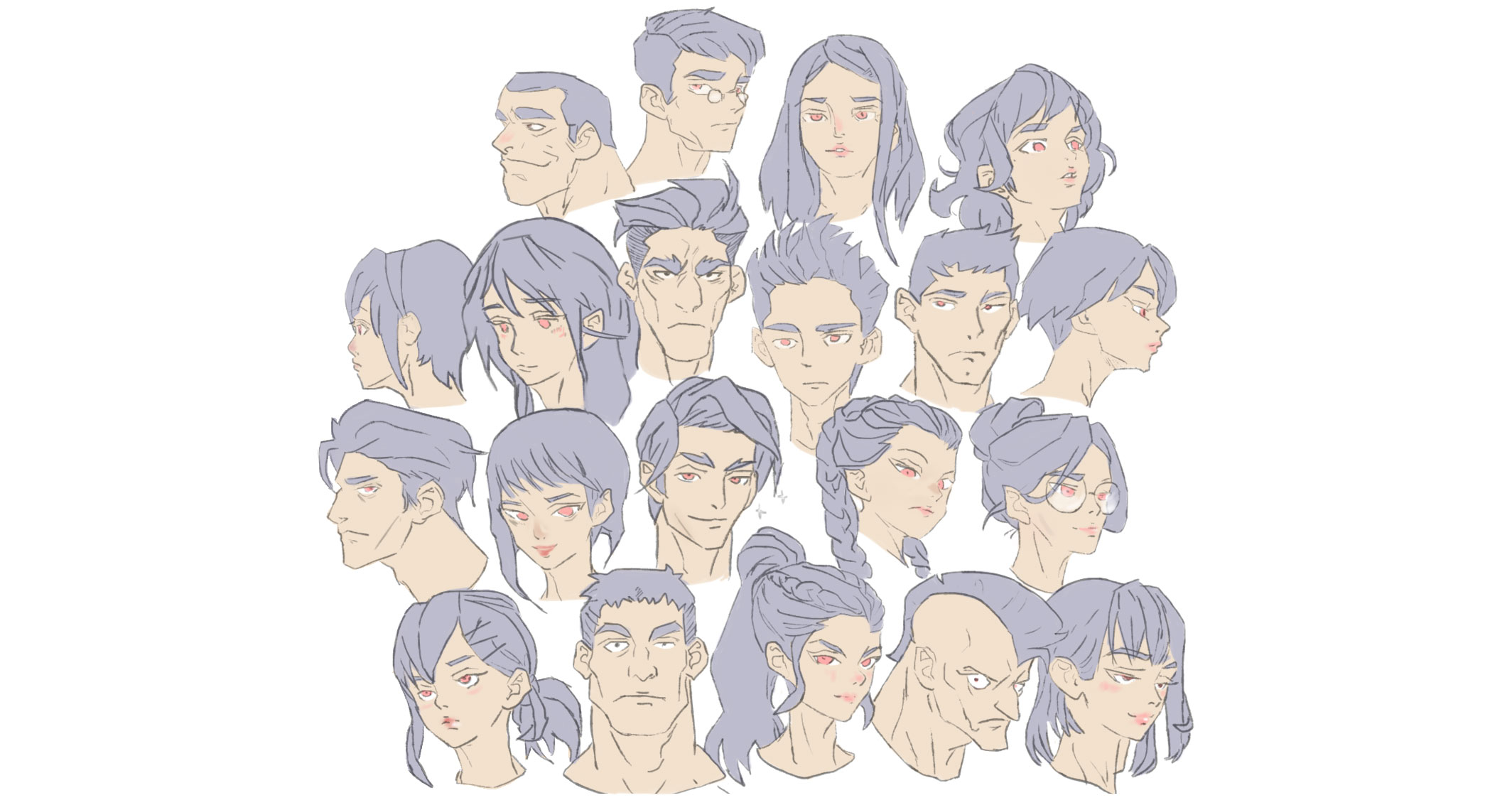
The Key Distortions in Anime Faces
- Eyes are dramatically oversized. In realistic faces, the eyes occupy roughly one-tenth of the total face height. In anime, they can occupy a quarter or more. This exaggeration puts emphasis on the eyes as the primary carrier of emotion and character — anime storytelling communicates through the face, and the eyes are its most expressive element.
- The nose and mouth are simplified to near-abstraction. A realistic nose is a complex 3D structure with nostrils, a bridge, a tip, and cartilage. An anime nose is often just a single line, a small dot, or a minimal triangular hint. This simplification keeps attention on the eyes and prevents visual competition between features.
- The lower face is shorter than realism suggests. In realistic proportions, the nose sits at the halfway point between the eyes and chin, and the mouth sits about one-third of the way between nose and chin. In anime, these distances are compressed — the lower face is shorter, giving characters a larger apparent eye area and a more youthful, expressive silhouette.
- The skull is larger relative to the jaw. The cranium (from the top of the skull to the eye line) is proportionally larger in anime than in realism. This is what creates the characteristic “big-headed” look that’s actually a sophisticated choice — more skull area means more room for hair, which is a major vehicle for character personality.
- Linework is clean and confident. Anime faces use deliberate, decisive lines rather than sketchy or textured marks. The line quality is as important as the proportions.
Knowing these rules means you can choose to break them intentionally for different character types — a more realistic nose for a grounded, mature character, slightly smaller eyes for a stoic type — and have those choices read as deliberate rather than accidental.
Part 2 — Head Construction: The Foundation of Everything
Every anime face — every character, every style, every angle — starts with the same underlying construction. This isn’t a limitation; it’s a framework that makes every subsequent decision faster and more accurate.
Step 1 — Draw the Skull Circle
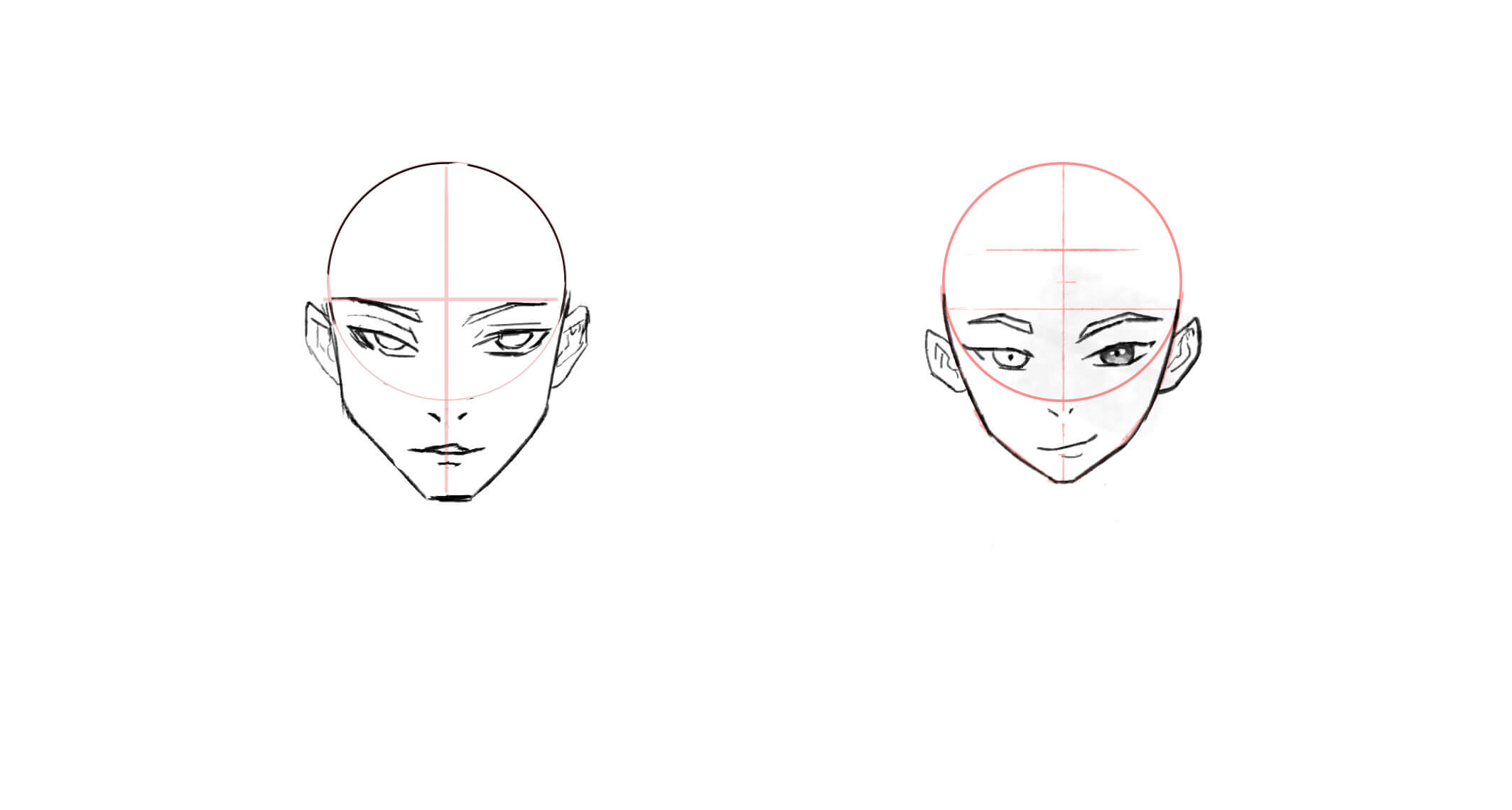
Start with a circle. This represents the upper skull — the cranium — not the entire head. Keep it light; you’ll adjust things as you go. The size of this circle sets the scale of everything else, so if you want a larger or smaller face, adjust the circle, not individual features later.
Don’t fuss over making a perfect circle freehand. A slightly irregular circle is fine and actually looks more natural than a mechanical circle drawn with a compass. Practice drawing circles in one smooth motion from the elbow, not the wrist.
Step 2 — Add the Jaw
From the lower sides of the circle, draw two lines angling inward and downward to a point — the chin. This is where your character type choice begins.
- Female or youthful character: The jaw lines are shorter and angle more sharply inward, creating a narrow, soft, pointed chin. The total distance from circle to chin is roughly half the circle’s diameter.
- Male or mature character: The jaw lines are slightly longer and angle less sharply, creating a wider, squarer chin. The jaw itself may have a slight angular corner where it turns rather than curving smoothly all the way.
Nothing stops you from mixing these — a strong-jawed female character reads as powerful and confident; a soft-jawed male character reads as gentle or androgynous. These are design choices, not rules.
Step 3 — Draw the Cross Guidelines
This is the most important step and the one most beginners skip when they shouldn’t. Draw two guidelines across the face:
- Vertical center line: From the top of the skull straight down through the chin. This marks the face’s axis of symmetry — every feature that appears on both sides of the face must be equidistant from this line.
- Horizontal eye line: A horizontal line across the circle at roughly its halfway point. This is where the eyes sit. Note that it’s the halfway point of the circle, not the halfway point of the total head — because the jaw adds length below the circle, the eyes end up in the upper portion of the total face.
These two lines are your scaffolding. Everything else in the face is positioned relative to them. Drawing features without these guidelines is why faces end up lopsided, with eyes at different heights, or features that don’t sit properly on the face’s surface.

Step 4 — Establish the Eyebrow Line
I always place the eyebrows before the eyes — they’re the anchor that makes positioning everything else easier. Draw the eyebrows just below the horizontal eye line, or right on it depending on how you want the eye area to feel. In anime, eyebrows are typically two simple angled lines, slightly thicker toward the center of the face and tapering toward the outer edge.
Eyebrow placement and angle is your single most powerful tool for shaping a character’s default expression. Flat, even brows read as neutral or calm. Brows angled downward toward the center read as intense or angry. Brows angled upward toward the center read as worried or sad. Set the brows first and your character’s resting personality is immediately established.

Step 5 — Add the Ears
Ears sit between the eyebrow line and the nose line — vertically, they span roughly that distance. Horizontally, they attach at the sides of the skull circle, just where the jaw lines begin. In anime, ears are usually simplified to a rounded C-shape or a slightly flattened oval. If you want to add detail, the main shapes to learn are the helix (outer ridge), the inner concha curve, and the small triangular tragus at the front. Even a minimal version of these three elements makes ears read as convincing.

Step 6 — Place the Eyes
Eyes sit on or just below the horizontal guideline. Use the vertical center line to ensure equal spacing — the inner edge of each eye should be the same distance from the center line. A common spacing rule: leave one eye-width of space between the two eyes. This feels wider than realistic human faces, but it’s correct for most anime proportions.

For detailed eye construction — the anatomy of the iris, highlights, lashes, and the full step-by-step drawing process — see the dedicated guide: How to Draw Anime Eyes.

The iris shape changes the whole mood. Big, round irises feel playful or cute. Smaller, narrow irises feel intense or intimidating. Add highlights for that classic anime sparkle, and darken the top edge of the iris to make the eyes pop.
I usually color my characters, so I skip this step. But if you’re working in line art, you can draw a circle or two in the same spot for both eyes, then fill in the pupil and darken the top of the iris to make it pop. That’s basically the anime starter pack.

Step 7 — Place the Nose
The nose sits between the eye line and the chin — approximately two-thirds of the way down, or at the midpoint between eyes and chin depending on your style preference. In anime, the nose is simplified dramatically. My approach: a single short vertical line for the base of the nose bridge, optionally with a tiny horizontal mark or dot at the bottom to suggest the tip. Some styles use just a dot; others use a small upside-down triangle.
For male characters, the nose line can be slightly longer and more defined. For female characters, it’s often reduced to almost nothing — just a suggestion. The nose is the feature where anime artists have the most stylistic freedom. Find the level of simplification that fits your style and be consistent with it across all your characters.

Step 8 — Place the Mouth
The mouth sits between the nose and the chin — roughly two-thirds of the way between them, or slightly above the midpoint. For a relaxed, neutral expression: a simple curved line for the upper lip shape and a shorter, slightly curved line below for the lower lip or chin shadow. In anime, the mouth is simplified much like the nose — details are implied rather than drawn literally.
The corners of the mouth should align with the inner edge of each eye (or slightly inside them) for a natural proportion. Mouths that extend past the outer edge of the eyes look unnaturally wide. Mouths that don’t extend past the nose look pinched.
Step 9 — Add the Neck
Two nearly parallel vertical lines extending downward from below the jawline — slightly narrower than the jaw width. For female characters, the neck is slender and the lines are more closely spaced. For male characters, it’s wider. The neck connects to the trapezius muscles on each side, which angle outward toward the shoulders — don’t draw the neck as ending abruptly; let it flow into the shoulder area with a slight outward curve.

Step 10 — Clean Up and Refine
Now darken your final lines and erase the guidelines. The features should sit clearly on the face without the scaffolding visible. Check proportions: are the eyes symmetrical? Does the nose sit at the right height? Are the mouth corners in line with the eyes? Make small adjustments now before proceeding to hair and details. It’s much easier to fix proportions at this stage than after hair, shading, and color are added.
Part 3 — Male vs. Female Anime Faces
The construction method above applies to all anime faces. What changes between male and female characters is a set of deliberate adjustments to proportions, line quality, and feature details. These aren’t rigid rules — they’re conventions you can use, break, and combine intentionally.
| Feature | Female / Youthful | Male / Mature |
|---|---|---|
| Jaw shape | Narrow, soft, pointed chin; smooth curves throughout | Wider, more angular; squared chin; jaw corner visible |
| Face length | Slightly shorter overall; more compact lower face | Slightly longer; jaw adds more height |
| Eye size | Larger relative to face; more vertical height in iris | Slightly smaller; less vertical; more horizontal emphasis |
| Eye shape | Rounder; more curved upper lid; more lash detail | Narrower; more angular upper lid; minimal lashes |
| Nose | Very minimal — often just a dot or tiny mark | Slightly more defined line; occasionally a bridge shadow |
| Mouth | Smaller; lips may be slightly fuller in shape | Wider and thinner; less lip definition |
| Eyebrows | Thinner, more arched; delicate | Thicker, flatter, more angular; bolder |
| Cheeks | Softer, rounder; blush marks common | Less defined; sharper plane transitions |
| Neck | Slender, elongated | Wider, more muscular column |
| Line weight | Thinner, softer lines overall | Heavier, more confident linework |
💡 Design principle:
These distinctions are tools, not requirements. The most interesting character designs often deliberately subvert them — androgynous characters, physically imposing women, delicate men — and those choices are expressive precisely because they break from convention. Master the conventions first; then break them with intention.
Part 4 — Drawing Anime Faces from Any Angle
A drawing method that only works straight-on is only half a method. Characters turn, tilt, and look in every direction — your face construction needs to work at every angle too. This is where understanding the head as a 3D form, not a flat diagram, becomes essential.
The key insight is this: the cross guidelines (center line and eye line) are drawn on the surface of a sphere. When the head turns or tilts, those lines curve with the surface. They don’t stay flat — they follow the contour of the rounded skull.

Front View (0°)
The baseline. Both guidelines are perfectly flat and straight. The face is fully symmetrical. This is the easiest angle and the right starting point for learning. Vertical center line is straight up and down. Horizontal eye line is a flat horizontal.
Key check: Both eyes should be exactly the same size and at the same height. Both ears should be the same size and at the same height. If anything is off, the guidelines will show you where.
Three-Quarter View (45°)
The most common angle in anime art — slightly turned, showing more dimension than a front view without losing both eyes. The vertical center line curves to the turned side: if the face turns right, the center line curves toward the right side of the skull. The horizontal eye line remains level but now curves slightly with the face’s surface.
Key adjustments: The far eye (on the turned side) appears narrower — compressed horizontally because we’re seeing less of it. The nose and mouth shift toward the turned side, following the center line. The far cheek becomes partly visible; the near cheek protrudes more. The near ear is more visible; the far ear may be partially hidden by the face or disappear entirely.
The most common mistake at 3/4 view: Placing the far eye at the same size as the near eye. The far eye must be narrower — how much narrower depends on the degree of turn. At a gentle 3/4 view, it’s subtly narrower. At a strong 3/4 view approaching profile, it may be only half the width of the near eye.
Side / Profile View (90°)
Only one eye visible. The face’s silhouette — the profile line — becomes the dominant element. The profile line is a signature: the slope of the forehead, the bridge of the nose, the curve of the lips, the angle of the jaw. In anime, these are stylized: the forehead is often vertical or slightly angled, the nose bridge is minimal, the lips form a distinctive small convex curve.
How to construct it: Start with a circle for the skull. The face in profile doesn’t extend past the front of the circle — the front of the face (forehead, nose tip, lips, chin) falls within the circle’s boundary. Draw a vertical tangent line at the front of the circle: this is roughly where the nose and forehead sit. The jaw and chin extend slightly forward from the circle’s center. The ear sits at the center of the skull circle.
Key checks: The eye in profile is a simplified wedge or narrow curved shape — not a full oval. The iris becomes a thin sliver. The nose in profile is more defined than in the front view — a small bump at the bridge, a subtle tip. The mouth in profile shows the lip shapes as a pair of small convex curves.
Looking Up (Low Angle / Worm’s Eye)
The horizontal eye line curves upward on both sides — like a smile shape. The more extreme the upward tilt, the more pronounced this curve. The nose appears foreshortened — you see more of the underside, less of the bridge. The chin becomes more prominent. More of the underside of features (the bottom of the nose, the underside of the jaw) becomes visible.
Key adjustment: The center line curves slightly backward (away from the viewer) at the top and forward at the bottom. The top of the skull is less visible; the jaw and chin dominate. Features shift upward on the face relative to the chin.
Looking Down (High Angle / Bird’s Eye)
The horizontal eye line curves downward on both sides — like a frown shape. The forehead and top of the skull become more prominent. The chin recedes and appears shorter. Features shift downward — the nose appears lower, and you may see more of the top of the head. The ears shift upward in the visual field.
Key adjustment: This is the most common angle for scenes where a character is feeling vulnerable, small, or being looked down upon — it’s a powerful tool for emotional storytelling through framing.
📌 The universal rule for all angles:
The cross guidelines always curve with the surface of the sphere. Practice drawing just the sphere with the guidelines at different orientations — no features, just the sphere and the two lines. Get those curves feeling natural and every angle becomes much easier. This isolated exercise is what breaks the “only works front-on” limitation.
Part 5 — Drawing Expressions on Anime Faces
The same face construction becomes dozens of different characters through the adjustment of expressions. Anime expressions are deliberate and often exaggerated — more theatrical than realistic, because they need to communicate emotion clearly and quickly, often at small sizes in a panel or frame.
The Four Elements of Expression
Every anime expression is a combination of adjustments to four elements:
- Eyebrows — The fastest communicator. Eyebrow angle and height alone communicate 80% of the emotional read. Low inner brows = anger. High inner brows = worry or sadness. High outer brows = surprise. Flat, low brows = intensity or calm.
- Eyelids — How much of the iris is visible. Wide-open upper lid = surprise, fear, innocence. Half-closed lid = confidence, tiredness, seduction. Narrowed, squinting lid = anger, suspicion, focus.
- Pupil size — Large pupils = softness, emotion, surprise. Small pupils = shock (paradoxically), coldness, aggression, supernatural.
- Mouth shape — The secondary communicator. Open wide = shock, laughter. Downturned corners = sadness, displeasure. Upturned corners = happiness, smirking. Tight, pressed = determination, suppressed emotion.
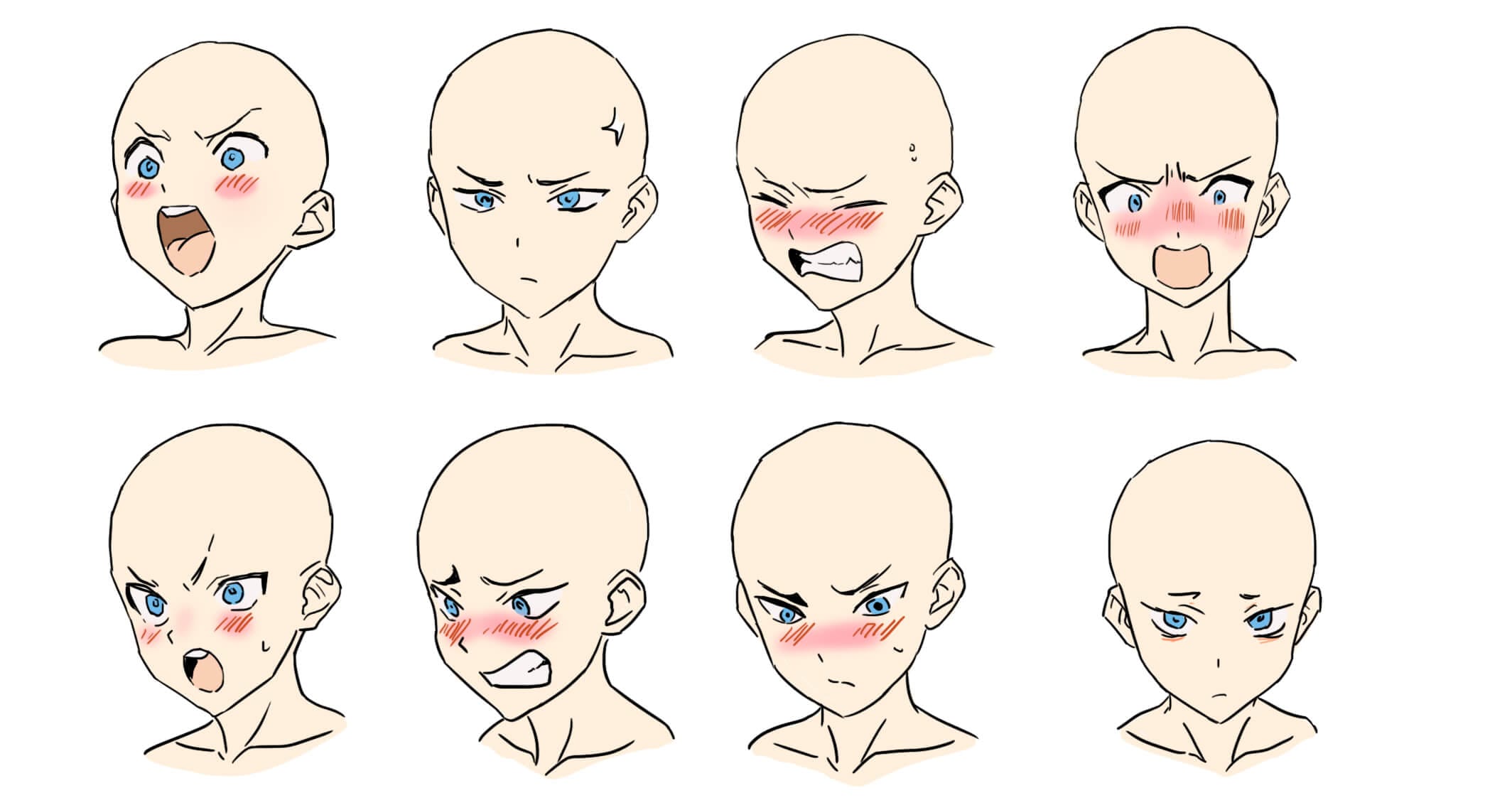
Expression Reference Table
| Expression | Eyebrows | Eyelids | Pupils | Mouth |
|---|---|---|---|---|
| Happy | Slightly raised, gentle | Normal or slightly closed (squinting with smile) | Normal to large | Open smile or closed upward curve |
| Angry | Inner ends sharply lowered — strong V-shape | Inner corners lowered; eyes narrowed | Small, constricted | Tightly pressed or open snarl |
| Sad | Inner ends raised, outer ends lowered | Slightly lowered; eyes look downward | Large, watery | Downturned; trembling corners |
| Surprised | Raised high, arched up | Wide open; upper lid rises dramatically | Very large, dilated | Open circle or wide O shape |
| Scared | Raised, inner ends tilted up and together | Very wide open | Very large or small (shock) | Open or trembling |
| Disgusted | One raised, one lowered (asymmetric) | One narrowed | Normal, looking sideways | Downturned on one side |
| Smug / Confident | One slightly raised; both relaxed | Half-closed; heavy-lidded | Normal to small | Slight smirk on one side |
| Crying | Inner ends raised | Squinted or wide open | Large, watery; tears visible | Open or downturned, trembling |
| Determined | Low and flat, slight furrow between | Slightly narrowed, intense | Small to normal | Pressed tight or firmly set |
| Embarrassed | Normal or slightly raised | Looking down or away | Normal; avoiding gaze | Curved down, flushed cheeks |
How to Push Expressions Further
Anime expressions often go beyond realism for comedic or dramatic effect. Some techniques:
- Super-deformed (SD) mode: For comedic reactions, the face temporarily shifts to a 2–3 head proportion with extremely simplified, exaggerated features — dot eyes, huge open mouth, tiny nose. Used for shock, anger, embarrassment, or comedic moments.
- Blush marks: Simple horizontal lines or pink ovals on the cheeks indicate embarrassment, shyness, excitement, or physical exertion. Positioned below the eyes, aligned with the nose.
- Vein marks: A stylized “X” or angular mark at the temple indicates suppressed anger or frustration.
- Sweat drops: A single teardrop shape at the side of the head or face indicates nervous embarrassment or awkwardness.
- Sparkle effects in eyes: Stars or sparkle shapes replacing the iris for dreamy, awestruck, or romantic moments.
Part 6 — Facial Feature Deep Dives
The Nose in Detail
Anime noses are one of the most stylistically variable features — different artists handle them completely differently. Here are the main approaches:
- Single vertical line: The most minimal approach. One short vertical mark indicates the base of the nose bridge. Used in many shounen and casual anime styles.
- Dot or tiny mark: Just a small dot at the tip position. Common in very cute or simplified styles, particularly for female characters.
- Small triangle or inverse triangle: A tiny triangular shape at the tip of the nose, sometimes with a horizontal mark at the base. More definition than a dot, less than a realistic nose.
- Two nostrils + bridge line: A slightly more detailed approach — a short horizontal mark for the base, two small curved lines for the nostrils. Used for more mature or realistic anime styles.
- Profile view nose: In profile, the nose has the most visible structure. A small bump at the bridge, a short outward curve at the tip, and a subtle inward curve back to the lip area.
Pick one nose style and use it consistently across all your characters. Inconsistency in nose style makes your art look unfinished.
The Mouth and Lips in Detail
Like the nose, anime mouths are simplified — but they communicate enormous amounts through shape alone.
- Closed neutral mouth: A single curved line, very slightly upturned at the corners. The most common resting expression. Keep it short — the corners should fall roughly under the inner edges of the eyes.
- Closed smile: A more curved upward line, corners clearly lifted. Can add a small parenthesis-shaped curve at each corner for a fuller smile.
- Open mouth: For talking or expressions — the upper lip shape (a gentle M or W curve) sits on top; the lower lip is a simpler convex curve below. Teeth are represented as a white rectangle within the opening, with a tongue line if needed.
- Teeth detail: In anime, teeth in an open mouth are usually not drawn individually — the whole row is represented as a single white shape. Individual teeth are drawn only for comedic effect or specific character design purposes (sharp vampire teeth, etc.).
- Lip detail: Some styles include a fuller upper lip shape — a subtle M curve at the top of the mouth line — and a rounded lower lip line below. This adds femininity and sensuality without overdrawing.
Ears in Detail
Ears are often an afterthought in character drawing but are visible from many angles and worth learning properly. The simplified anime ear has three main elements:
- The outer helix: The large C-shaped outer rim of the ear. This is the dominant shape — the outline of the entire ear.
- The inner concha curve: A smaller curved shape inside the helix, like a smaller C nested inside the larger one.
- The tragus: A small triangular or oval bump at the front of the ear opening, where the ear meets the cheek. Often just a small curved mark.
Even at the simplest level of detail, including these three elements makes anime ears read as convincing rather than like a placeholder shape stuck to the side of the head.
Part 7 — Shading and Rendering Anime Faces
Once the line drawing is complete, shading transforms a flat face into something dimensional. Anime face shading follows specific conventions that differ from realistic portraiture — simpler, more graphic, and very deliberate.
Establishing the Light Source
Before shading anything, decide where your light is coming from. The most common setups in anime:
- Upper front light (most common): Light from slightly above and in front of the face. Leaves minimal harsh shadows — the forehead is lit, a subtle shadow under the nose, under the lower lip, and under the chin.
- Upper side light: Light from one side and slightly above. Creates a stronger shadow on the opposite side of the face — the shadow side. Adds dramatic dimension and is common in more serious or atmospheric character art.
- Rim light / back light: Light from behind the character, with a secondary fill light on the face. Creates a glowing edge on one side with softer illumination on the face. Used for emotional or cinematic moments.
Standard Anime Face Shading Areas
Skin Base Color
Fill the entire face with a flat base skin tone. No shading yet — this is your neutral, mid-lit skin color. Keep a separate layer below the linework for all color fills.
Shadow Layer (Multiply)
On a layer set to Multiply blend mode, paint hard-edged shadow shapes in the key areas: under the fringe of hair that falls across the forehead (a strong cast shadow from hair is one of the most characteristic elements of anime face shading), under the nose, under the lower lip, at the sides of the face on the shadow side, and under the chin where it meets the neck. Anime shadows are typically hard-edged and graphic rather than gradual — they’re shapes, not gradients.
Blush / Cheek Color
A soft, warm pink or peach on the cheeks — oval shapes beneath the eyes. In anime, this is almost universally applied with a soft brush at low opacity. It adds warmth, youth, and life to the face. Even a very subtle application makes a significant difference to how the face reads.
Eye Shading
Eyes get the most detailed shading on the face — see the dedicated guide for the full eye coloring process: How to Draw Anime Eyes. The key elements: upper shadow across the iris (cast shadow from the eyelid), highlight placement, and the glassy luminosity of the iris itself.
Hair Shadow on Face
If the character has bangs that cross the forehead, cast a shadow from the hair onto the forehead skin — this is one of the most recognizable and characteristic elements of polished anime face art. On a Multiply layer, paint a soft-edged shadow shape that follows the underside of the hair fringe. This simultaneously grounds the hair to the head and adds dimension to the forehead area.
Highlights on the Face
On a Screen or Add layer, add subtle highlights to the most lit surfaces: the bridge of the nose (a small dot or short vertical stroke), the cupid’s bow of the upper lip (a tiny highlight mark), the tip of the chin, and the apples of the cheeks if using upper-front lighting. These highlights are very small and subtle compared to eye highlights — they suggest dimensional form without competing with the eyes as the face’s visual focal point.
Part 8 — Common Mistakes and How to Fix Them
❌ Eyes at different heights or sizes
✅ Fix: Always draw and confirm the horizontal eye guideline before placing either eye. Mark the width of each eye lightly before adding detail — confirm they’re equal. Draw both irises simultaneously before adding any detail to either one. If using digital tools, use the symmetry/mirror function during the sketch phase.
❌ Features placed too high on the face (not enough forehead)
✅ Fix: This happens when the eye line is placed too high on the skull circle. Remember: the eye line is at the halfway point of the circle, not the halfway point of the total head. Because the jaw extends below the circle, the eyes end up in the upper portion of the overall face. When in doubt, look at how much space is above the eyes versus below — there should be significantly more space above.
❌ The jaw is too wide, making the face look blocky
✅ Fix: The jaw lines should angle more sharply inward than feels natural at first. The chin in anime is narrower and more pointed than in realistic faces. If the jaw feels too wide, bring the jaw lines in more steeply, and make the chin point sharper. The total width of the chin should be noticeably narrower than the width of the skull circle.
❌ The nose and mouth float disconnected from the face
✅ Fix: Use the center line to anchor them. The nose sits exactly on the vertical center line (front view) or shifts toward the turned side (3/4 view). The mouth is centered on the same line. If these features wander off the center line, the face loses structural coherence. In 3/4 view especially, the center line is what tells you how far to shift features toward the turned side.
❌ Faces look fine front-on but fall apart at 3/4 or profile
✅ Fix: Practice the sphere-and-guideline exercise separately — draw a sphere and place the cross guidelines at different orientations without adding any facial features. Get comfortable with how the lines curve with the surface. Once the curved guidelines feel natural, add features to them. The features follow the curves; the curves are the hard part to learn.
❌ All expressions look the same — just a different mouth
✅ Fix: Expressions live primarily in the eyebrows and eyelids, not the mouth. The mouth is secondary. Practice drawing the same face 10 times with only the eyebrows and eyelids changed — no mouth changes at all. Notice how much the emotional read shifts from just those two elements. Then add the mouth as the final layer of expression, not the first.
Part 9 — Practice Plan for Anime Faces
Faces improve through volume — drawing many faces, not spending a long time on each one. Here’s a structured practice plan that builds the right skills in the right order:
| Week | Focus | Exercise | Daily Time |
|---|---|---|---|
| Week 1 | Head construction | Draw 10 front-view heads per day — circle, jaw, guidelines only. No features. Focus on consistent proportions and jaw shape. | 20 min |
| Week 2 | Feature placement (front view) | Add eyes, eyebrows, nose, mouth, ears to your Week 1 heads. Draw 8 faces per day. No hair or shading — just feature placement and proportion. | 25 min |
| Week 3 | 3/4 view | Draw 8 heads at a gentle 3/4 turn per day. Focus on the curved guidelines and the far eye compression. Don’t rush to add features — get the structure right first. | 30 min |
| Week 4 | Expressions | Draw the same face 8 times per day with a different expression each time. Use the expression table above. Focus on eyebrow and eyelid changes first. | 30 min |
| Week 5 | Male vs. female differentiation | Draw 5 female faces and 5 male faces per day. Focus on jaw width, eye size/shape, and eyebrow weight differences. Draw them side by side for easy comparison. | 30 min |
| Week 6 | Full faces from imagination | Draw 4 complete faces per day from imagination — no reference. Include hair, a full expression, and light shading. Take at least one to a digitally colored finish. | 45 min |
| Ongoing | Angle variety | Once per week: draw the same character face from 5 different angles (front, 3/4, profile, looking up, looking down). This is the exercise that builds true spatial understanding of the head. | 30 min |
💡 The single most useful practice habit:
Fill pages with faces. Not one careful face per session — pages of them. Quick, loose, building speed. Speed drawing faces (30–60 seconds each) trains your hand to place features correctly without second-guessing. Slow, careful faces train precision. You need both. Aim for at least 5–10 faces per practice session, even if only one of them is taken to a careful finish.
Frequently Asked Questions
How long does it take to get good at drawing anime faces?
With daily practice of 20–30 minutes, most beginners draw recognizable, reasonably proportioned anime faces within 4–8 weeks. Drawing faces that feel expressive, characterful, and consistent across multiple angles typically takes 3–6 months of regular practice. The skill that takes longest — drawing faces at any angle from imagination without reference — usually requires 6–12 months of deliberate practice before it feels comfortable. The pace varies, but the single biggest factor is drawing volume: artists who draw many faces (even quick, rough ones) improve faster than those who spend a long time on each face but draw fewer overall.
Should I use the circle method or another head construction method?
The circle method (skull sphere + jaw) is the most widely taught approach for anime faces, and it’s the one I use because it naturally handles multiple angles — the sphere gives you a 3D reference point that flat methods don’t. Other methods exist: some artists use an oval or egg shape instead of a circle, which works fine for front-view faces but is harder to work with at angles. Some use a box-based construction (Andrew Loomis method adapted for anime). Try the circle method first — if it doesn’t click after a few weeks, experiment with alternatives. The best method is whichever one you’ll actually use consistently.
Why do my anime faces look “off” even when the proportions seem right?
A few common causes that aren’t proportion-related: line weight inconsistency (all lines the same weight; the upper eyelid should be the heaviest line on the face, followed by the jaw, with features being lighter), lack of a clear focal hierarchy (if the nose is as prominent as the eyes, the face has no clear focus), the eye style doesn’t match the overall face style (heavily detailed realistic eyes on a minimalist face, or vice versa), or the face looks flat because there’s no depth indication (the nose and ear positions need to suggest that the face is a 3D form, not a flat diagram). Checking each of these systematically usually identifies the issue.
How do I make all my characters look different from each other?
Character differentiation in anime comes from a combination of: face shape (the jaw line and overall skull proportions), eye style (shape, size, how open they sit), default expression (eyebrow resting angle), and distinctive feature details (a specific nose shape, lip style, ear detail). Hair style is the most immediately readable differentiator, but if two characters have the same face without their hair, they’re essentially the same character. Build a small “design sheet” for each character that documents their specific face shape and feature style choices, so you can maintain consistency across many drawings.
What’s the hardest angle to draw an anime face from?
For most beginners, the three-quarter view is paradoxically harder than the full profile — because it requires understanding exactly how much to compress the far side of the face, how far to shift the features toward the center line, and how the jaw asymmetry works, all at once. The profile (full side view) is actually easier once you understand that the face fits within the boundary of the skull circle. The most difficult angle overall is the low three-quarter (slightly from below and to the side), because it combines the horizontal eye line curve, the vertical center line curve, the feature shift of the 3/4 view, and the foreshortening of the low angle simultaneously.
How do I draw a character looking to the side without it looking wrong?
When a character looks to the side (eyes shifted in their sockets without the whole head turning), the pupils and irises shift while the eyelids and brow stay in place relative to the head. The visible white of the eye (sclera) increases on the side the eyes are moving away from, and decreases on the side they’re moving toward. In anime, the iris may partially disappear behind the eyelid on the side it’s moving toward — cut off by the lid edge. The eyebrow typically stays neutral during a simple sideways gaze. To avoid the “floating eyes” problem, make sure the irises still sit correctly within the eyelid openings, and that they’re both looking in the same direction.
How do I draw tears and crying correctly in anime?
Anime tears are stylized and fall in specific patterns depending on the emotional intensity. Light tears: a small shiny liquid shape along the lower eyelid, with a single teardrop falling from the outer corner. The tear follows the curve of the cheek downward. Heavy crying: tears stream from both corners of the lower lid, sometimes in multiple streams. The eyes may squint or close partially. Extreme crying (comedic or very emotional): large, fountain-like streams of tears from both eyes, sometimes rendered as almost cartoonish jets of water. The skin around the eyes may turn slightly pink/red with the blush tool. Tears catch light — add a small highlight to each tear drop or stream.
How important is it to study realistic human anatomy for anime faces?
More important than it might seem — but you don’t need to master it before drawing anime. Understanding where the skull bones are, how facial muscles attach, and how fat deposits on the cheeks and around the eyes shape the face helps you make intentional choices about your stylization rather than guessing. For example: knowing that the realistic nose bridge sits at the inner corner of the eye explains why anime nose simplification still “reads” correctly — the position is accurate even if the detail is omitted. A few weeks spent studying basic facial anatomy (not full medical-level detail, just the main shapes) will improve your anime face drawing more than those same weeks spent copying more anime faces.
How do I draw older or aged anime characters?
Aging in anime is communicated through a combination of: sharper, more angular jaw and cheekbones; smaller eyes with heavier upper lids; visible wrinkles drawn as fine lines at the outer eye corners and around the mouth; heavier, straighter eyebrows; more defined nose bridge; and thinner lips. Hair graying (white or grey streaks) is also a common visual shorthand. The exaggerated youthfulness of standard anime proportions means aging cues need to be deliberate and clear to read — a few well-placed wrinkle lines and a squarer jaw communicate “older character” immediately even in an otherwise stylized face.
Is it okay to have a consistent “face formula” or should every character look unique?
Having a consistent base formula is not only okay — it’s how professional anime artists work. Most illustrators have a signature face shape and eye style that appears across all their characters. What creates character differentiation is the deliberate variation of a few key elements within that formula: jaw width, eye opening, brow style, nose size, and of course hair. Think of your face formula as a template with dials you can adjust. A wide jaw dial up = more imposing character. A smaller eye dial = cooler personality. The formula is the consistency; the dial adjustments are the individuality. This is more efficient and more recognizably “your style” than trying to design every face from scratch.
What to Learn Next
The face is the heart of character drawing — but it sits within a complete figure. Here are the next guides to build your full skill set:
- How to Draw Anime Eyes — the most detailed and expressive element of the anime face, covered completely with step-by-step eye construction, coloring, and expression
- How to Draw Anime Hair — hair is the second major vehicle for character personality and style; the complete guide to construction, flow, and shading
- Complete Anime Drawing Guide for Beginners — the full roadmap from face to full body, including proportions, clothing, and character design
- How to Draw Clothing Folds — once the face and head are solid, clothing folds are the next skill that elevates full character illustrations
- Color Theory Made Simple — understanding color makes face shading choices (skin tones, shadow colors, eye colors) feel intentional rather than arbitrary
Faces are the part of drawing that never stops being interesting. Every new character is a new design challenge. Every new expression is a new puzzle. Keep filling pages with faces — quick ones, slow ones, front views, 3/4 views, expressions you’ve never tried. The more you draw, the more fluent the language becomes. 🖊
Discover More Posts
Keep exploring stories, insights, and creative notes from my journey as an artist. Check out the latest blog entries and find topics that inspire your own process.
How to Draw Stunning Anime Clouds
Learn to draw anime-style clouds with this easy, step-by-step cloud tutorial. You’ll pick up tips on shapes, color, and composition—plus get free cloud brushes to use in your own art.
How to Paint Realistic Metal
Learn how to paint realistic metal with this step-by-step guide. From base colors to to lighting and reflections, get practical tips for your artwork shine, literally.

Color Theory Made Simple: A guide for Beginner Artist
New to Digital painting? This beginner-friendly guide breaks down hue, value, saturation, color harmonies, and practical tips to help you choose better palettes and level up your art.