
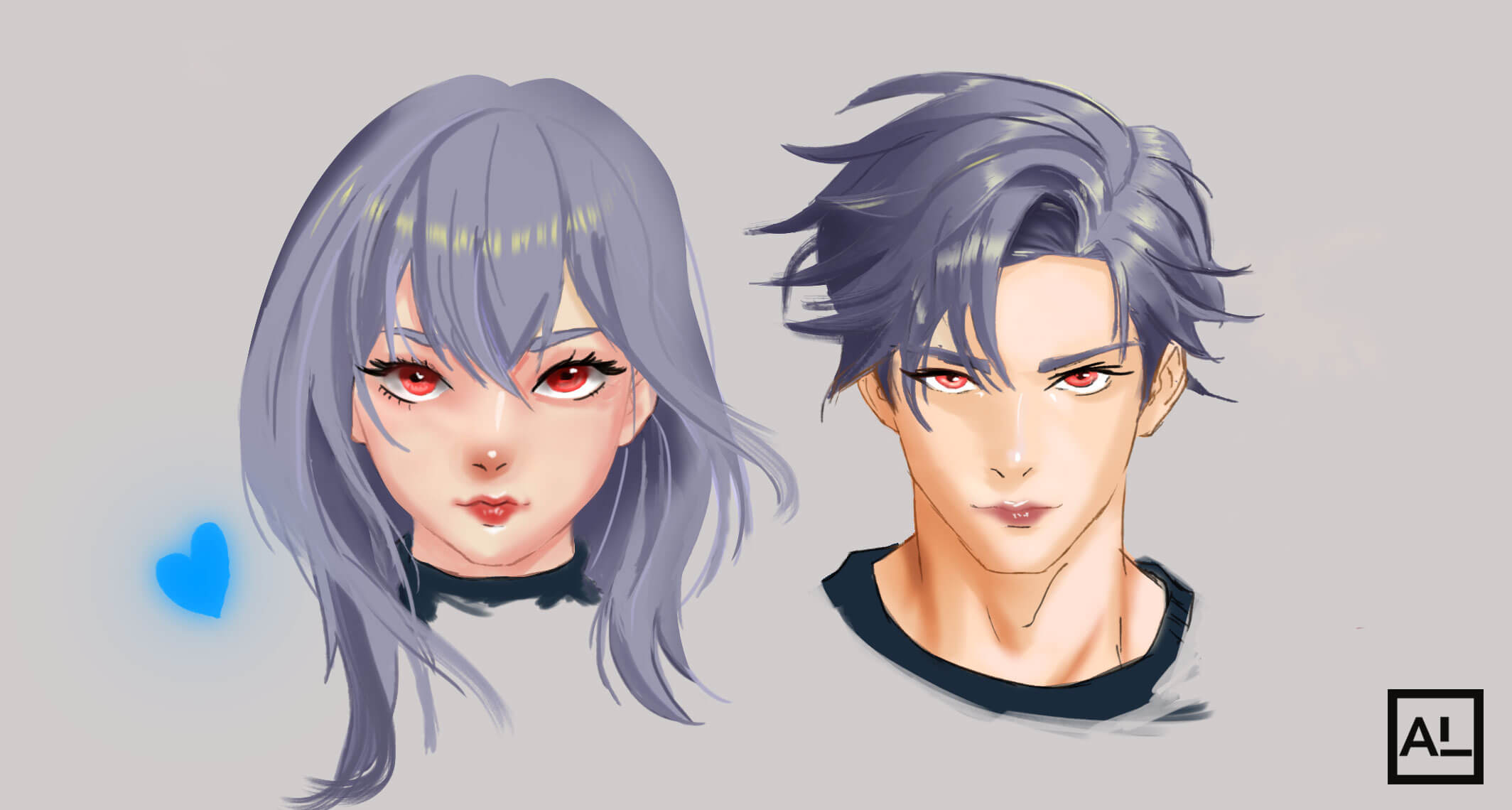
By:
Hair is one of those things that separates a character sketch that looks like a rough draft from a character sketch that looks like a person. Get it right and the whole face clicks into place. Get it wrong and no matter how well you’ve drawn the eyes and expression, something feels off about the whole piece.
I’ve been drawing anime characters since high school — starting with manga I wrote myself, drawing characters in pen with borrowed materials. Hair was one of the things I struggled with the longest, and for a specific reason I’ll explain shortly. Once I understood the actual mistake I was making, the fix was immediate and the result was noticeably better.
This guide covers everything: the underlying structure of anime hair, the six core steps from blank head to finished hair, how to draw every major hair style, my actual digital workflow including the mistake that took me a while to fix, how to handle lighting and shading, and a practice plan that builds real skill rather than just producing finished pieces you can’t reproduce.
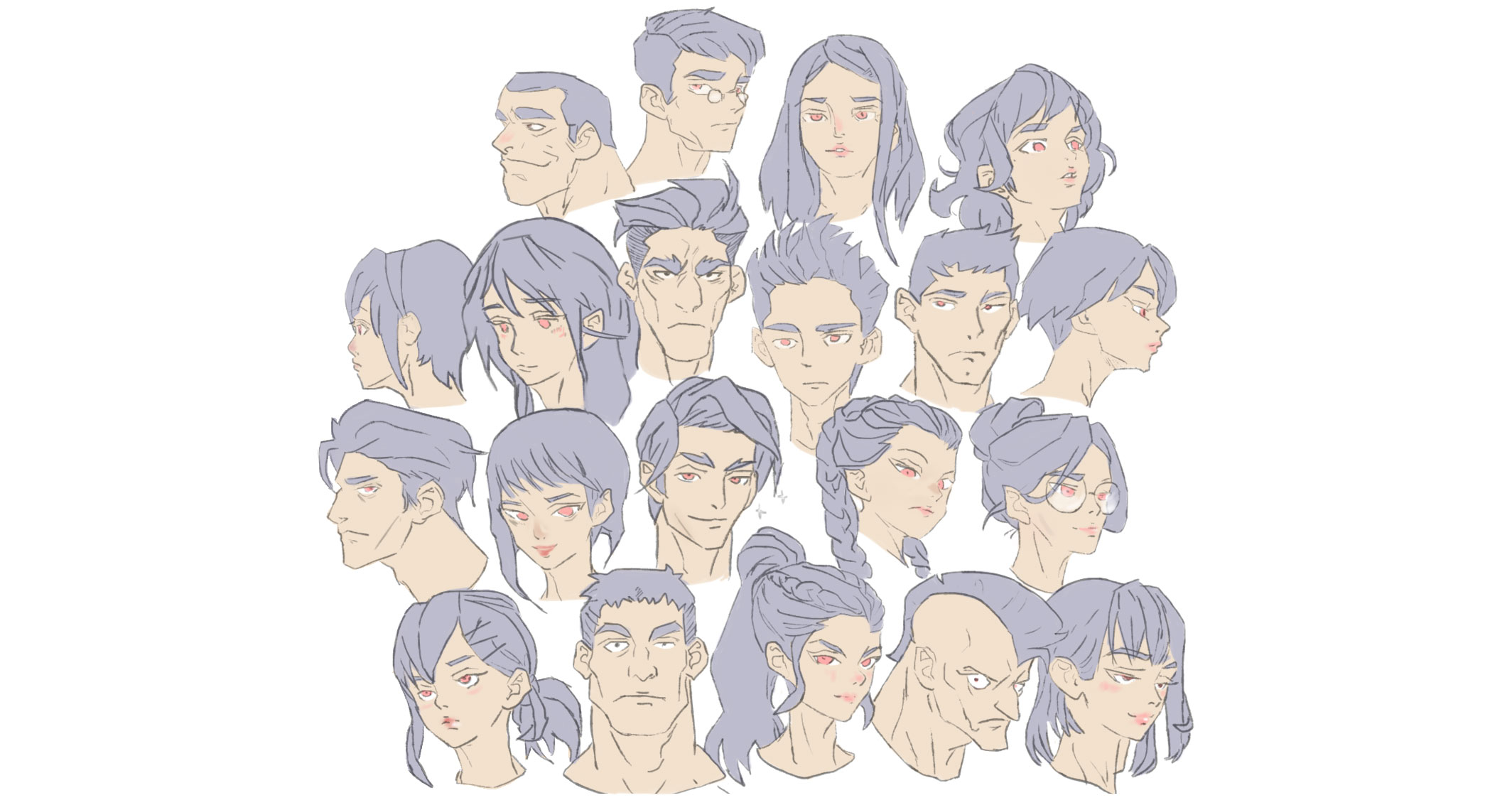
📌 What you’ll need:
Pencil and sketchbook for traditional practice, or any drawing software with a tablet for digital. The concepts in this guide apply equally to both. For digital, Clip Studio Paint, Krita, and Procreate all work. Canvas setup guide: Canvas Size for Digital Art.
Part 1 — The Biggest Mistake Artists Make With Anime Hair
Before the steps, before the techniques — I want to address the specific mistake that I made for too long and that I see beginners make constantly. Understanding this mistake is worth more than any individual technique.
💬 From Allard — the over-rendering problem:
When I was drawing anime hair early on, I drew every single strand one by one. Every individual hair. I thought more detail meant better hair. What actually happened was that the hair became the most rendered element in the entire piece — and the rest of the character stayed at the normal anime style level. The hair looked almost realistic while the face and clothes looked stylized. It was off. The hair was overpowering the whole artwork instead of supporting it. The fix was to stop thinking in strands and start thinking in shapes. Groups. Clumps of hair that move together as a unit, like ribbons flowing in the same direction. Once I drew the big shapes first and added detail selectively — not everywhere — the hair started looking like anime hair instead of a detailed hair study attached to an anime face. The lesson: anime hair is not about detail. It’s about shape, flow, and selective highlight. You can draw convincing anime hair with three large shapes and two highlight strokes. You cannot fix over-rendered hair by adding more.
Keep this principle in mind throughout everything that follows. When in doubt, do less. Simplify. The big shapes are the hair. The detail is seasoning, not the meal.
Part 2 — How Anime Hair Actually Works (The Mental Model)
Anime hair isn’t drawn strand by strand. It’s built in clumps and sections that each behave as a single flowing unit. Before you draw a single line, you need the right mental model — otherwise the technique is just steps you follow without understanding why they work.
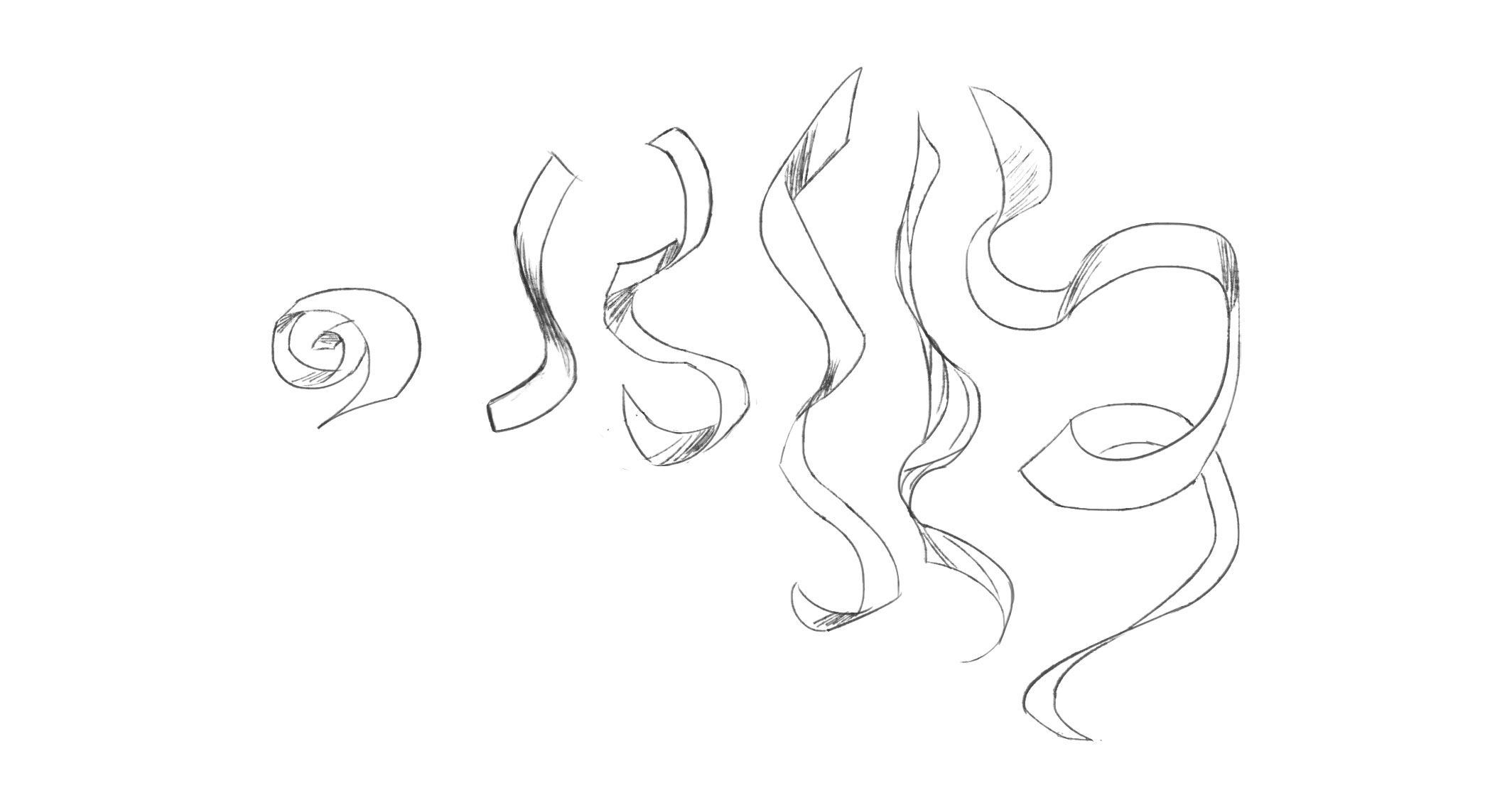
Think Ribbons, Not Strands
The single most useful way to think about anime hair is as ribbons twisting in space. Each clump of hair is a ribbon: it has a starting point at the scalp, it flows outward following gravity and movement, it tapers to a point or a tip at the end, and it can overlap, twist, and fold on itself. When you think of hair this way, you automatically get the flow, the taper, and the sense of three-dimensional movement that makes anime hair feel alive.
A ribbon has a leading edge and a trailing edge. It has a highlight on the surface facing the light and a shadow on the surface turning away. It narrows toward the ends. These properties — when applied to hair clumps — produce anime hair that has genuine volume and direction without requiring you to draw every strand.
The Three Zones of Anime Hair
Every anime hairstyle, regardless of how complex it looks, can be broken into three zones that you always handle separately:
- Front (Bangs) — The hair that falls across the forehead. This frames the face and is the most visually prominent hair section. It interacts with the forehead and sometimes crosses the eyebrow line. The shape of the bangs defines the character’s personality more than any other hair element.
- Sides — The hair that falls beside the face, often behind or in front of the ears. This connects the front bangs to the back volume and creates the silhouette of the head from three-quarter and side views.
- Back and Crown — The main body of hair flowing from the crown of the skull. This is the largest volume zone and determines the overall hairstyle — whether it’s long and flowing, short and close to the skull, spiky upward, or gathered into a ponytail.
Always think about these zones separately when planning a hairstyle. The front bangs flow forward and down. The sides flow downward or outward from the temple. The back flows from the crown in whatever direction the style dictates. They all originate from the skull and they all obey gravity — unless wind, water, or magical energy is involved.
The Hair Sits On a Sphere
This sounds obvious when stated plainly but it’s the thing most beginners forget in practice: hair wraps around a three-dimensional skull. It’s not flat. It has volume above the skull line. When you draw the head from different angles, the hair has to curve with the skull’s surface, not float flat in front of it.
The practical check: when you’ve drawn the hair, look at the crown area. Does the hair have a gentle dome shape above the skull that suggests volume? Or does it sit flat on the skull line like a cap? Volume above the skull line — even a small gap — is what gives hair its natural fullness.
Part 3 — The Six Steps: From Blank Head to Finished Hair
Step 1 — Establish the Hairline
Before drawing a single hair strand, mark where the hairline sits on the skull. The hairline is roughly one-third of the way down from the top of the skull circle — about the same distance above the eyebrows as the eyebrows are above the nose. This is the Loomis method guideline and it holds for most anime proportions.
The hairline position determines how much forehead the character shows. A high hairline (hairline drawn higher up the skull) creates more forehead — reads as elegant or mature. A low hairline creates less forehead — reads as youthful or childlike. Don’t place it too high (the character looks bald with a hair wig) or too low (the character looks like they’re wearing a helmet).
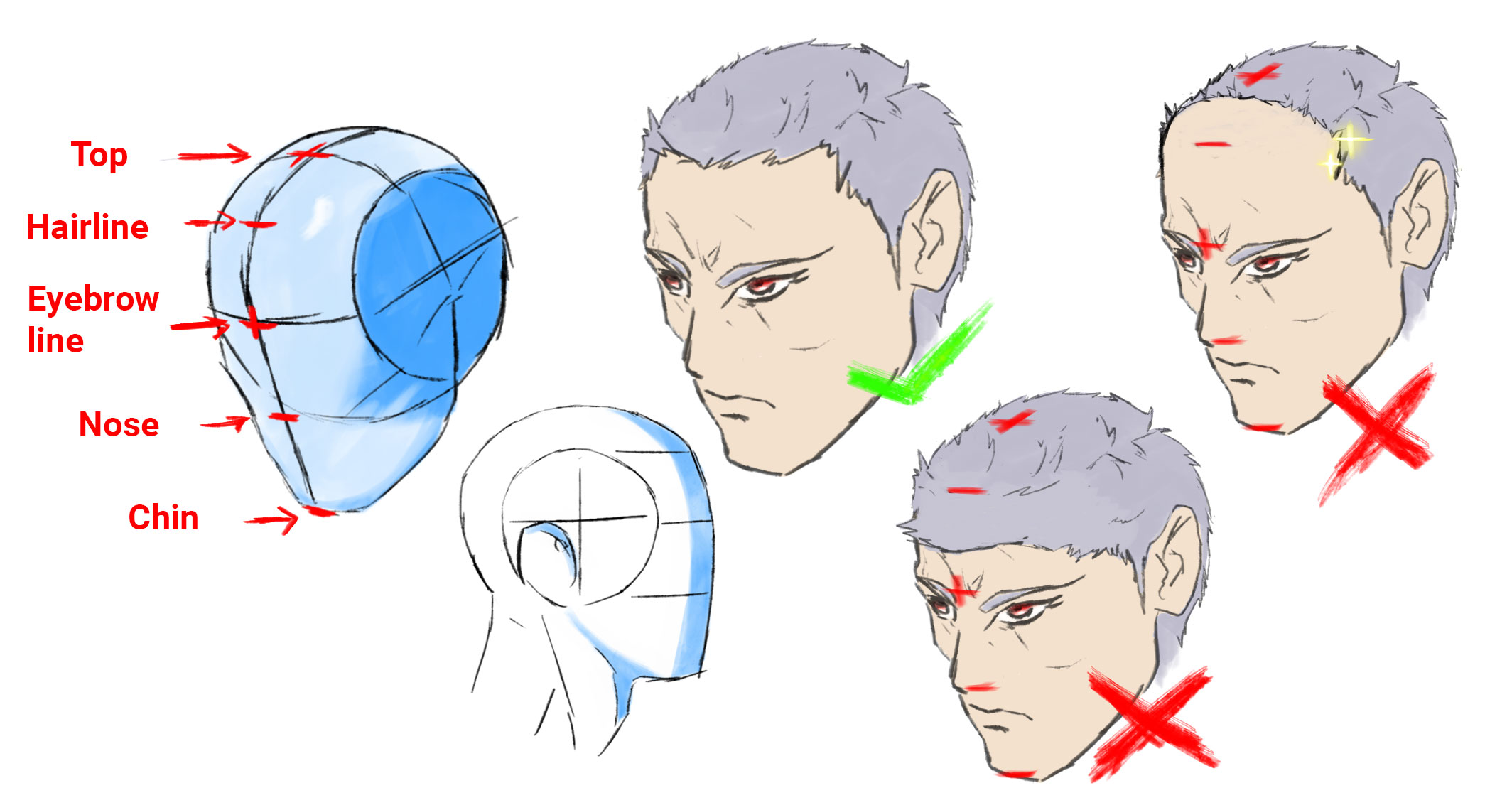
Important: the hair doesn’t start at the hairline and sit flat against the skull. It starts at the hairline and immediately projects outward from the skull surface, creating volume. Always leave a small gap between the skull circle and the hair outline.
Step 2 — Block the Overall Hair Shape
Before any detail, draw the overall silhouette of the hair as a single large shape. This is the most important step and the one most beginners skip. The overall shape — how wide the hair is, how far it extends from the skull, where it falls in the composition — determines whether the hairstyle looks right from across the room.
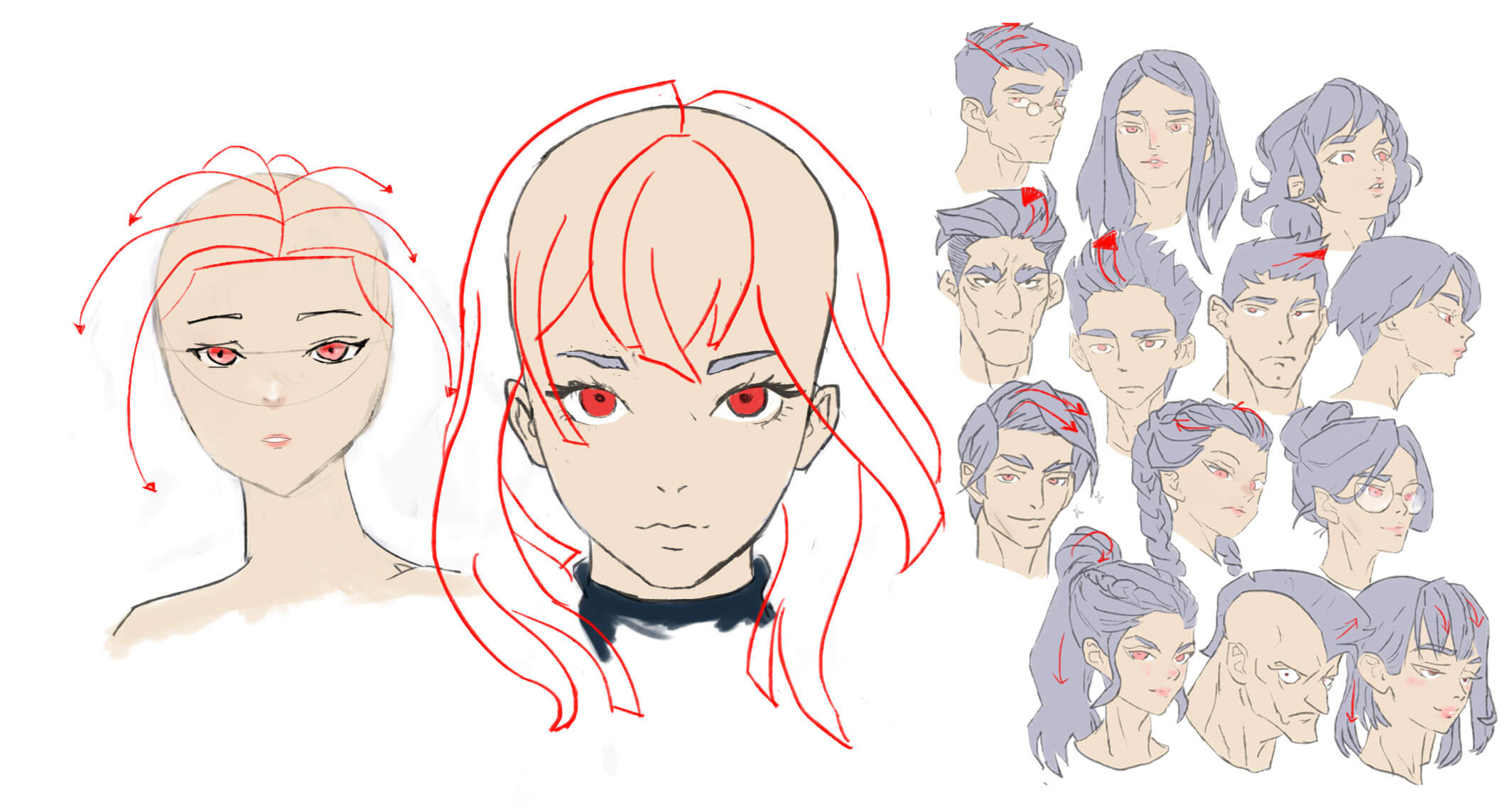
Draw a loose outline of the entire hair mass. For long hair, this silhouette reaches down to the shoulders or further. For short hair, it stays close to the skull with specific angles and points. For spiky hair, the silhouette has multiple upward projections. At this stage you’re designing the shape, not the detail.
Evaluate this shape before moving on. Does it read as the hairstyle you intend? Is the silhouette interesting and distinctive? A boring silhouette produces boring hair no matter how much detail you add. An interesting silhouette reads well even with minimal detail.
Step 3 — Place the Part and Establish Flow Direction
The parting line is the origin point of all hair flow. Everything radiates outward from the part. Middle part: hair flows outward symmetrically to both sides. Side part: hair flows predominantly to one side with a smaller section on the other. No visible part (common in spiky styles): hair flows upward and outward from the crown.
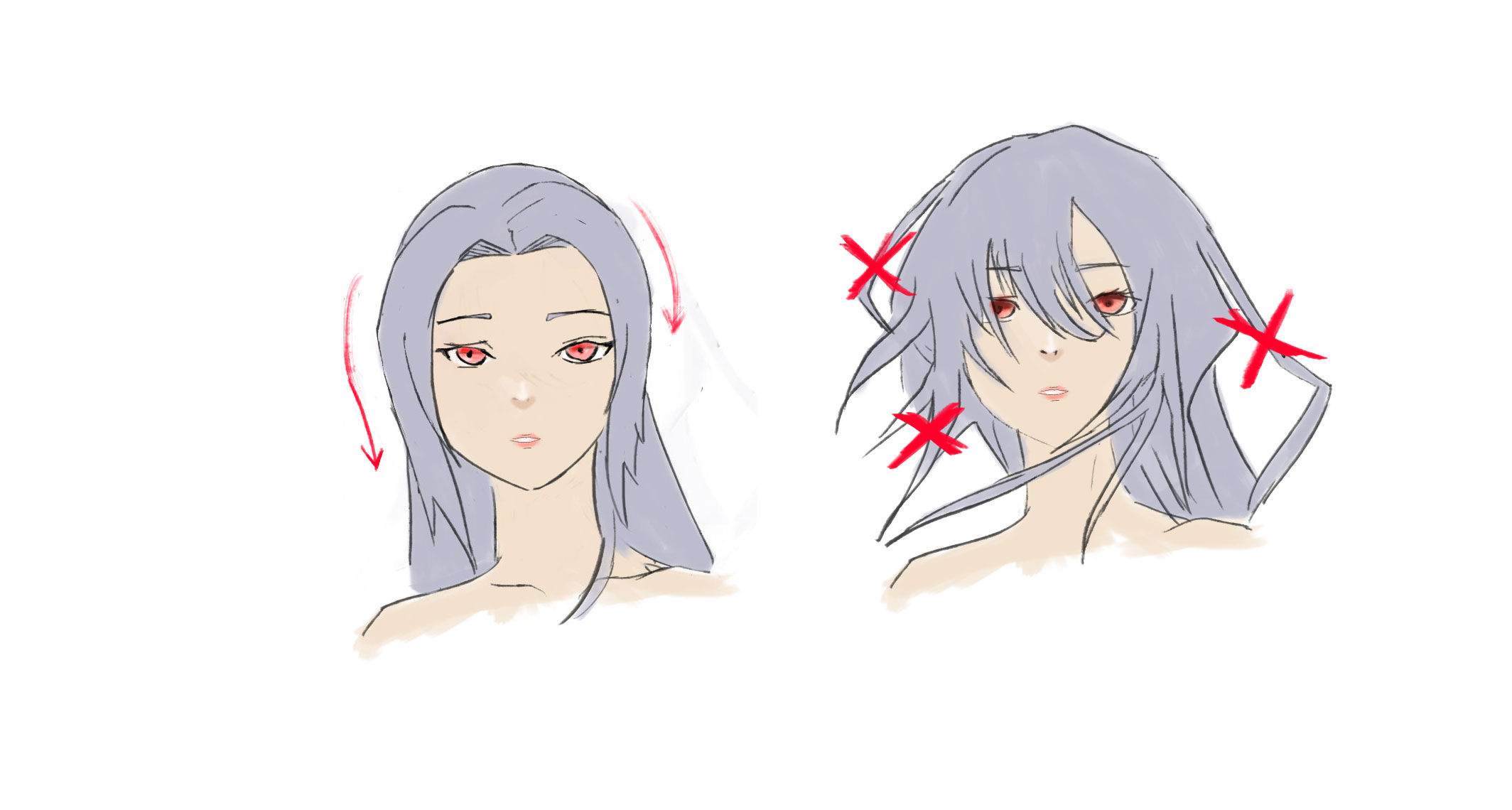
Once you’ve established the part, draw light directional lines flowing outward from it through the entire hair mass. These are not final lines — they’re direction guides. Think of them as the current in a river. The individual hair clumps (ribbons) will follow these currents. Conflicting flow directions within one section of hair look wrong because they fight the gravity and movement logic of the hairstyle.
Step 4 — Divide Into Major Clumps
Now divide the overall hair shape into major clumps — the large groups of hair that move together. These are your ribbons. For most anime hair, you’re looking at 5–10 major clumps across the entire head, not dozens of individual strands.
Each clump:
- Originates from the part or from the crown area
- Has its widest point near the scalp and tapers toward the tip
- Follows the directional flow you established in Step 3
- Overlaps adjacent clumps — hair isn’t uniformly separated
- Has a slightly curved, organic shape rather than perfectly straight edges
The spaces between clumps — the negative space where you see through to what’s behind — are as important as the clumps themselves. These gaps give the hair visual breathing room and create the impression of individual strands without drawing each one.
Step 5 — Add Secondary Clumps and Tips
Within and between your major clumps, add smaller secondary clumps that add complexity without overpowering the main shapes. These are narrower ribbons that sit at the edges of major clumps, emerge from underneath them, or break off at the tips.
Tip design is where a lot of character personality lives in anime hair. Sharp, angular tips read as energetic or aggressive. Soft, rounded tips read as gentle. Split tips (a clump that divides into two at the end) add visual complexity. Long, flowing single tips suggest elegance or length.
At this stage you’re still working in shape rather than strand detail. The secondary clumps are still larger shapes, not individual hairs.
Step 6 — Add Selective Detail and Refine Linework
Now — and only now — add individual strand detail. And add it selectively, not everywhere. The key areas for strand detail:
- The edges of major clumps where individual strands naturally separate slightly from the main mass
- The tips of clumps where hair thins out and individual strands become visible
- Any areas that catch light or wind where the hair surface breaks up
- The bangs, where fine strands crossing the forehead add character
The interior of large hair clumps should largely stay clean — no strand detail in the middle of a big hair mass. This is where the over-rendering trap lives. Draw strand detail at the edges and tips where it reads as natural hair behavior. Leave the interiors as clean shapes with value variation (from shading) rather than line detail.
Part 4 — Allard’s Real Digital Workflow for Hair
💬 From Allard — the dark-to-light hair process:
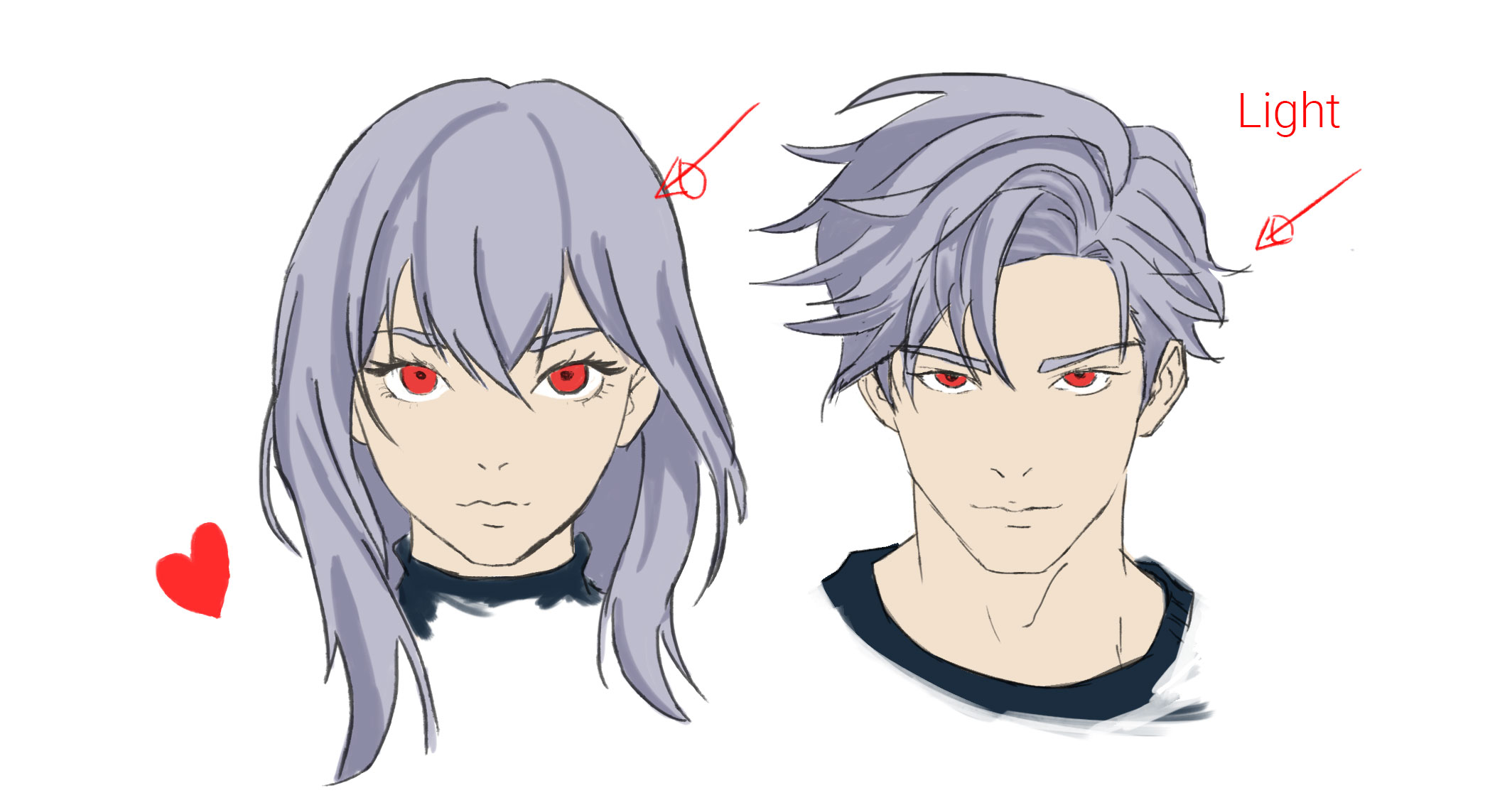
My hair process follows the same dark-to-light approach I use for everything else in a digital piece. I block the overall hair shape first as the darkest value — a solid mass of the shadow tone of the hair color. Then I paint the midtone base color on top of that dark foundation, covering most of the shape but leaving the darkest areas in the shadow zones (usually the underside of clumps, areas where clumps overlap, and the area underneath the bangs near the face). Then I add the lighter mid-tones — the ambient light areas that aren’t in direct light but aren’t in full shadow either. Finally, the highlights using Color Dodge or Add blend mode, which I keep narrow and crisp. The highlight on hair should be a thin stripe following the curve of the clump, not a broad soft glow. The place I have to discipline myself is still the over-rendering instinct. When I get into a piece and the hair is looking good, I want to keep adding strand detail because it feels productive. But I’ve learned to stop well before it feels finished — because at that point, the hair is almost always at the right level. Going further tips it into over-rendered territory where the realistic strand detail conflicts with the stylized rest of the character. The question I ask myself now: does this look like anime hair, or does it look like a realistic hair study? If it’s trending toward the second answer, I’ve gone too far.
Layer Setup for Digital Hair
| Layer | Blend Mode | Purpose |
|---|---|---|
| Hair Linework | Normal | Clean outlines for clumps and major strand details at edges |
| Sharp Highlight | Screen or Add | The bright stripe highlight on the most lit clump surfaces |
| Soft Highlight | Screen (low opacity) | Wider, softer secondary light areas |
| Mid-tone Detail | Normal | Color variation within the base — not strand detail, value variation |
| Shadow Layer | Multiply | Shadows under clumps, in overlaps, near face/neck cast shadows |
| Base Hair Color | Normal | Flat base fill of the entire hair shape |
Part 5 — Drawing the Major Anime Hair Styles
Every hairstyle is a variation of the same fundamentals — skulls, zones, clumps, flow direction. Here’s how those fundamentals apply to the styles you’ll draw most often.
⚔️ Short/Spiky Shonen Hair
The classic action protagonist look — think early Dragon Ball, Naruto, classic Bleach. Short overall length, multiple upward-pointing clumps, high visual energy.
The key: The spikes need to feel like they’re growing from a real skull, not floating disconnected above it. Each spike has a base that connects to the hairline and expands outward before tapering to a sharp point. The bases of adjacent spikes overlap slightly — they’re not perfectly separated. Vary spike height, width, and angle rather than making them uniform. Uniform spikes look like a cactus, not anime hair.
Common mistake: Making every spike the same size and angle. In good spiky anime hair, there are 2–3 dominant spikes and several smaller ones between them, creating a visual hierarchy rather than a repeating pattern.
🌊 Long Flowing Hair
The style that requires the most understanding of the ribbon concept. Long hair is all about flow — the continuous movement from the crown all the way down to the tips, following gravity with natural curves and occasional wind-influenced deviations.
The key: Long hair should look like it has weight. The upper sections near the crown show the hair originating and separating into clumps. The middle sections show the clumps flowing downward in gentle S-curves. The lower sections show the clumps narrowing to tips. Where the hair crosses the shoulders, it deflects — the shoulder is a physical object the hair rests on, which changes the flow direction below that point.
In motion: When a character with long hair is moving, the hair trails behind the direction of movement. The clumps nearest to the face may swing forward while the main mass trails back, creating the dynamic tension that makes anime action sequences visually exciting.
✂️ Short Bob / Shoulder-Length Hair
Clean, structured, and harder to make interesting than it looks. Short hair that stays close to the skull needs its shape variety to come from the silhouette and tip design rather than from flowing length.
The key: The silhouette of a short hairstyle is everything. A bob that curves under at the tips reads as elegant and neat. One that flicks outward at the tips reads as energetic. One that curves in multiple directions reads as individual and distinctive. Design the silhouette deliberately rather than just drawing hair close to the skull.
The back view challenge: Short hair often looks odd from behind if you haven’t planned how the clumps sit against the neck and nape. The hair near the neckline typically thins and tapers, following the natural way hair grows. Avoid drawing a sharp horizontal line where the hair ends at the nape — it reads as a wig.
🎀 Ponytail and Tied Hair
Tied hairstyles require thinking about two distinct zones: the gathered section at the tie point and the loose section flowing below it.
At the tie point: Draw the hair converging toward the hair tie or ribbon from all directions. The clumps compress and merge as they approach the tie. The tie itself creates a visible pinch in the hair mass — the hair is wider above the tie (spread from the skull) and then gathered tight at the tie before expanding again below it.
Below the tie: The hair expands outward from the gathered point like a drop fold — think of the tied section as an anchor point from which the hair falls freely (see the clothing folds guide for the drop fold concept — it applies directly to tied hair).
Hair accessories: Ribbons, hairpins, and hair ties are part of character design. They interrupt the flow of the hair and create new visual focal points. A large ribbon bow where a ponytail is tied should feel like it has weight — the bow droops slightly under gravity, it doesn’t float perfectly symmetrical.
💫 Braids and Complex Styles
Braids look complex but follow a simple repeating structure: three strands crossing over each other in alternation, forming a twisted rope-like pattern.
The simplified anime braid: Draw two edge lines slightly diverging from the origin point. Then draw a series of overlapping oval or leaf shapes within those edges, alternating left-to-right. Each oval represents one strand passing over the other two. You don’t need to draw every strand crossing individually — the repeating oval pattern reads as a braid clearly and quickly.
At the end: Where a braid ends, the strands separate back into individual clumps before being tied. Show 2–3 strands separating and tapering to points at the tip for a natural look.
Part 6 — The Golden Age Anime Hair Reference: What Those Styles Teach
💬 From Allard — the anime that shaped my eye for hair:
The anime that I grew up with and that most shaped how I think about hair aesthetics are Hellsing, Devil May Cry: The Animated Series (the original, not the Netflix version — let’s just not go there), Ninja Scroll, and Akira. These are what I call my golden age references. What those styles have in common is that the hair is drawn with clear, decisive shapes and strong silhouettes. There’s no over-rendering, no obsession with individual strand detail. The hair reads from a distance as a powerful shape. Alucard’s long black mass in Hellsing. Dante’s white spikes in DMC. Jubei’s tied and flowing style in Ninja Scroll. These hairstyles are recognizable as silhouettes. You could cut out the character in solid black and identify who they are from their hair shape alone. That’s the target. A hairstyle that works as a silhouette is a well-designed hairstyle. Everything else — the highlight placement, the strand detail at the edges, the color — is secondary to that fundamental shape reading clearly.
The silhouette test is worth adding to your practice: after drawing a hairstyle, fill the entire hair area with solid black and check whether the character is still recognizable and the style still reads clearly. If it does — if the shape is strong enough to carry the identity alone — the foundational design work is done. If it doesn’t, the shape needs more work before you invest in rendering and detail.
Part 7 — Lighting and Shading Anime Hair
Anime hair shading follows the same underlying logic as shading any rounded surface: the portions facing the light source are brightest, the portions turning away are darkest, and there’s a specific characteristic of hair that makes it different from other surfaces — the specular highlight stripe.
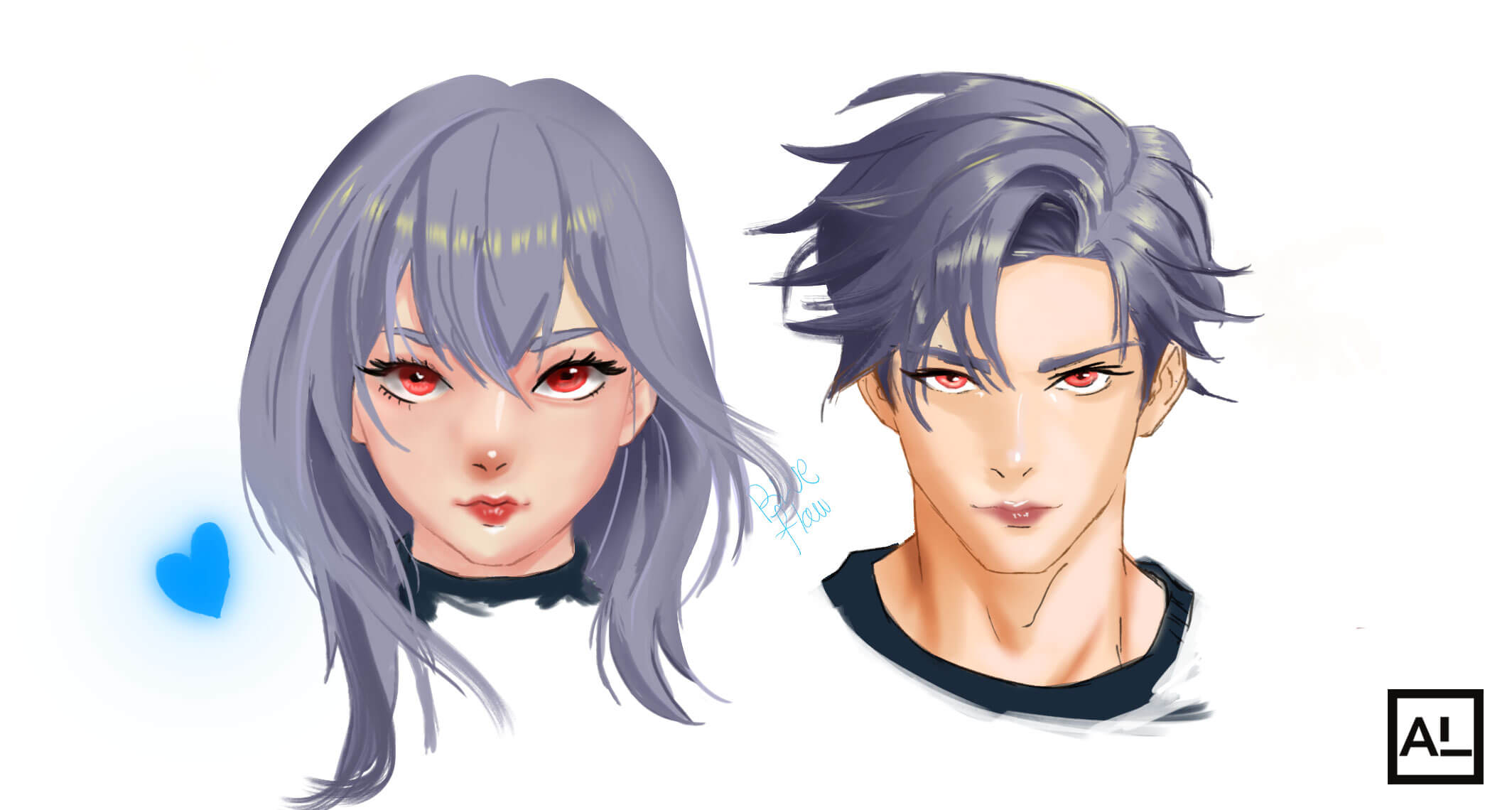
The Specular Highlight
The bright, often near-white highlight stripe that crosses the top surface of a hair mass is called a specular highlight — the direct reflection of the light source on a smooth surface. Anime exaggerates this into a clean, crisp stripe that runs across the crown of the hair, following the curve of the major clumps.
Characteristics of a well-placed anime hair highlight:
- Shape: A thin, elongated stripe — not a broad glow, not a dot. It follows the contour of the clump’s rounded surface.
- Position: On the uppermost surface of the hair clumps, where the surface is most perpendicular to the light source
- Edge quality: The edge toward the light is sharp; the edge away from the light is slightly softer
- Color: Near-white for most hair colors, slightly tinted with the hair color for darker hair (a dark blue hair color produces a blue-white highlight, not pure white)
One primary highlight stripe on the main hair mass. One secondary, dimmer stripe on a secondary clump. That’s usually all you need. More highlights start competing with each other and the clarity of the main one is lost.
Shadow Zones in Anime Hair
Where do shadows sit in anime hair?
- Underneath the top clumps — where upper clumps cast shadow onto lower clumps beneath them
- The underside of the overall hair mass — where the hair turns away from the primary light source (usually the top)
- Where hair crosses the face or neck — cast shadows from the bangs onto the forehead are one of the most characteristic elements of polished anime character art
- Inside overlapping clumps — where one ribbon of hair passes over another, the one underneath is in partial shadow
Color Variation in Hair
The same color theory that applies to skin applies to hair. Shadows don’t just get darker — they shift in temperature. For most anime hair under daylight conditions:
- Lit surfaces: warmer or slightly lighter version of the base hair color
- Shadow surfaces: cooler, more saturated, or slightly differently-hued version of the base
- Areas near the neck/face: sometimes pick up warmth from skin tone reflected into the shadow
See the Color Theory guide for the full breakdown of temperature shifting in shadows — the same principles apply to hair as to any other surface.
Part 8 — Common Mistakes and How to Fix Them
❌ Over-rendered hair that fights the rest of the character
✅ Fix: Stop adding strand detail once the major clump shapes and primary highlight are established. The interior of hair clumps should be clean value gradients, not networks of individual line strands. Ask yourself: does this look like anime hair, or a realistic hair study? If you’re trending toward the second answer, you’ve gone too far. Selectively erase or reduce strand detail in the interior areas of clumps while keeping it only at edges and tips.
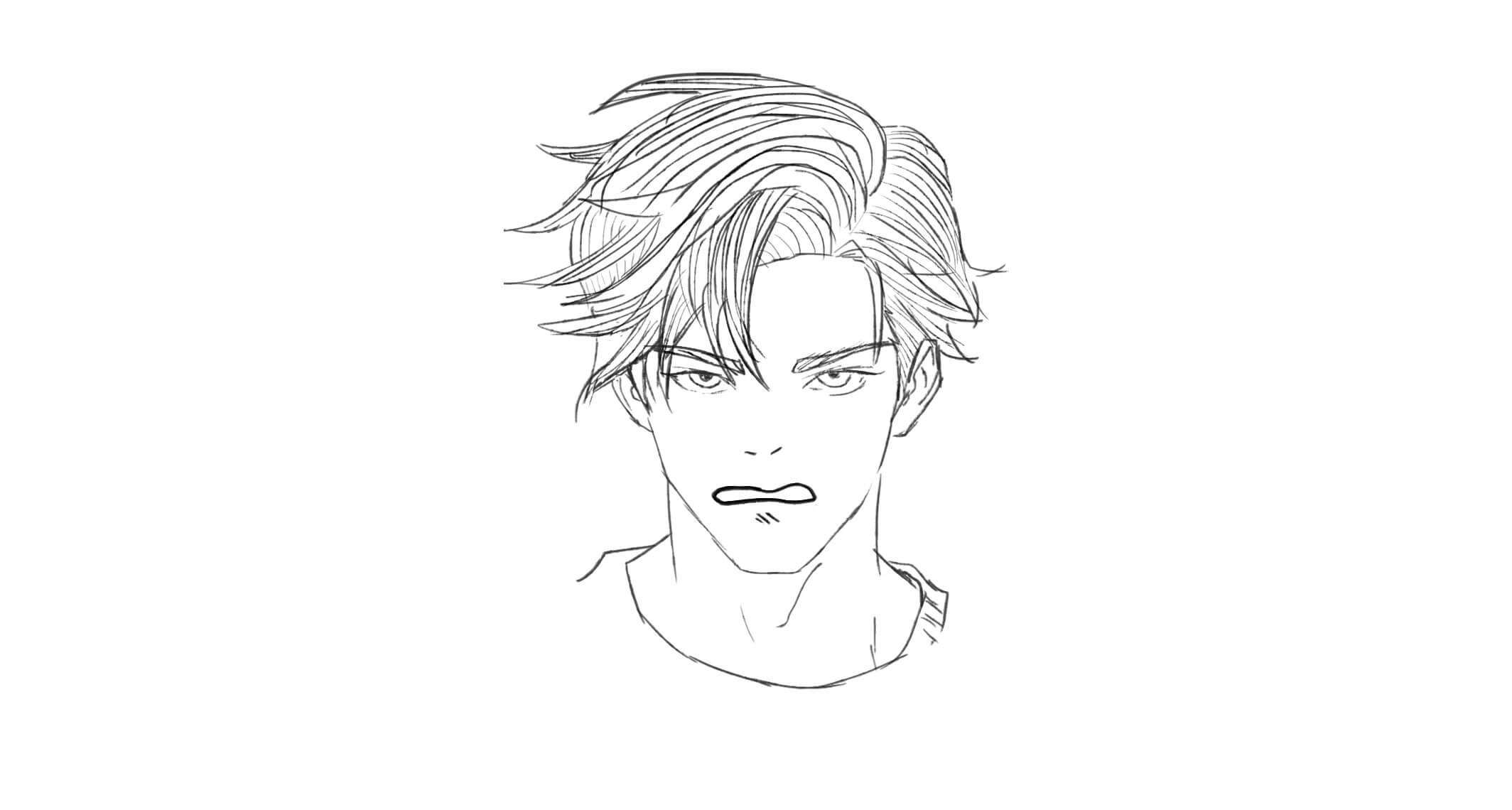
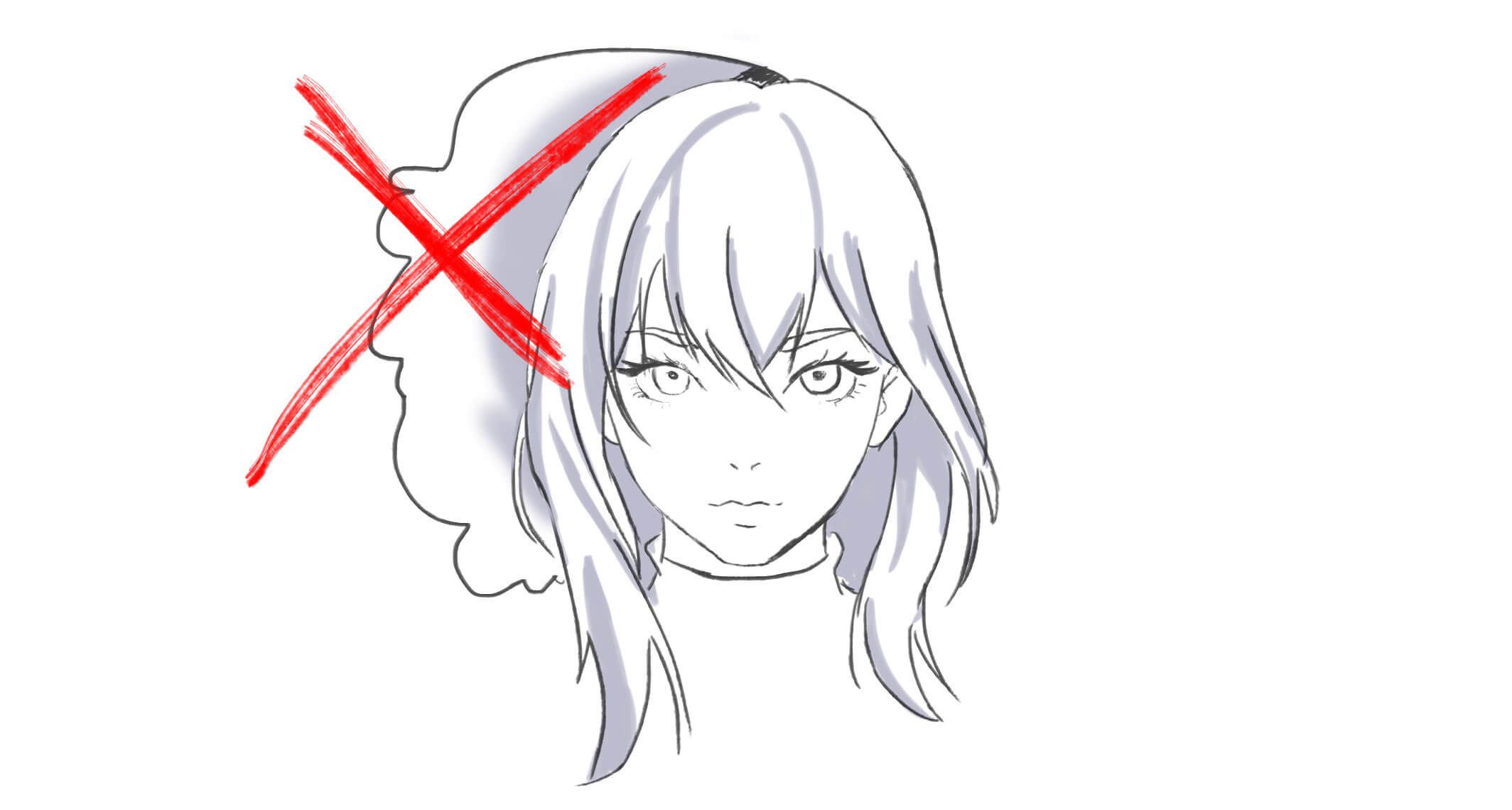
❌ Hair that looks like a helmet — flat against the skull with no volume
✅ Fix: Add a gap between the skull circle and the hair outline. Hair has volume — it projects outward from the scalp. Even short hair has a few millimeters of visual gap between skull and hair surface. The crown of the head should show a gentle dome of hair volume above the skull line. If your hair sits exactly on the skull outline, it looks painted on rather than growing from the head.
❌ Uniform strand size — every clump is the same width and taper
✅ Fix: Deliberately vary clump sizes. Design your hairstyle with 2–3 dominant large clumps and several smaller ones. The large clumps establish the overall character of the style; the small ones add variety. Think of it like composing a sentence — you need a few big words carrying the meaning and some smaller ones filling the space, not a string of equally-weighted words in a row.
❌ All hair flows in the same single direction with no variation
✅ Fix: Within the overall flow direction, individual clumps should have slight variations in angle. A general flow to the right doesn’t mean every strand points exactly right — some lean slightly forward, some slightly backward, creating the overlapping, layered quality of real hair. Also, where hair passes over physical objects (shoulders, ears) the flow changes direction below the point of contact.
❌ The highlight is a broad soft glow rather than a crisp stripe
✅ Fix: Use a hard or semi-hard brush for hair highlights, not a soft airbrush. The anime hair highlight is a crisp, defined stripe following the curve of the clump surface. A soft glow blurs the form and reads as generic lighting rather than the specific anime specular highlight. Start with a hard-edged stroke and slightly soften only the trailing edge if needed.
❌ Spiky hair looks like separate unconnected spikes floating above the head
✅ Fix: Every spike needs a base that connects visibly to the scalp. The base of each spike is wider and overlaps with adjacent spikes at the root — they’re all growing from the same head. Draw the bases connecting to the hairline first, then let each spike narrow toward its point. Spikes that don’t connect to the skull look like a crown placed on top of the head rather than hair growing from it.
Part 9 — Practice Plan for Anime Hair
| Week | Focus | Exercise | Time |
|---|---|---|---|
| Week 1 | Silhouette shapes | Draw 10 hair silhouettes filled in solid black — no detail, just shapes. 5 different styles. Evaluate: do they read from a distance? | 30 min/day |
| Week 2 | Clump structure | Draw the same simple hairstyle 10 times, each time practicing the ribbon/clump approach — large clumps first, secondary clumps after, minimal strand detail | 30 min/day |
| Week 3 | Flow and movement | Draw the same character’s hair in 5 poses: standing still, running, wind from left, wind from right, looking up. Practice how flow direction changes with movement. | 45 min/day |
| Week 4 | Lighting and highlights | Draw one hairstyle 5 times with 5 different lighting setups — top light, side light, backlight, low light, two light sources. Practice highlight placement for each. | 45 min/day |
| Week 5 | Style variety | Draw one character with 6 different hairstyles — short spiky, long flowing, bob, ponytail, braid, plus one style you invent. Practice the different structural approaches for each. | 60 min/day |
| Week 6 | Integration on a full character | Draw a complete character from sketch to colored finish, focusing on hair integration — how the hair relates to the face, how the shadows from hair fall on the forehead, how the overall value balance sits between hair and face. | 90 min |
| Ongoing | Silhouette test habit | For every hairstyle you draw: fill it in solid and check it reads. If not, go back and strengthen the shape before adding any detail. | 1 min per drawing |
✅ The fastest improvement habit for hair:Study the golden age anime you admire and specifically analyze the hair. Don’t just watch — pause on frames and ask: how many major clumps is this? Where is the highlight? How simplified is the interior detail? How does the silhouette read? Twenty minutes of deliberate hair analysis in anime you love teaches more than two hours of drawing practice without a reference point.
Frequently Asked Questions
How many clumps should anime hair have?
For most hairstyles, 5–10 major clumps is the right range. Fewer than 5 and the hair looks too simplified — almost like a cartoon. More than 10 major clumps and it starts to look complex and restless. Within those major clumps, you can have 3–5 secondary clumps at the edges and tips for additional variety. The key is maintaining a clear hierarchy: a few dominant large shapes, secondary shapes in between, and detail only at the periphery. Think of it the way a good composition works — a few major focal points with supporting elements, not equal weight everywhere.
How do I make anime hair look like it has volume instead of lying flat?
Two main fixes: first, leave a gap between the skull circle and the hair outline — even a few pixels of air space at the crown creates the visual impression of volume. Second, make sure the hair mass is wider than the skull at its widest point. Hair expands outward from the scalp — the silhouette of the hair should be visibly wider than the head underneath it. A hair silhouette that exactly follows the skull shape reads as hair plastered flat against the head, which looks unnatural.
Should I draw hair before or after the face?
Draw the face construction (skull, guidelines, features) first, then add hair on top. This way the hair is designed to frame a face that already exists, which produces much more natural proportions than drawing hair first and trying to fit a face inside it. The bangs especially need to relate to the forehead and eyebrow position — you can only place them correctly if you already know where the eyebrows are. Think of hair as clothing for the head: you design the person first, then dress them.
How do I draw anime hair from the back?
Back-view hair requires planning the crown area, where all the clumps originate and radiate outward from the part. From behind, the part is the most prominent structural element — everything else flows outward from it. For long hair from behind, the clumps overlap each other as they fall, with the ones nearest the viewer appearing in front. The nape of the neck is where hair naturally thins and tapers — show this thinning rather than a hard horizontal line where the hair ends. For the back of a head with a ponytail, show the gathering point clearly and let the tail fall naturally below it.
What makes anime hair look “anime” rather than realistic?
Several specific stylistic choices: the hair is organized into clear, graphic clumps rather than individual strands; the highlight is a crisp, defined stripe rather than a diffuse sheen; the tips of clumps are exaggeratedly sharp and defined; the overall silhouette has clean, designed edges rather than the fuzzy natural edges of real hair; and the interior detail is selectively simplified rather than fully rendered. These choices exist because anime art communicates at a distance and at speed — in a moving sequence, hair needs to read clearly at small sizes and in quick glances. The stylization is functional, not arbitrary.
How do I draw anime hair blowing in the wind?
Wind gives hair a secondary force to obey alongside gravity. Instead of falling straight down, the clumps angle away from the wind direction — the leading edge of the hair (facing the wind) is relatively compressed and smooth; the trailing edge (away from the wind) is more extended and dynamic. Individual clumps separate more clearly in wind, with visible gaps between them. Tips become more active — they curl, twist, and point in the wind direction rather than just tapering to neutral points. The base sections near the scalp resist the wind more than the tips, creating a visual gradient from more stable near the head to more active at the ends.
What’s the difference between drawing male and female anime hair?
In anime conventions, the differences are more about style choices than structural differences: female hair tends to be longer on average, with softer, more flowing clumps and rounder tips. Male hair tends to be shorter with sharper angles, more angular tips, and either very close to the skull or aggressively spiky. The highlight placement is the same — both use a specular stripe. The clump structure is the same — both use the ribbon approach. What changes is the silhouette language: feminine designs favor flowing curves; masculine designs favor angular, dynamic shapes. These are conventions, not rules — plenty of male characters in anime have long flowing hair (Hellsing’s Alucard, for instance), and the style still reads correctly because of how it’s drawn.
How do I color unusual anime hair colors — blue, green, pink — realistically?
Unusual hair colors follow the exact same shading logic as natural ones — the base mid-tone, a cooler/deeper shadow tone, and a bright near-white highlight. The mistake most artists make is keeping the whole value range within the saturated color zone: a blue-haired character whose shadow is dark blue and whose highlight is light blue. The highlight should approach near-white (just a slight tint of the base color), and the shadow should go much darker and potentially cooler or more muted than the base. That contrast — dark saturated shadow, mid-tone vivid base, near-white highlight — is what reads as shiny anime hair regardless of the base color.
How long does it take to get good at drawing anime hair?
Recognizable, intentional anime hair — hair that reads as the style you intended with believable flow and volume — is achievable within 4–6 weeks of focused daily practice. Hair that looks polished in finished illustrations with correct lighting and shading typically takes 3–6 months to develop consistently. Hair that you can draw quickly, correctly, at any angle, for any style without reference — that takes longer, around a year of regular practice. The fastest path is the silhouette-first approach in this guide: don’t add detail until the shape works. Every session where you practice the shape before the detail builds the right foundation faster than sessions where you jump straight to rendering.
What to Learn Next
- How to Draw Anime Faces — hair frames the face; getting both right together is the real skill, and this guide covers everything from skull construction to expressions
- How to Draw Anime Eyes — the other element that defines character identity as powerfully as hair
- Color Theory Made Simple — the temperature shifting and highlight logic in this guide makes most sense with a solid color theory foundation
- How to Draw Clothing Folds — the ribbon/clump approach to hair is closely related to how fabric folds work; the same spatial thinking applies to both
- Complete Anime Drawing Guide for Beginners — the full character roadmap that puts hair, face, and body together into a complete figure
Draw the silhouette first. Always. Everything else is detail that serves the shape — not the other way around. That single principle, applied consistently, will do more for your hair drawing than any technique in this guide. 🖊
Discover More Posts
Keep exploring stories, insights, and creative notes from my journey as an artist. Check out the latest blog entries and find topics that inspire your own process.
How to Draw Stunning Anime Clouds
Learn to draw anime-style clouds with this easy, step-by-step cloud tutorial. You’ll pick up tips on shapes, color, and composition—plus get free cloud brushes to use in your own art.
How to Paint Realistic Metal
Learn how to paint realistic metal with this step-by-step guide. From base colors to to lighting and reflections, get practical tips for your artwork shine, literally.
Color Theory Made Simple: A guide for Beginner Artist
New to Digital painting? This beginner-friendly guide breaks down hue, value, saturation, color harmonies, and practical tips to help you choose better palettes and level up your art.