
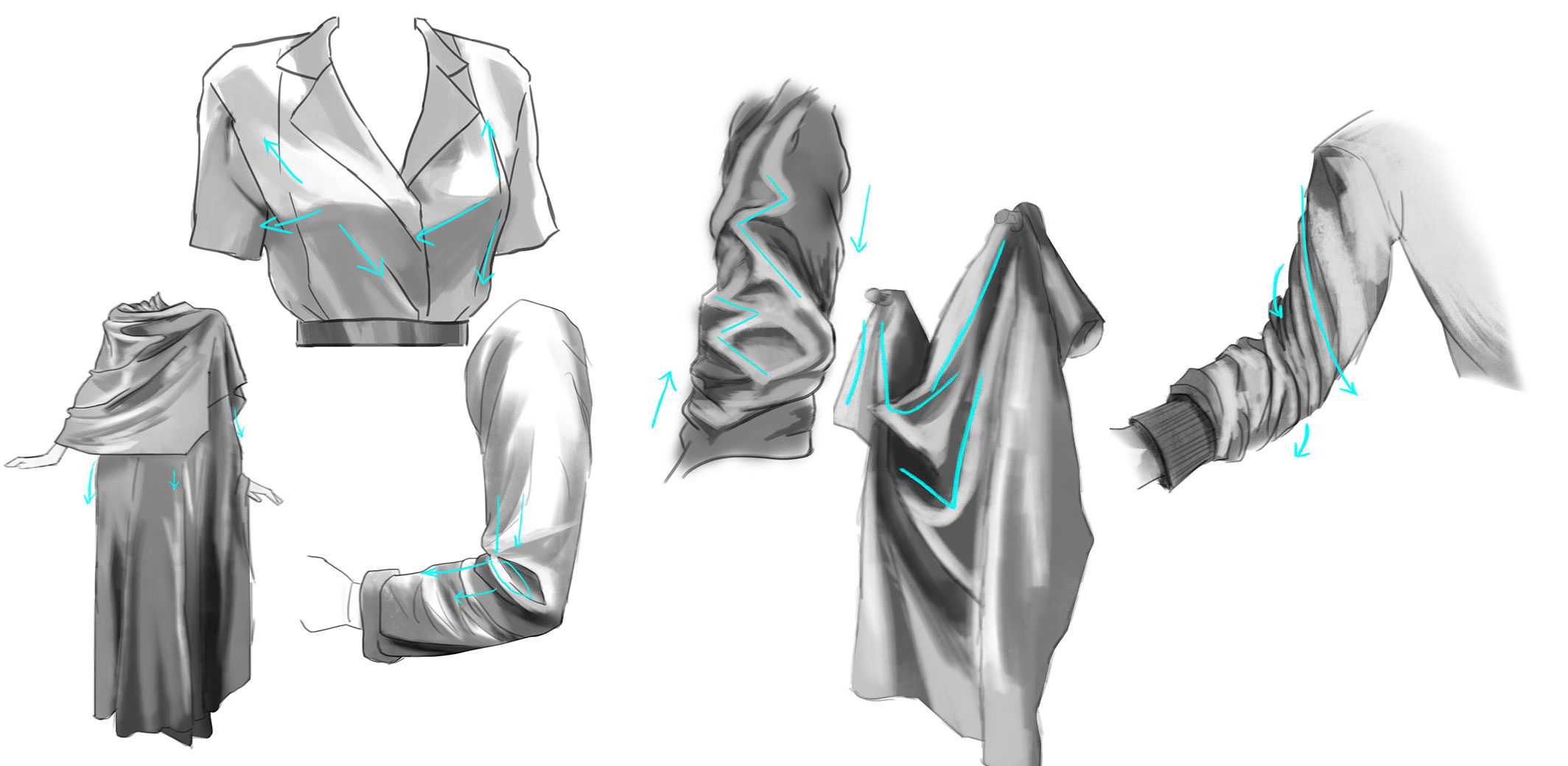
Clothing folds are one of those things that look chaotic until they don’t. You stare at a shirt bunched at an elbow, or a cape sweeping in the wind, and it looks impossibly complex — too many creases, too many overlapping lines, no obvious logic to any of it.
But there is logic. Every fold you’ll ever draw, on every garment in every pose, belongs to one of six fundamental types. Once you know those six types — what causes them, what they look like, and where they appear on the body — the chaos resolves into recognizable patterns you can draw with intention instead of guessing at.
This is the guide I wish I had when I started drawing characters. It covers all six fold types in depth, the physics behind how fabric behaves, how to apply folds correctly to specific garments (shirts, pants, capes, skirts), how fabric weight changes everything, how to shade folds digitally, and a structured practice plan for building real muscle memory. Work through it with a pencil in hand. Fabric is learned by drawing it, not by reading about it.
📌 Who this guide is for:
Beginner to intermediate artists who want to draw convincing clothing on anime, manga, or illustration-style characters — from imagination, not just by copying reference. You’ll also find this useful if your folds technically look “right” but still feel flat or unconvincing.
Part 1 — Why Clothing Folds Are Hard (and Why They Don’t Have to Be)
The reason clothing folds feel so hard to draw is that most artists approach them visually instead of structurally. They look at a fold and try to copy the shape they see, rather than understanding what caused that shape. The result is folds that look right only when copied from that exact reference, and fall apart completely when trying to draw from imagination or a different pose.
The structural approach is different. Instead of copying shapes, you learn the rules that generate those shapes. Once you understand those rules, you can predict what a fold will look like on any garment in any pose without needing a reference for every single drawing.
Everything about fabric behavior comes down to two forces working against each other:
- Gravity — always pulling fabric straight down toward the floor
- Tension — the force of the body or anchor points pulling fabric tight
Where these two forces interact, you get folds. Where tension is high (a bent elbow, a clenched fist, a shoulder bearing weight), fabric pulls taut and forms angular, tight folds. Where tension is low (loose fabric between two anchor points, fabric hanging freely), gravity dominates and you get soft, rounded, drooping shapes.
Every single fold type you’ll ever encounter is just a different ratio of these two forces playing out in a specific physical configuration.
The Three Rules of Fabric Behavior
- Fabric always originates from an anchor point. An anchor point is anywhere fabric is held in place — a shoulder seam, a waistband, a hand gripping cloth, a button. Folds radiate outward from anchor points like spokes from a hub. Find the anchor points first; the folds follow.
- Fabric takes the path of least resistance to its next anchor or to the floor. Between two anchor points, fabric hangs in the most relaxed curve physics allows. The tighter the tension between points, the straighter that path. The looser the fabric, the more gravity shapes it.
- More fabric = more folds; less fabric = fewer, larger folds. A baggy shirt on a slim figure has more excess fabric and therefore more folds. A fitted shirt stretched across broad shoulders has almost no excess fabric and very few folds — maybe just a handful of tension lines pulling toward stress points. Match your fold density to how much excess material the garment has.
💡 The most useful habit you can build:
Before drawing any fold, ask yourself two questions:
Where is the anchor point?
and
Where is the gravity pulling?
The answer to both determines what kind of fold you draw and where it goes. These two questions eliminate guessing entirely.
Part 2 — The Six Essential Fold Types
These are the six fundamental fold types identified by artists like Andrew Loomis and further systematized by contemporary illustration educators. Every fold you’ll ever draw is one of these — or a combination of two or more happening simultaneously.
1. The Pipe Fold
What it is: Long, cylindrical tubes of fabric that flow parallel to each other from a single anchor point. The name comes from the way each fold resembles a rounded pipe or column.
What causes it: Fabric hanging from a single anchor point (like a shoulder, a belt loop, or a waistband) with gravity pulling it straight down. The fabric has nowhere to go but down, so it arranges itself into a series of rounded vertical tubes.
What it looks like: Rounded ridges and troughs running parallel and vertical. Each “pipe” is a convex ridge; between two ridges is a concave trough. The ridges catch light; the troughs fall into shadow. They’re widest and most relaxed at the bottom, slightly tighter and closer together near the anchor point where the fabric is constrained.
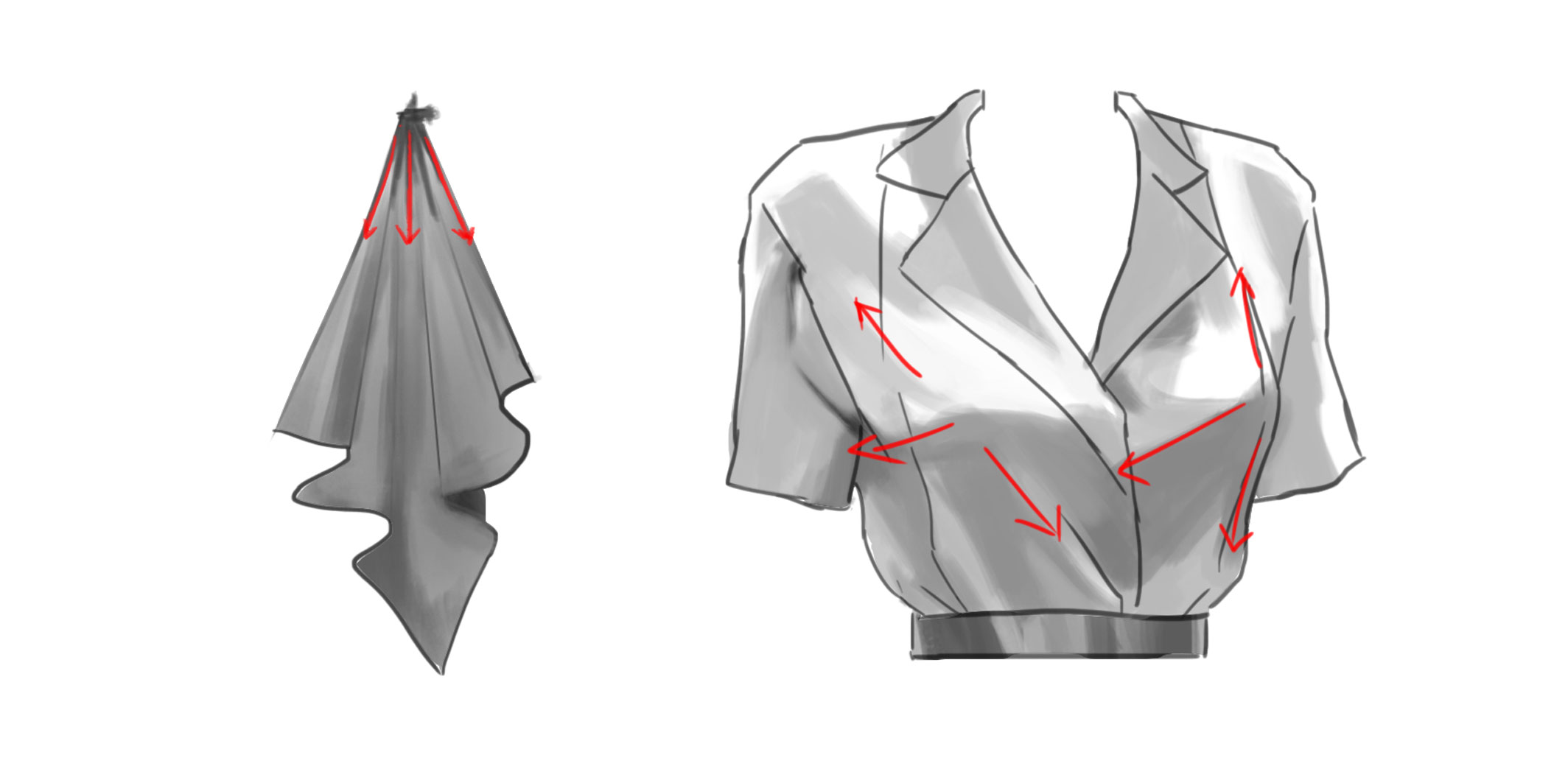
Where it appears:
- Long skirts hanging from a waistband
- Capes or cloaks hanging from shoulder clasps
- Curtains hanging from a rod
- A loose sleeve falling from the shoulder when the arm is down
- Dress pants hanging from the hips in a standing figure
How to draw it: Start at the anchor point. Draw a series of gentle vertical curves radiating downward — these are the edges of each pipe. Each curve bows slightly outward at the midpoint, then straightens near the bottom. Add a rounded crease at the top of each trough where the fabric turns inward. The pipes don’t need to be perfectly equal — slight variation in width makes them look natural.
Key insight: The more fabric there is relative to the anchor width, the more pipes you’ll see. A wide skirt hanging from a narrow waistband creates many pipes. A narrow sleeve has fewer and larger pipes.
2 The Zigzag (Interlocking) Fold
What it is: Sharp, angular folds that alternate direction, creating a Z or S pattern. The name describes the alternating direction of each crease.
What causes it: Fabric compressed between two surfaces or against a bend — like fabric bunching at the back of a bent knee, the inside of a bent elbow, or at the waist when a figure leans forward. The fabric has more length than the space allows, so it collapses into a series of alternating angled ridges.
What it looks like: Alternating diagonal lines that change direction sharply at each crease, forming a zigzag or accordion-like pattern. The creases are more angular and sharp than other fold types. The individual folds compress tightly together at the point of maximum bend and spread apart as they move away from it.
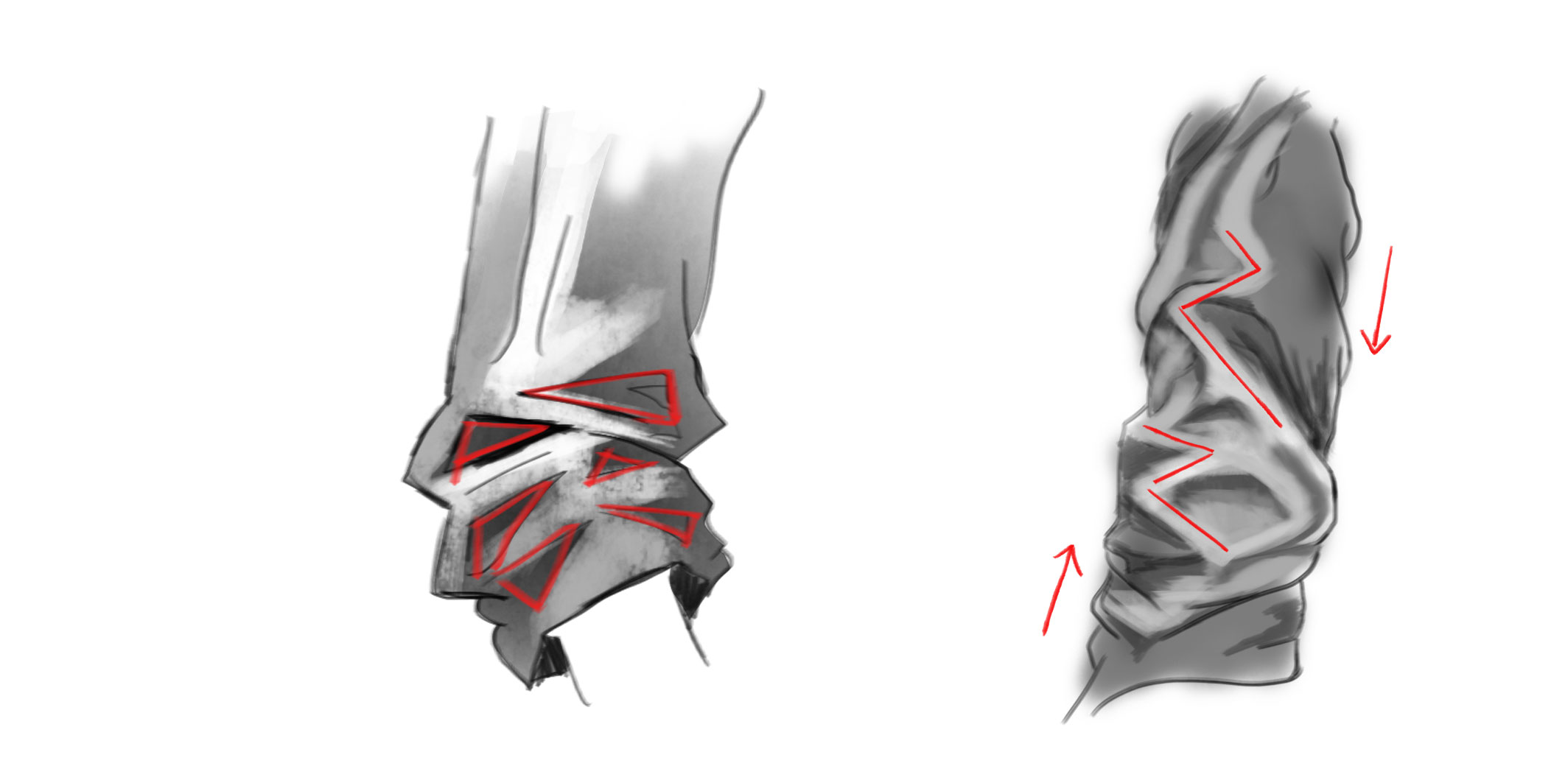
Where it appears:
- The back of the knee in pants when the leg is bent
- Inside of a bent elbow on a sleeve
- The waist of a shirt when a figure bends forward
- Fabric bunching at the wrist above a tight cuff
- Around the ankle area of loose pants that are too long
How to draw it: Draw a series of diagonal lines alternating direction, each one overlapping the last slightly. The angle of each zigzag should point toward the compression point — the inside of the bend. Don’t make the angles too equal or too regular; real compression folds have variation in size and spacing. The fold closest to the bend is typically the tightest; they loosen as they move away.
Key insight: Zigzag folds are almost exclusively found at joints under compression — bent knees, elbows, waists. If you see a zigzag fold somewhere unexpected, look for what’s being compressed and in what direction.
3 The Spiral (Wrapping) Fold
What it is: Folds that wrap around a cylindrical form — an arm, a leg, or a torso — spiraling around the shape rather than hanging straight or compressing at a bend.
What causes it: Fabric wrapped around a rounded, cylindrical body part. The fabric conforms to the cylinder’s surface, and as it does, the tension lines and gravity interact to create diagonal wrapping folds that spiral around the form. Twisting of the fabric (like a torso in rotation) also creates spiral folds.
What it looks like: Diagonal creases that wrap around the limb, moving from lower on one side to higher on the other as they cross the form. They’re consistent in their diagonal angle and create a sense of the underlying cylindrical volume. Unlike pipe folds (which fall straight) or zigzag folds (which compress at a bend), spiral folds travel around the form.
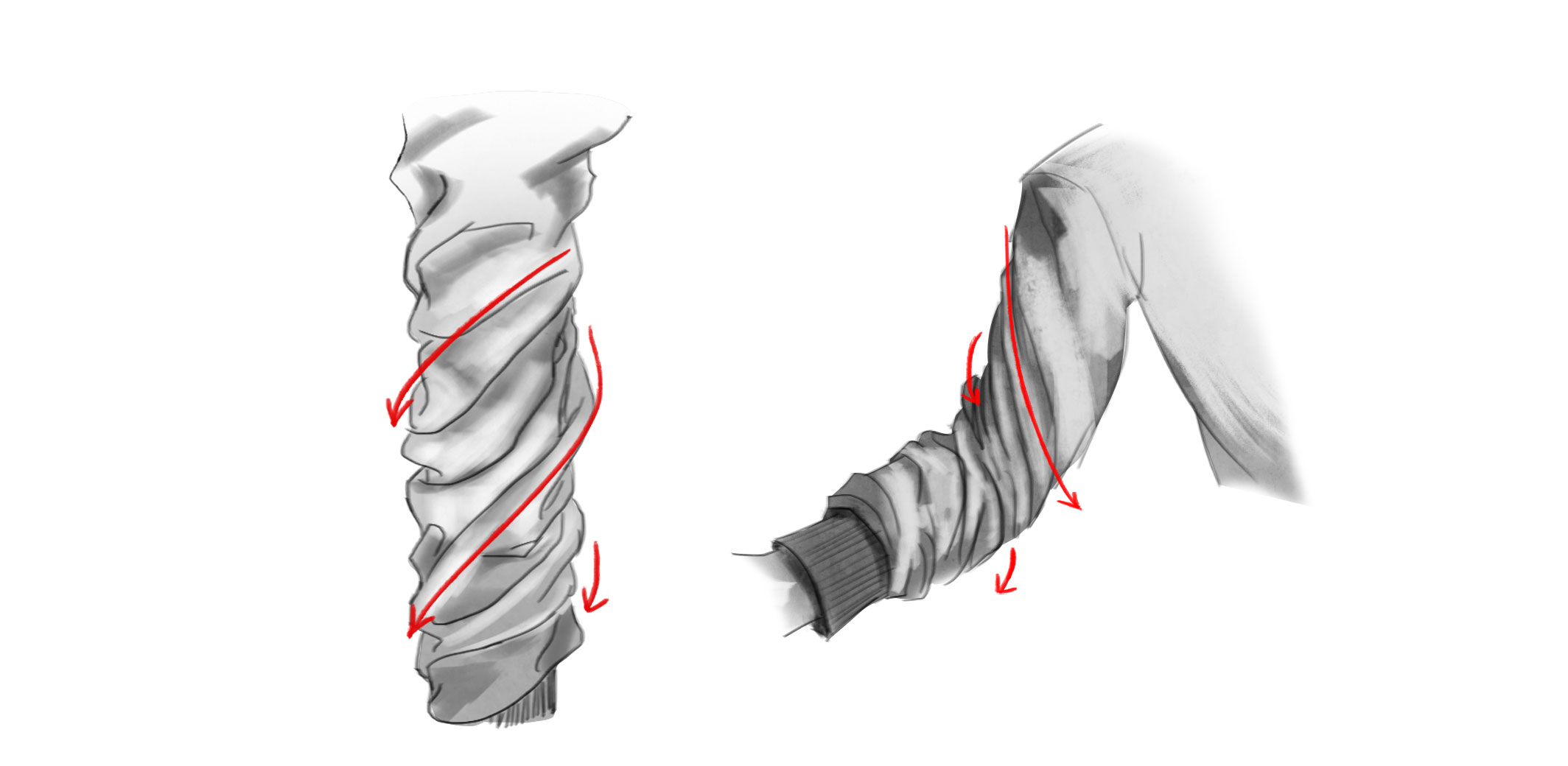
Where it appears:
- Long sleeves on an arm that’s extended or slightly rotated
- Tight-fitting pants on legs in motion
- Wrapped bandages or bound cloth on limbs
- A body in a twisted pose, particularly through the torso
- Leg wraps or puttees on fantasy/historical characters
How to draw it: Think of the limb as a cylinder and the fabric as a sheet of paper wrapped around it. Draw diagonal lines that curve around the cylinder form — they should follow the surface of the shape, not cut across it. In a straight, untwisted limb, spirals are minimal. In a twisted limb, they become more pronounced. The direction of the spiral follows the direction of the twist.
Key insight: Spiral folds are the clearest indicator of the underlying cylindrical form. Drawing them well requires understanding the 3D shape beneath the fabric. If your spiral folds look flat, it’s almost always because the underlying form isn’t clearly established in your sketch.
4. The Half-Lock Fold
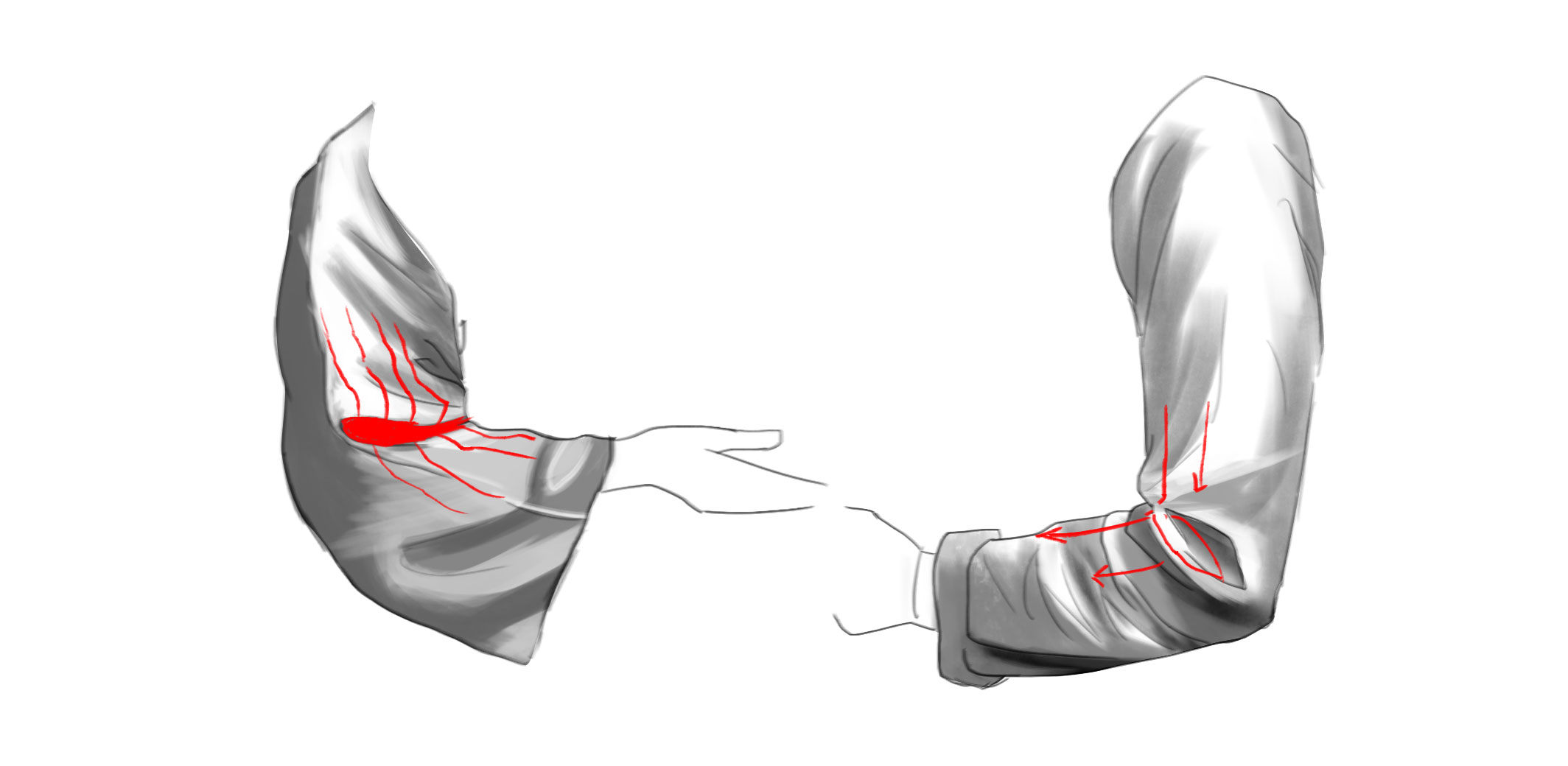
What it is: A fold that occurs at a single bend point, where fabric locks at one side of a joint and hangs freely on the other. It’s half-tension (at the bend), half-gravity (the hanging portion).
What causes it: A limb bent at a joint while wearing loose fabric. The fabric at the outside of the bend is pulled taut (tension), while fabric at the inside of the bend and below the joint hangs loosely under gravity. The result is a distinctive shape that “locks” at the joint and releases below it.
What it looks like: On the outside of the bent joint, the fabric stretches relatively smooth and taut. At the bend itself, a single dominant horizontal or diagonal crease forms — this is the “lock.” Below the lock, the fabric hangs in relaxed pipe-like folds. The locked crease is typically sharp and angular; the hanging portion below it is soft and rounded.
Where it appears:
- A sleeve at a bent elbow — particularly on the outside of the arm
- Pants at a slightly bent knee when standing
- A jacket at the shoulder when the arm is raised
- Fabric at the hip when a figure leans to one side
- A glove at the knuckle line when the hand is partially closed
How to draw it: Find the joint. Draw the taut, relatively smooth fabric on the outside/top of the bend. Then draw the lock crease — one clear angular fold at the bend point, usually pointing toward the tension. Below the lock, draw 2–3 soft hanging folds that flow downward. The contrast between the angular lock above and the soft folds below is what makes this fold type so distinctive and believable.
Key insight: The half-lock fold is the most common fold in clothed figure drawing because any slight bend at a joint creates one. Master this fold and your standing and walking figures will immediately look more convincing.
5. Diaper Folds
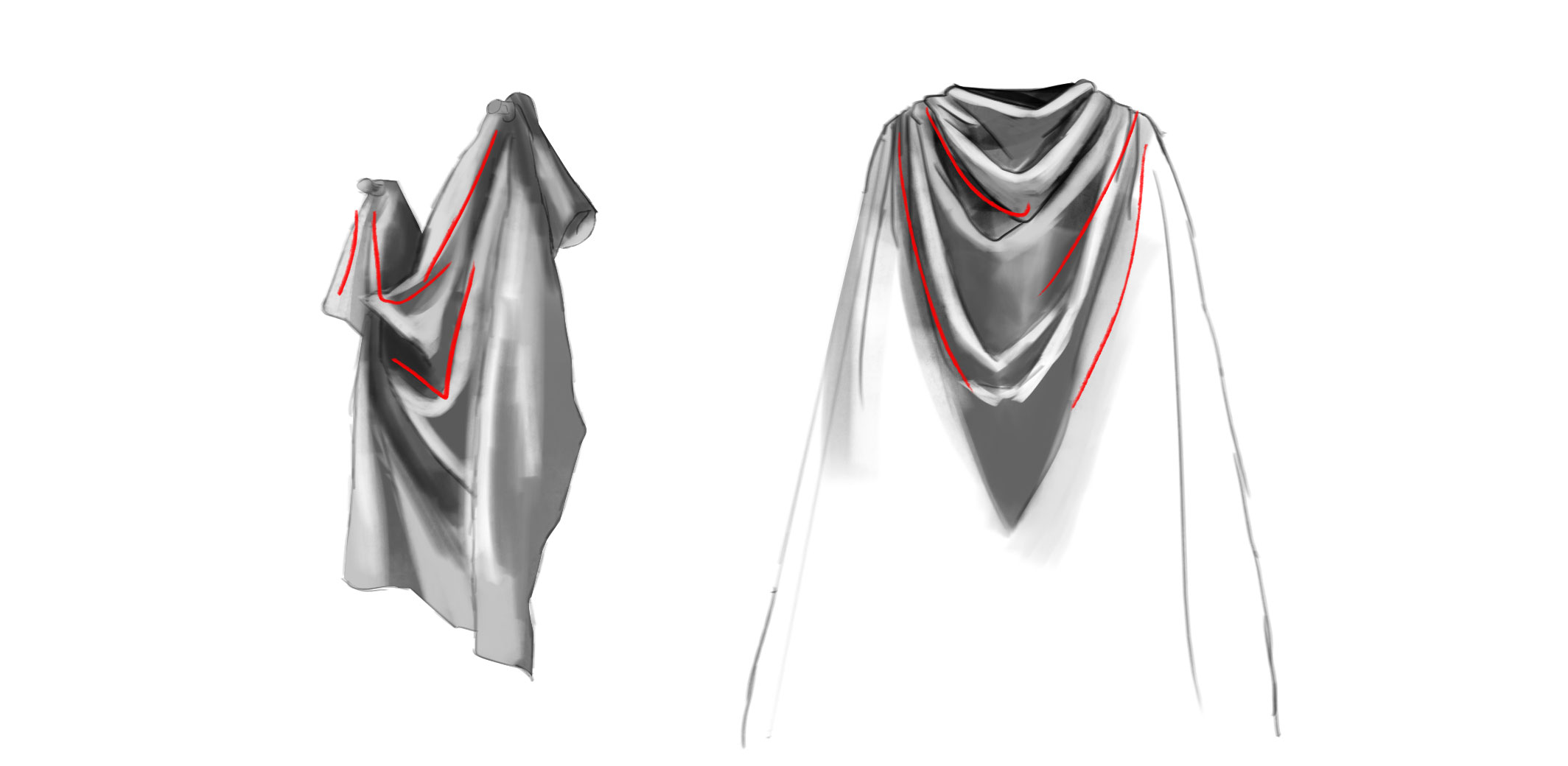
What it is: A sagging, U-shaped fold that forms when fabric is suspended between two anchor points and allowed to hang freely under gravity. Named after the traditional textile term “diaper” (a patterned cloth), not the modern meaning.
What causes it: Fabric held at two separate points, with the middle left unsupported. Gravity pulls the unsupported middle section downward in a smooth, rounded arc. The shape is a catenary curve — the same natural curve formed by a hanging chain or rope.
What it looks like: A smooth U-shape or arc sagging between two higher anchor points. The fold is widest and deepest at the center (where gravity has the most effect) and tightens as it approaches each anchor. Multiple diaper folds can occur side by side when fabric hangs between many points, creating a series of overlapping U-shapes.
Where it appears:
- The back of a loose shirt between the shoulder blades
- Fabric between the legs of baggy pants when the figure is standing
- A shawl or scarf draped over both shoulders
- The underside of a sleeve when an arm is raised
- A bag’s strap sagging between two attachment points
- A hammock or sling bearing weight
How to draw it: Establish your two anchor points. Draw a smooth, gentle arc connecting them — slightly asymmetric is more natural than a perfect U. The lowest point of the arc should be soft and rounded, not pinched. Where the arc meets each anchor, it tightens and the fabric transitions to whatever else is happening at that anchor (pipe folds, tension folds, etc.). Add a secondary smaller arc along the inner edge of the fold to suggest depth and thickness.
Key insight: The size of the diaper fold depends on how much slack fabric exists between the anchor points. Very little slack = a shallow arc close to straight. Lots of slack = a deep, full, sagging U. This is a key dial for communicating how loose or fitted a garment is.
6. The Drop Fold
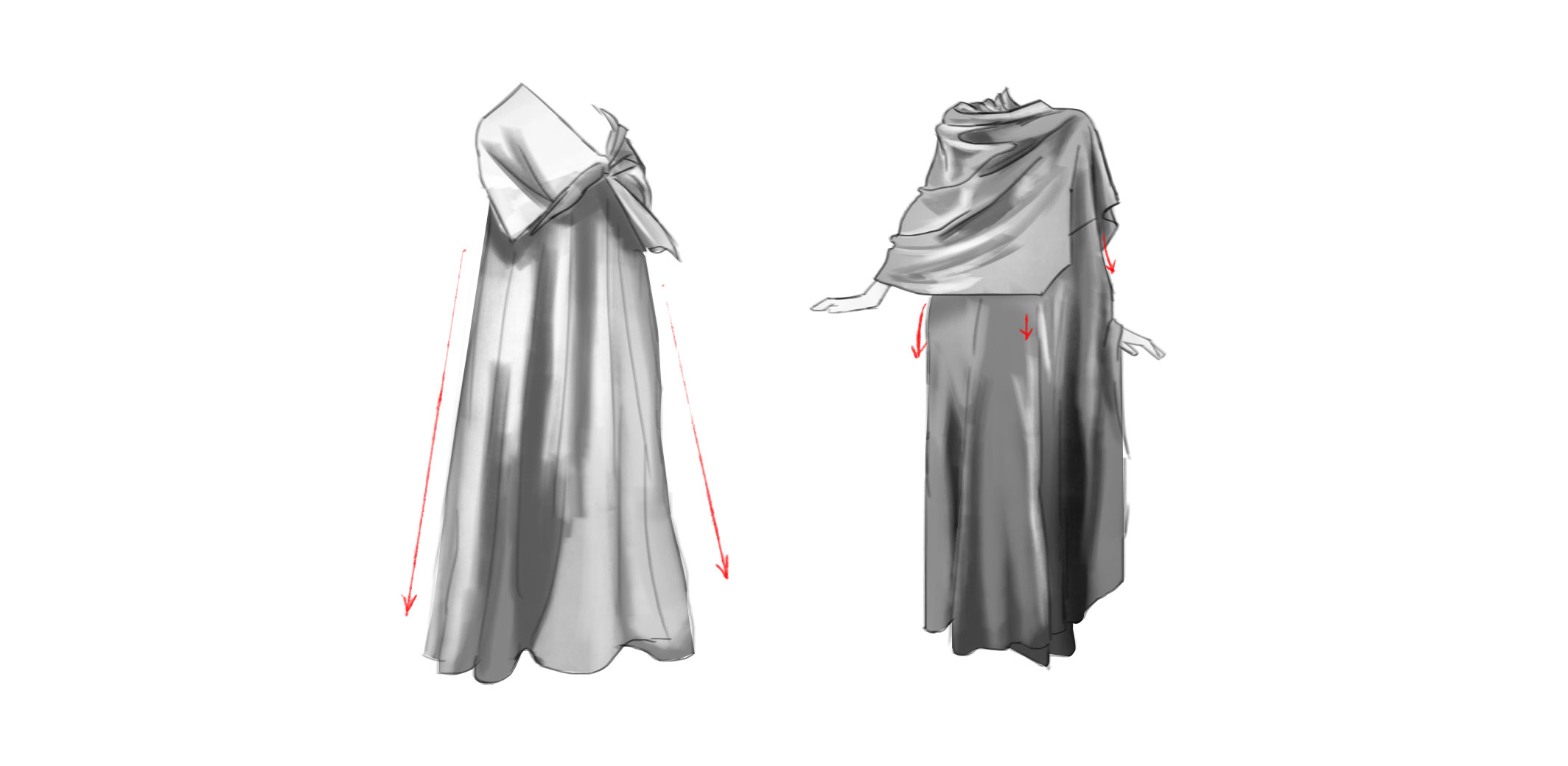
What it is: Fabric falling freely from a single point, spreading outward under gravity as it falls. The name comes from the visual — fabric “drops” from one point.
What causes it: A single anchor point with fabric hanging freely below it in all directions, with no secondary anchor to constrain where it falls. The fabric radiates outward from the anchor as it descends, creating a flowing, spreading shape.
What it looks like: From the anchor point, fold lines radiate outward like spokes from the top, then gradually curve downward as gravity takes over. The silhouette widens as it descends. In profile, a drop fold looks like an inverted cone or funnel shape. Individual folds within the drop are a combination of pipe folds (vertical component) and spiral folds (radial/spreading component).
Where it appears:
- A cape or cloak hanging from a single shoulder clasp or brooch at the center chest
- A skirt gathered at the waist and flowing freely below
- A cloth draped over a single hook or nail on a wall
- A flag hanging from a single attachment point
- A scarf pinned at the center falling to both sides
How to draw it: Place your anchor point first. Draw radiating fold lines from it, spreading outward like a fan. As each line descends, curve it slightly inward toward vertical — gravity pulls the lower portions toward the floor even as the upper portions spread from the anchor. The edges of the falling fabric should curve gently, not fall straight down. Add depth by suggesting that alternate folds fall slightly in front of or behind each other.
Key insight: Drop folds are the most dramatic and visually striking fold type, which is why they appear constantly in fantasy character art (capes, robes, dramatic scarves). Their dramatic quality comes from the clear single anchor point and the radiating, spreading flow below it — so always establish the anchor visually before drawing the fall.
Part 3 — How the 6 Folds Work Together on a Full Figure
In real clothing on a real body, you’ll rarely see just one fold type in isolation. A dressed figure almost always has multiple fold types occurring simultaneously on different parts of the garment, and sometimes multiple types interacting within the same area of fabric.
Learning to identify which fold type is dominant in each area — and which secondary fold types are layering on top — is the key skill that separates artists who can draw folds from reference from artists who can draw them from imagination.
A Full Figure Fold Map
| Body Area | Primary Fold Type | Secondary Fold Type | Notes |
|---|---|---|---|
| Shoulder to upper arm | Half-lock | Pipe fold | Especially prominent when arm is raised |
| Bent elbow (outside) | Half-lock | Tension lines | Taut on outside, compressed on inside |
| Bent elbow (inside) | Zigzag | — | Compression at the joint interior |
| Forearm/wrist | Spiral | Pipe fold | Especially on twisted or extended arms |
| Chest/back (loose shirt) | Tension lines radiating from pull points | Diaper fold | Tension lines point toward movement direction |
| Waist (seated figure) | Zigzag | Diaper fold | Compression at front of waist |
| Hip to mid-thigh | Pipe fold | Tension lines | Gravity-dominant in standing figures |
| Bent knee (outside) | Half-lock | Tension lines | Fabric pulled taut over kneecap |
| Bent knee (inside) | Zigzag | — | Classic compression fold in pants |
| Lower leg / shin | Pipe fold | Spiral | Looser in baggy pants, minimal in fitted |
| Long skirt (standing) | Pipe fold | Drop fold | More pipe folds with more fabric volume |
| Cape/cloak (hanging) | Drop fold | Pipe fold | Drop from shoulders; pipes in the body |
This table is a starting point, not a rulebook. The exact folds depend on the specific pose, garment looseness, and fabric weight. Use it as a mental checklist when building a clothed figure from imagination.
Part 4 — How Fabric Weight Changes Everything
The same fold types appear in all fabrics — but how they look varies enormously depending on what the fabric is made of. Heavy fabric and light fabric obey the same physical laws, but they respond very differently in practice, and drawing them the same way is one of the most common mistakes artists make.
Light Fabric (Silk, Chiffon, Thin Linen)
- Forms many small, fine folds with soft edges
- Responds dramatically to movement and airflow
- Falls in flowing curves, rarely angular
- Transparent or semi-transparent, may show body contours through it
- Folds taper to delicate points rather than thick, rounded creases
- Draw it with: Many fine, curving lines; tapered ends; minimal thick creases; suggest transparency with light, broken outlines where the fabric overlaps
Medium Fabric (Cotton, Denim, Standard Wool)
- A balance between soft curves and angular creases
- Holds its shape more than light fabric but still drapes naturally
- Folds are distinct but not rigid
- The most common fabric type in everyday clothing
- Draw it with: A mix of softer and harder edges; creases that have some solidity; fewer folds than light fabric, larger and more clearly defined
Heavy Fabric (Thick Wool, Leather, Canvas, Denim Outerwear)
- Resists folding — holds its own shape against gravity
- Fewer folds overall, and each fold is larger and more angular
- Creases have clear, sharp edges rather than soft transitions
- Doesn’t conform closely to body shape — sits away from the body
- At rest, hangs in broad, weighty shapes; under tension, stays relatively flat
- Draw it with: Fewer, larger, more angular folds; sharp, defined crease lines; thick silhouette edges that suggest weight and stiffness; less draping, more structure
Stiff Fabric (Armor-plate cloth, Starched fabric, Structured tailoring)
- Minimal folding — maintains its own geometric shape regardless of the body beneath
- Creases appear only under extreme stress (compression at a deep bend)
- Silhouette is clean and architectural
- Draw it with: Almost no fold lines; focus on the silhouette shape and clean surfaces; add subtle tension lines only at major joint flexion points
| Fabric Type | Fold Count | Fold Size | Edge Quality | Examples |
|---|---|---|---|---|
| Very light (chiffon, silk) | Many | Small, fine | Soft, tapered | Flowing dresses, scarves, veils |
| Light-medium (cotton, linen) | Moderate | Medium | Mixed soft/sharp | T-shirts, school uniforms |
| Medium (wool, denim) | Moderate–few | Medium–large | Defined, some sharp | Jeans, wool sweaters, coats |
| Heavy (thick wool, leather) | Few | Large, dramatic | Sharp, angular | Leather jackets, heavy overcoats |
| Stiff (structured tailoring) | Minimal | Broad planes | Hard, geometric | Suit jackets, armor padding |
Part 5 — Applying Folds to Specific Garments
Theory is only useful when you can apply it. Here’s how the fold types map onto the most common garments you’ll draw on anime and illustration-style characters.
Shirts and Tops
Fitted shirts show tension lines radiating from stress points (shoulder seams, the pull of the torso in motion) with minimal draping folds. Loose shirts show diaper folds across the back, pipe folds at the sides, and zigzag folds wherever the torso bends. The collar area shows short tension lines radiating from the neck opening. Key rule for shirts: draw the body shape first, then lay the shirt over it — don’t try to draw the shirt independently of the figure beneath.
Jackets and Outerwear
Heavy outerwear resists folding, so use fewer and larger folds. The main areas to show folds: the inside of each elbow when bent (zigzag), across the upper back when shoulders are pulled forward (diaper fold, relatively shallow due to fabric stiffness), and at the waist if the jacket has a cinched fit. The shoulders of a heavy jacket barely fold at all — they hold their own architectural shape. Front opening edges (lapels, zipper lines) should be drawn with clean, relatively straight lines.
Pants and Trousers
Standing figure: pipe folds hanging from the hip/waistband, minimal fold elsewhere in a fitted cut. Walking or running figure: half-lock folds at the front of the supporting leg knee, zigzag compression folds at the back of the bent knee, and tension lines running diagonally from the hip across the leg in the direction of movement. Sitting figure: diaper fold between the legs, zigzag at both knees, and compression folds at the waist front.
Skirts
A-line or full skirts: primarily pipe folds hanging from the waistband, transitioning to drop fold character at the hem. The number of pipe folds depends on how much fabric there is — a full skirt has many small pipes; a pencil skirt has very few. Movement adds drama: a skirt in motion develops strong drop-fold character as the fabric swings away from the body. Pleated skirts: each pleat creates a clearly defined pipe fold with hard-edged creases at the pleat lines.
Capes and Cloaks
The most fold-rich garment type in fantasy character design. A cape hanging from two shoulder clasps: pipe folds across the top edge between the clasps, drop fold character below each clasp, and diaper fold in the back where the cape sags between the shoulder attachments. A cape in dramatic wind: the windward edge shows tension lines; the leeward edge shows freely flowing pipe and drop folds. The hem of a wind-blown cape develops a complex wave pattern — treat this as a series of alternating pipe and zigzag folds responding to both wind (horizontal force) and gravity (downward force).
Hoodies and Sweatshirts
Medium-weight, somewhat loose — one of the most common garments in anime art. Key areas: diaper fold across the chest/stomach area below any graphic or lettering, zigzag folds at both elbows when bent, pipe folds at the wrists and hem, and the hood — when worn down, the hood creates a complex drop fold/pile fold behind the neck; when worn up, it frames the face with pipe folds radiating from the opening.
Part 6 — How to Shade Clothing Folds
Once you can draw convincing fold shapes, shading them correctly is what makes them look three-dimensional. The logic of shading folds is simple once you understand that every fold is essentially a series of curved surfaces — ridges that face the light, troughs that face away from it.
The Basic Rule of Fold Shading
Establish your light source first and keep it consistent. Then apply this rule to every fold:
- Ridges (convex surfaces facing the light) = light value
- Troughs (concave surfaces turning away from light) = dark shadow
- Deep creases (where fabric folds sharply inward) = darkest value, hard edge
- Gentle transitions between ridge and trough = gradual mid-tone
Shading Folds Digitally (Step by Step)
Step 1 — Flat Base Color
Fill the entire garment with a single flat base color — no shading yet. Use a mid-tone value: not too light, not too dark. This is the “true” color of the fabric in neutral lighting.
Step 2 — Identify the Shadow Shapes
Before painting anything, decide where your light source is. Then mentally map every fold — which surfaces face the light (ridges), which turn away (troughs), and where the deepest creases are. Sketch these shadow areas lightly if needed before committing to paint.
Step 3 — Paint the Shadows (Multiply Layer)
On a new layer set to Multiply blend mode, paint shadow shapes in the troughs and deep creases with a hard-edged brush. Start bold — you can soften edges later. Shadow color should be a cooler, darker version of your base color (for a warm red fabric, shadow toward a cool deep maroon or near-purple, not just a darker red).
Step 4 — Soften Gradual Transitions
Where fabric transitions gradually from light to shadow (the sides of pipe folds, the gentle curves of diaper folds), use a soft brush at low opacity on your shadow layer to blend the edge. Deep, sharp creases keep their hard edge. Gentle curves lose their edge into a gradual fade. This mix of hard and soft edges is what creates the sense of different fabric surfaces — flat panels vs. rounded ridges vs. deep creases.
Step 5 — Add Highlights
On a new layer set to Screen or Add blend mode (or Normal at low opacity with a light color), paint highlights on the crests of ridges — the surfaces that face most directly toward the light source. Highlights on fabric are narrower and softer than highlights on hard surfaces like metal. They sit at the very top of the ridge and fade quickly into the mid-tone. For shiny or satin fabric, make highlights harder-edged and brighter. For matte fabric, keep them subtle and wide.
Step 6 — Occlusion Shadows in Deep Creases
In the very deepest folds — where fabric presses hard against itself — add an extra dark value using a small hard brush on a Multiply layer. This is occlusion shadow: the darkest dark in the piece, where barely any light reaches at all. Used sparingly, these very dark crease lines make the rest of the fabric look dramatically more three-dimensional. Don’t overuse them — one or two well-placed occlusion lines per garment area is usually enough.
Shading Different Fold Types
| Fold Type | Shadow Quality | Highlight Quality | Edge Quality |
|---|---|---|---|
| Pipe fold | Wide, gradual, covers the trough | Long stripe along each ridge crest | Gradual — curves, not cuts |
| Zigzag fold | Sharp, alternating triangular shadows | Sharp highlights on each angled face | Hard — creases are angular |
| Spiral fold | Diagonal shadow bands wrapping around form | Diagonal highlight bands | Medium — follows cylinder surface |
| Half-lock fold | Dark at the locked crease; lighter on hanging section | On the taut, outer surface | Hard at lock; soft on hang |
| Diaper fold | Wide, soft shadow in the sagging center | Light along the top edges near anchors | Soft — gravity curves, not creases |
| Drop fold | Alternating light and shadow radiating from anchor | Highlights on ridges facing light source | Mix: soft at top, harder at hem |
Part 7 — Common Fold Drawing Mistakes (and How to Fix Them)
❌ Drawing folds without first establishing the figure beneath
✅ Fix: Always sketch the body (or at minimum, a gesture line and the major body volumes) before adding clothing. Folds are generated by the body underneath — they can’t be correct if you don’t know where the body is. Even a rough stick figure with basic volume shapes is enough to anchor your fold decisions.
❌ Adding too many folds everywhere
✅ Fix: Folds appear where there’s excess fabric or compression. A fitted shirt on a muscular character has very few folds — maybe just tension lines pulling toward the shoulder seams. Only loose or draped garments have many folds. Match your fold density to the garment’s fit and how much excess fabric it has. Over-folded tight clothing looks messy and incorrect.
❌ All folds look the same regardless of garment or pose
✅ Fix: Go back to the six fold types and identify which one should be dominant in each area. If every fold in your drawing looks like a generic wavy line, you’re drawing the idea of folds rather than specific fold types. Pick a fold type for each area and commit to its characteristic shape — pipe folds are round tubes, zigzag folds are angular compressions, diaper folds are smooth U-arcs.
❌ Folds float free of anchor points
✅ Fix: Every fold must originate from or resolve to an anchor point. Trace each fold line — it should connect back to a seam, a joint, a grip point, or a surface where the fabric is constrained. If a fold doesn’t connect to anything, it looks physically impossible and the drawing loses credibility. Delete unanchored folds or trace them back to their logical origin.
❌ Flat shading that doesn’t follow the fold surfaces
✅ Fix: Before shading, trace the ridge-trough structure of your folds. Each ridge is a convex surface facing the light — it gets highlighted. Each trough is a concave surface facing away — it gets shadowed. If your shadow shapes don’t match your fold shapes, the shading will fight the linework and the drawing won’t read as three-dimensional. Shadow shapes should reinforce fold shapes, not contradict them.
❌ Making all folds the same weight and darkness
✅ Fix: Fold importance varies by proximity and depth. Primary folds — the dominant, deepest, most structurally important folds — should have the heaviest lines and darkest shadows. Secondary and tertiary folds (smaller, shallower) should be lighter, thinner, and softer. This hierarchy makes the drawing readable from a distance: the eye reads the main fold structure first and the details second.
Part 8 — Practice Plan: Building Fold Muscle Memory
Drawing folds well is a physical skill as much as a conceptual one. You need enough repetitions that the right fold appears naturally when you encounter a bent elbow or a hanging cape — without stopping to think through the physics every time. Here’s a structured plan to build that automaticity:
| Week | Focus | Exercise | Daily Time |
|---|---|---|---|
| Week 1 | Pipe fold | Draw 20 pipe fold examples — hanging skirts, sleeves, curtains. Vary number of pipes and fabric volume. | 30 min |
| Week 2 | Zigzag fold | Draw 15 bent joints — elbows, knees, wrists — showing zigzag compression at the inside of each bend. | 30 min |
| Week 3 | Diaper + Drop | Draw 10 draped scenes — fabric over two points (diaper), fabric from a single hook (drop). Practice the catenary arc. | 30 min |
| Week 4 | Half-lock + Spiral | Draw 15 partially bent limbs showing half-lock folds. Draw 10 twisted arms showing spiral wraps. | 30 min |
| Week 5 | Full garments | Draw a full shirt, pants, and cape from imagination. Identify and label which fold type is dominant in each area. | 45 min |
| Week 6 | Fabric weight variation | Draw the same pose three times: once in light silk clothing, once in cotton, once in heavy leather. Notice how fold count, size, and edge quality change. | 45 min |
| Ongoing | Clothed figure studies | Once per week: take a reference photo of clothing (any source) and draw just the folds — no figure, no face, just the fabric. Identify each fold type by name. | 30 min |
💡 The fastest way to improve at folds:
Carry a small sketchbook and draw fabric from real life whenever you have a few minutes — the folds of your own sleeve, a jacket on a chair, a towel hanging on a hook. Real fabric from life is infinitely richer reference than photos, because you can move it, change the lighting, and examine it from any angle. Ten minutes of life observation beats an hour of copying from flat reference.
Frequently Asked Questions
How many folds should I draw on a character?
Fewer than you think. The number of folds should match the amount of excess fabric in the garment and the degree of movement or compression in the pose. A fitted T-shirt on a standing figure might have 3–5 visible fold lines in total — mainly subtle tension lines from the shoulder seams and a few creases at the elbows. A loose, flowing robe on the same figure might have 20–30 folds. More folds doesn’t mean more skill — the right number of folds for the garment and pose is what demonstrates understanding. Over-folding tight clothing is one of the most recognizable signs of a beginner drawing without structural knowledge.
Do I need to use reference photos for every clothing fold I draw?
Not forever — but early on, yes, absolutely. Reference is how you build the mental library of what different folds look like in different conditions. The goal of using reference isn’t to copy it — it’s to train your eye so that eventually you can predict and generate accurate folds from imagination. Most experienced artists use reference selectively: for unusual or unfamiliar garments, for complex or uncommon poses, or to check their instincts on a specific fold type. For common situations (bent elbow, hanging sleeve, simple standing pose), they draw from the mental library they’ve built through years of practice and observation.
How do I draw fabric that’s being blown by wind?
Wind adds a horizontal force to the usual vertical gravity force. Think of it as a second “gravity” pulling from the side. Fabric that hangs downward in still air will trail sideways and slightly backward in wind. The windward edge (the edge facing into the wind) will be relatively taut with tension lines. The leeward edge (trailing behind) will flutter and fold more freely. The hem of a windswept garment develops a wave pattern — treat this as alternating pipe and zigzag folds, compressed at the wave troughs and stretched at the wave crests. The speed and direction of the wind determines how dramatic the angle and how many waves appear.
How do I draw folds on anime-style clothing vs. realistic clothing?
Anime clothing folds are stylized — they follow the same underlying physics, but they’re simplified, exaggerated, and made more graphic. Key differences from realistic folds: fewer total folds, each one cleaner and more clearly defined; stronger contrast between light ridges and dark troughs with less gradual transition; fold lines tend to be more confident and angular; and the “important” folds are exaggerated while secondary and tertiary folds are mostly eliminated. Think of it as editing: take the realistic fold structure, identify the 3–5 most important folds that tell the story of the garment’s movement and fit, draw those clearly and dramatically, and leave the rest out.
Why do my clothing folds look wrong even when I copy from reference?
This usually comes down to one of three things. First, you may be copying the shape without understanding what caused it — which means slight inaccuracies compound because you have no internal logic to correct against. Second, the fold lines may be disconnected from the underlying figure — if the body position in your drawing is slightly different from the reference, all the folds need to shift too, and copying them straight doesn’t work. Third, your fold lines may all have the same weight and character, lacking the hierarchy of primary, secondary, and tertiary folds. Try this: before copying, identify every fold type in the reference. Name each one. Then draw understanding the type, not just the shape.
How do I draw the collar and neckline area of shirts and jackets?
The collar area is governed by the same fold physics as anywhere else, just at a smaller scale. A collar sits at an anchor point (the neckline seam) and folds are generated by the movement of the neck and the collar’s own weight and stiffness. A relaxed collar on a standing figure: minimal folds, mostly following the curve of the neck. A collar on a turned or tilted neck: tension lines pulling toward the side of turn, with slight compression on the opposite side. A high collar or turtleneck: shows horizontal compression bands when the neck bends forward, and smooth tension when the neck is upright. Draw the neck shape first, then wrap the collar around it.
What’s the difference between a fold and a crease?
A fold is a temporary deformation of fabric caused by the current force situation — the way a sleeve bunches at the elbow when the arm is bent, for example. Straighten the arm and the fold disappears. A crease is a permanent deformation of fabric at a specific line — like the sharp crease deliberately pressed into dress trousers, or the worn crease that develops at the elbow of a well-used jacket over time. In drawing, folds are drawn as soft or angular shapes with rounded edges; creases are drawn as sharp, decisive lines that cut straight across the fabric. Both use the same underlying fold structure, but creases have a hard, permanent-looking character that folds don’t.
How do I make loose, flowing garments look heavy instead of weightless?
Weight in fabric is communicated through three things: the size and depth of folds (heavy fabric makes fewer, larger folds), the curve quality of hanging sections (heavy fabric hangs in tighter, more vertical curves rather than wide, drifting arcs), and the behavior of the hem (a heavy garment’s hem falls straighter and moves less dramatically; a light garment’s hem drifts, curls, and catches air). Also, heavy fabric compresses the forms beneath it more — it doesn’t cling to the body’s contours the way light silk does. When in doubt, reduce fold count, increase fold size, straighten the hanging curves, and make the hem fall more decisively toward the ground.
How do I draw pockets, buttons, and seams without losing the fold structure?
Pockets, buttons, and seams are all additional anchor points — treat them that way. A front pocket on a pair of pants creates a small anchor where the pocket attaches to the fabric; folds will radiate slightly from the pocket corners when the fabric is under tension. Buttons under tension (a slightly-too-tight shirt) become tiny anchor points with radiating tension lines between them. Seams are the primary structural anchor points of any garment — fold lines should resolve to seams, not float between them. Draw the fold structure first, then add details like buttons and pockets, adjusting the fold lines around them rather than ignoring them.
How long does it take to get good at drawing clothing folds?
Most artists see meaningful improvement within 4–8 weeks of focused practice — meaning they can identify fold types, apply them correctly to common poses, and produce folds that read as intentional rather than guessed. Getting to the level where folds feel automatic in complex poses with unusual garments takes longer — typically 6–12 months of regular practice on clothed figures. The key acceleration is studying folds from real life, not just from other drawings. Real fabric teaches you things that even excellent reference art can’t, because you can touch it, move it, and see it from any angle.
What to Learn Next
Clothing is one part of the clothed figure puzzle. Here are the related guides on this site to build a complete foundation:
- Complete Anime Drawing Guide for Beginners — the full roadmap from head construction to finished character, including body proportions that clothing folds attach to
- How to Draw Anime Eyes — the most expressive element of any anime character, covered in full detail
- How to Draw Anime Hair — hair follows similar physics to fabric, and the same anchor-point thinking applies
- Color Theory Made Simple — how to choose and apply color to your characters, including the shading logic that makes folds look three-dimensional
- Digital Art for Beginners — if you want to take your fold drawings into digital color and shading
Clothing folds are one of those skills that starts feeling satisfying very quickly once you have the framework. Draw a few capes. Draw a few bent elbows. You’ll start seeing fold types everywhere — on people on the street, on your own clothes, in movies and anime. Once you see the structure, you can’t unsee it — and that’s when drawing fabric stops being hard and starts being fun. 🖊
Discover More Posts
Keep exploring stories, insights, and creative notes from my journey as an artist. Check out the latest blog entries and find topics that inspire your own process.

How to Draw Stunning Anime Clouds
Learn to draw anime-style clouds with this easy, step-by-step cloud tutorial. You’ll pick up tips on shapes, color, and composition—plus get free cloud brushes to use in your own art.
How to Paint Realistic Metal
Learn how to paint realistic metal with this step-by-step guide. From base colors to to lighting and reflections, get practical tips for your artwork shine, literally.

Color Theory Made Simple: A guide for Beginner Artist
New to Digital painting? This beginner-friendly guide breaks down hue, value, saturation, color harmonies, and practical tips to help you choose better palettes and level up your art.